| |
|
|
The Arthurian Legend

|
The tales of Arthur are
moralistic, being developed by three clergymen, Gildas,
Nennius and Geoffrey of Monmouth. |


|
| Gildas writing during the 500-600's, and thus a
possible contemporary of Arthur, mentions Medraut (Mordred) and
Myrddin (Merlin) but not Arthur. Being a member of the Christian
clergy we cannot discount the possibility that Gildas, as an
upholder of Christianity against the pagan invaders, was
denouncing the sins of the British while promoting
Christianity in Britain. An early form of what we now call
religious propaganda, ironically much used later by the clergy
during the medieval period to control morality.
|
The Welsh Celtic Christian monk Nennius
in 830 A.D. wrote the
Historia Brittanum
which is the first publication to contain a mention of the hero
Arthur
|
The Round Table It is hypothesised that the Chester
Ampitheatre may be she site of a post-Roman Round Table but then why not Caerleon which also had a legionary
fortress and a well exhibited amphitheatre. Perhaps more
plausibly, if the tales are much older, why not Stonehenge. The
so-called bluestones of Stonehenge are from the Prescelly
Mountains in South Wales while crushed and cremated bone shards were recovered
from the bottom of some of the bluestone holes, thus predating
the bluestones and even the sarsens of Stonehenge. The
interesting fact emerging from an oxygen isotope study of the bone
shards is that they originated in south west Wales. Even more
intriguing is the fact that the so-called Altar Stone
at Stonehenge originates from the Orkney Isles, Scotland, the
land of stone henges and the Skara Brae neolithic stone
houses. |
| There are at least two Roman legionary fortress
amphitheatres in Britain, those of Caerleon and Chester.
There is also thought to be another at York,but not yet
discovered.
|
|
See 'Toime
Team' and the Chester Amphitheatre - a parody concerning
its exhibition.
|
|
Nennius's
brief mention of Arthur occurs when he describes him as being the
British leader who fought against the Anglo-Saxons. The battle culminated
in a victory for the Britons at the Battle of Mt.Badon (Mons Badonicus)
possibly near Bath* (Bath-Hill, Wellow) in 493, 516 or 526 A.D. although many
other sites have been suggested.
Nennius lists twelve battles with which Arthur was involved:
i) Gleni at the mouth of the river.
ii)-v) Dubglas (Douglas?) meaning "blackwater" near
Linnius (?Lincoln)
vi) Bassas
vii) Celidon (Catcoitcelidon) The forest of Celidon in
Scotland
viii) Castellen Gunnon
ix) Caerlegion (City of the legion, Caerwent or Chester)- see
latest hypothesis
x)Trebuit (river) possibly at Caerleon.
xi) Mt. Badon (not definitely identified) A.D. 493
/516 in which the Welsh/British won a decisive battle over the Saxons
and Arthur died fighting1
(although others say this occurred at Camlann) Besides Bath,
sites suggested for Mons Badonicus are Badbury Rings near Wimbourne,
Dorset,and the Swindon Gap, Berkshire/Wiltshire, the latter two
being hill forts reoccupied in the 400-500's
Badon was important as this battle halted the Saxon
advance who then withdrew for over 40 years even retro-migrating
to the continent17.
* Bath was called Bathanceaster by the Saxons in
577. There are other suggestions such as De Bathe (Badon) Moor
near North Tawton which lies near the site of the Roman road
leading from the Roman fort of Nemetostatio (hence Nymet),
towards Colebrooke, Devon
The Celtic Christian monk, Gildas in De excidio et conquestu
Britanniae (The Loss & Conquest of Britain) AD 545 mentions
the Battle of Badon occurring in about AD 500 (but does not mention
Arthur) which in 730 Bede dated to 493. Thus Arthur's life may
have overlapped Gildas'17.
About AD 950-1000 the Annales Cambriae recorded Arthur's
victory at Mt. Badon and also referred to the Battle of Camlann [in
Rheged / Reget] in AD 537 "in which Arthur and Medraut fell"
Geoffrey of Monmouth a Welsh cleric gives the earliest story
of Arthur's life in Historia Regum Britanniae (History of the Kings
of Britain) in 113511, but Geoffrey is now much maligned
for his 'embellished' history and probable fabrications.6 However
Geoffrey was the first to popularise the legend.
About 30 years later, probably as a result of the popularity of
Monmouth's work 'Rex Arturus' was depicted in a mosaic on the floor of Otranto Cathedral,
Southern Italy [1163-1166]:

 Hero Hero
In the 1190's Hugh de Morville of Cumberland & Westmorland
is said to have taken the local story of Arthur in written form to
the Continent when he replaced King Richard of England as a hostage
of the Austrians. This work influenced Ulrich Von Zatzighoven
who in turn influenced Chretien de Troyes
who wrote Morte D' Arthur which reintroduced Arthur into Britain
as a medieval romance. Marie Capet the daughter of Eleanor of Aquitane
and Louis VII Capet was a patron of Chretien de Troyes who at Marie's
suggestion composed the romance of Sir Lancelot and Queen Guinevere.18
Both Marie and Queen Eleanor wanted a 'Court of Love' and set down the
rules for such, this led to the Romantic period in Europe and paved the way for courtly manner and even some of today's attitudes of
how men should behave towards women. Arthur Plantagenet, son of Geoffrey
Plantagenet, son of Eleanor and Henry II of England was named by Constance
of Brittany, his mother, after King Arthur, who in legend was King of the
Bretons. Arthur Plantagenet was probably killed by King John to remove
him from contention as a future king of England.
Morville had his castle at Eamont Bridge and it is here that a raised
earthen structure is found called "The Round Table". This site seems
to be prehistoric but was used as a meeting point between the Scots and
English in Athelstan's time. Near Plumpton Wall was a lake, now drained,
which was reputed to be where the 'Lady of the Lake' appeared.
It was from Geoffrey of Monmouth's works that
Chaucer (ca. 1340-1400) mentioned Arthur:-
"In old dayes of the King Artour
Of which that Bretons speken gret honour,
All was this land fulfilled of faeries:
The elf-queen with hire jolie company
Daunsed full of te in many a grene mede;
This was the old opinion as I rede.
I speke of many hundred yeres agoe,
But now can no man see non elves mo".
The story of Arthur found its way to France during the "Chivalrous
Period" and returned to England through Malory (Mallory) written
in the vernacular.
Sir Thomas Malory wrote the work Le Morte
d'Arthur concerning Arthur in the 1460's which was published by
William Caxton in 1485, but a question remains- who was
Thomas Malory? He could have been:
i) A Welshman or
ii) A person living at Newbold Revel in Warwickshire
who was a criminal & who appears to have written "Le Morte
d'Arthur" whilst in Newgate prison. No original MS. was ever found,
only Caxton's printing which was a translated work from a French MS. in
Dick Whittington's library in Greyfriar's monastery.
iii) In 1934 W.F. Oakeshott located a Mallory MS. at
Winchester College.
iv) In 1966 William Matthews discovered another Thos.
Mallory MS.
The discovery of this MS. suggests Thomas Mallory was the son
of William Mallory of Hutton, Yorkshire and Dionisia
of Studley Park near Fountains Abbey, nr. Ripon, Yorkshire. From this
lineage it was shown that Mallory died before 1485. Thomas Mallory
drew upon French texts written in a northern English regional dialect
(English was gradually becoming standardised)
At Ribston Hall, Wetherby, Yorkshire, a MS. was found
in 1945 and bought by Cambridge University. It had been found in a
trunk with a charter and other documents of the Mauleverer family
who owned the estate and intermarried with the same Yorkshire families
as the Mallory's of Hutton & Studley.
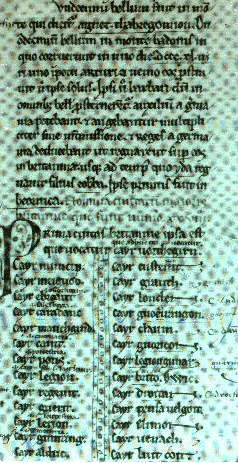
 The MS. contains the "History of the Holy Grail"* and
"Merlin" This version of Merlin corresponds very closely
to Mallory's translation.
The MS. contains the "History of the Holy Grail"* and
"Merlin" This version of Merlin corresponds very closely
to Mallory's translation.
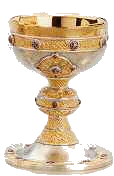
*The chalice used by Christ at the last supper
supposedly brought to Glastonbury by Joseph after Christ's death.
Joseph may have visited on occasions on tin trading excursions
with Jesus as a boy but this may be the monks of Glastonbury again trying
to create a myth. One fact we can be sure of is that there was a British
('Celtic') monastery at Glastonbury. Some believe that the Rosslyn Templar Chapel
at Rosslin in Scotland houses the chalice beneath its floor. However,
the idea of the 'Holy Grail' was introduced by the French
writers and is thus a late addition to the refracted British
oral folk history.
Holy
Grail
|
Arthur's beginnings:
Tintagel:
 Tintagel headland lies on the north coast of Cornwall surrounded
by cliffs overlooking the sea.
In the 1100's Geoffrey of Monmouth claimed this site as the traditional
place of Arthur's conception.
After Radford's excavations of the 1930's what we thought of as fact,
that Tintagel was the site of a
British (so-called 'Celtic') monastery is now questionable. Tintagel headland lies on the north coast of Cornwall surrounded
by cliffs overlooking the sea.
In the 1100's Geoffrey of Monmouth claimed this site as the traditional
place of Arthur's conception.
After Radford's excavations of the 1930's what we thought of as fact,
that Tintagel was the site of a
British (so-called 'Celtic') monastery is now questionable.
In 1983 a small excavation here found the remains of dozens
of huts dating from the 400's. In 1991 the first major excavation since the 1930's took place at Tintagel
Castle directed by Professor Chris Morris of the University
of Glasgow. During the1998 excavation in August some evidence
of a Latin inscription on a piece of slate dating from the 500's supposedly
mentioning
Arthur ('Artognov')* was located12. Examining the slate
inscription we can see discernable script. The A X E(?)
is probably Roman, the script below this is Romano-British. : + PATER COLI AVI FICIT
ARTOGNOV COL[I] FICIT i.e. 'Artognou, father of a descendant of Coll, had (this) made.'
Whether this is evidence for a connection between
Geoffrey of Monmouth's claim or merely coincidence has yet to be
determined but the connection is intriguing given that
according to the current hypothesis Arthur, if he existed, lived
sometime during the 'Dark Ages'. In the 2018 excavations on
Tintagel island a window sill with Latin and British words and
an ornate letter M as might be found in illuminated Christian
manuscripts was found.
Richard earl of Cornwall, an early Plantagenet and brother of
King Henry III, acquired Tintagel headland from Gervase de Hornicote
as part of the manor
of Bossiney in 1236 at a time when the medieval
stories of Arthur were in full swing., adding a wall and a great ward on the mainland linked to the island by a bridge.25
Here he built his new castle
which in effect was a folly as it seems to have had no obvious
strategic or trading advantage. However, it's connections with
Arthurian folklore may have encouraged Richard to associate
himself with the supposed site of the Arthur's conception when
Uther Pendragon drank a potion prepared by Merlin that
transformed him into the likeness of Ygerna's husband, Gorlois
allowing him entry to the castle and thus Ygerna's bed. Thus Arthur's birth site is reputed to lie beneath
Earl Richard's castle. The present day
economy of Tintagel is closely built upon the myth of King Arthur.10
A little known fact relates to Piers Gaveston, a favourite
of King Edward II, who was made earl of Cornwall in 1307,
when he sailed to this castle in 1312 upon his secretive return
from banishment in Ireland. As with Richard, Gaveston also held
Wallingford Castle and many manors throughout England.
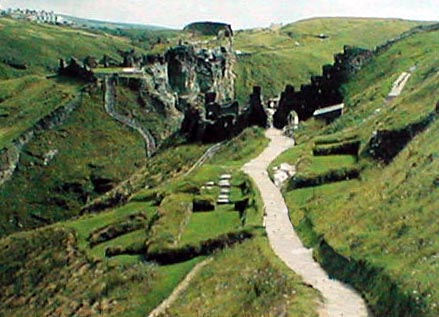
Remains of Tintagel Castle
|

Above: The gate in the northern curtain wall to
Richard's Castle.
Left, The northern curtain wall in the mid-ground
and the remains of Dark Age buildings on both sides of the
path. The two parts of Richard's Castle are now separated by
sea erosion and cliff collapse.
|

|
An artist's impression of Tintagel Castle built
by Richard earl of Cornwall from about 1233.
|

|
Tintagel Castle from Tintagel Haven beach
showing caves beneath the castle. The so-called 'Merlin's
Cave' beneath the remains of Richard's castle has been the
site of mining in the past and so is not entirely natural.
Streetmap-
Tintagel
|
 Local tradition says this was
part of Camelot where Arthur had his court and lived with Queen
Guinevere. (both these names are French and do not bear much
relation to Celtic naming). Merlin was reputed to have
lived in a sea cave under the castle. Cornish tradition places the battle
of Camlann at Slaughter Bridge on the Camel River17. This
tradition finds its literary roots in John Leyland's Itinerary
(1542) and is evidence of Leylands strong patriotism and
imagination, coming to associate West Camel and Queen Camel with
South Cadbury
Castle.
Local tradition says this was
part of Camelot where Arthur had his court and lived with Queen
Guinevere. (both these names are French and do not bear much
relation to Celtic naming). Merlin was reputed to have
lived in a sea cave under the castle. Cornish tradition places the battle
of Camlann at Slaughter Bridge on the Camel River17. This
tradition finds its literary roots in John Leyland's Itinerary
(1542) and is evidence of Leylands strong patriotism and
imagination, coming to associate West Camel and Queen Camel with
South Cadbury
Castle.
"At the very south ende of the chirch of South-Cadbyri
standeth Camallate, sumtyme a famose toun or castelle, apon a
very torre or hille, wunderfully enstregnthenid of nature. .
.The people can telle nothing ther but that they have hard say
that Arture much resortid to Camalat."

|
|
North Gate in the northern curtain wall to Richard earl of
Cornwall's castle
|
PLAYING DIABLO ADVOCATUS
AND OCKHAM'S RAZOR AT TINTAGEL
Refuting Radford's 1930's conclusions, the 1990's excavation
report found timber buildings that pre-dated the
'Dark Age' stone ones. The Dark Age buildings constructed
of stone at Tintagel are now recognised as part of a 400-600's AD SECULAR trading
community, not an ecclesiastical site.
Perhaps the label on Ordnance Survey maps showing a 'monastery'
here should be removed, there was only ever a medieval chapel
here.
Pottery from the 400's - 600's, much of it from the
Mediterranean, is of Late-Roman age. There is fine black
tableware from France, fine glassware from southern Iberia, fine
red table bowls from Tunisia and Western Turkey, a rim of
Phoenician red-slip ware and wine amphorae from Greece and what
is now Southern Turkey. Apart from a Dark Age defensive ditch, there is no evidence of a militaristic disposition
taken up by the inhabitants. No Dark Age weaponry or castellation has been identified. One could say they were a peaceable community which may have been absorbed into Saxon culture through intermarriage.
No burials are known from the headland, the soils are too shallow,
while it was common for Romano-Britons to bury their dead. Perhaps the burial site for the
Romano-British Dark Age community was in a more propitious
location on the mainland or as a result of cliff erosion, they have
perished. Two Romano-British inscribed
milestones are known from the vicinity of Tintagel. Both
stones bear the names of their contemporary Roman emperors from
the 200-300's AD. One (309-324 AD) is now to be found near Tintagel at St. Materiana's Church
naming Emperor Lucianus who was killed on the order of
Constantine! The other is a granite Roman
milestone (251-253 AD) now found outside St. Piran's Chapel in a
private garden at Trethevy, 2.5 km east of Tintagel headland. It
is possible that the Tintagel churchyard, where one of the
stones was found in 1889 is the site of a pre-existing
Romano-British cemetery and that the Roman milestone was brought
a long distance, perhaps as ships ballast, and re-used to mark a
burial site.
The 1998 excavations revealed the 'Artognou' slate covering a Dark Age drain
dated to the 500's. It is crudely fashioned but indicates a level
of education that would be found in more sophisticated
communities. The script contains no runes or ogham and thus
fits with a Romano-British Dark age period without Norse or
Irish influence. Another primitively
inscribed slate recently discovered from excavations during the
Summer of 2017 and dating from the 600's, exhibits
Romano-British script and is now on
show at Tintagel Castle. This latest find formed part of a
window sill and included words, names, letters and symbols:
tito
(Latin)
ui. ri. Duo
(Latin: viri duo, two men)
AE (DA) Fili (fili: son or sons)
bue dic
(Budic, Celtic, perhaps related to the place-name of Bude)
tu delta / DA (Greek, although the delta
may be the Phoenician 'da-lith' meaning door)
The Phoenicians of Phoenicia, essentially people of Lebanon and
southern Turkey today, are known to have traded Cornish tin,
which combined with Cypriot copper was used to make
bronze. Such activity at Tintagel would explain the
Mediterranean goods off-loaded here and perhaps the varieties of
Mediterranean scripts for although the Phoenicians had their own
22 letter alphabet, they often used symbols and letters from
other cultures in order to communicate. Although Tintagel
headland is now seen as a Dark Age secular community, these
artefacts show that there was a high level of script writing
where we should not discount the influence of these Mediterranean
sea traders.
The 2016 excavations revealed one metre thick Dark Age stone walls, perhaps
representing a 'palace' or large hall for the rulers or a ruler of Dumnonia
which at that time included what is now Devon, parts of Cornwall and
Somerset. Throughout the Tintagel headland there are at least 100 buildings perhaps dating from
the as early as the 300's - until as late as the 700's AD of
which many have yet to be excavated.
After 1233 Richard earl of Cornwall built a castle here probably in response to local folk tales
following Geoffrey of Monmouth's book Historia Regum Britannae,
completed by 1138, which stated that Arthur was conceived here. The castle is said to have been constructed to appear more ancient than it was, certainly there are what appear to be original
putlog holes in the walls.
Similar structures are to be found in the Roman walls at Wroxeter which are considered to be evidence for
scaffolding (Pers. obs. 2018) and may have been an attempt by
Earl Richard's builders to fabricate an ancient look.
Arthur is neither mentioned in the Anglo-Saxon Chronicle nor Bede's
Ecclesiastical History of the English People or any works written between 400 and
820 although this might be expected as both works were more
concerned with Angle and Saxon perspectives.
The naming of a sea-cave below the headland as 'Merlin's Cave' seems to
have followed the publication of Lord Alfred Tennyson's poems published in
the second half of the 1800's, Idylls of the Kings, wherein Merlin
is said to have recovered the infant Arthur from the sea, all of course
fictional romanticism.
English Heritage tentatively suggests that Tintagel was the Ravenna
Cosmographer's 'Dvrocornovio' / 'Pvrocoronavis'/'Dvrocornovivum'. But the
evidence indicates from the distance to Gloucester (Glevum) indicated on
the cosmography, that this remains as Wanborough in Wiltshire.
Dozmary Pool Thankfully, unlike
Tintagel, this is a place of contemplative solitude untrammelled by the heels of
multitudes of the curious urged on by English Heritage. This, by local
tradition, is where Arthur will regain the sword from the lady of the lake
and save Britain. The 'pool' or lake lies high on the granite of Bodmin Moor near
Jamaica Inn. By local folklore it was supposed to be 'bottomless' but the
pool is very shallow and has probably been shrinking for centuries as
indicated by peat deposits now isolated above the present level of the
lake. Periodically during droughts it is known to have virtually evaporated so that sheep
could graze on the lake bed, while fence posts reminiscent of Arthurian
swords, can be found in the waters of the lake.
Nanstallon near the town of Bodmin is known to have had Roman
a fort with alluvial tin mining in the River Camel at nearby Boscarne.
Tin is principally found within granites that formed in ancient fold
belts and were brought to the surface through a long period of erosion.
Other possible sites are West Moor near Altarnun, 15 km S.E. of Tintagel
and Mulberry Hill tin mine near Lanivet. Thus Cornwall was an important tin producing area for the much of
Europe and the Middle East. This tin may have been traded through
Tintagel following the fall of Rome. What is the possibility that
Dozmary Pool, within the granites of Bodmin Moor, was at one time
a tin mining area?
Castles reputed to be
Arthur's:
Pendragon Castle at Mallerstang, Cumbria:
Uther Pendragon in folk history was the father of Arthur. Cumbria was a Welsh-British haunt
and this is a reputed castle
of Arthur. Saxton's map of Westmorland (1576) shows the forest of Mallerstange
and Pendragon Castle at the eastern boundary of the forest on the river
Eden.
The Parish church is built on the site of a Saxon church which
contains relics including the "Loki Stone" from the 700's. Loki was
the Norse god representing a bound devil, this is one of only two known
in Europe13.
Castle Hill (Camulodunon) an Iron Age hill fort
near Almondbury, Yorkshire. The name may identify with "Camelot" but
'Camelot' is a later French addition to the Arthurian tales. Cam
is also found in the Roman Camulodunum for Colchester and means "crook
bank". Castle Hill was a Brigantian hill fort of the Iron Age Celtic Welsh
Britons which was attacked and probably overthrown by the Romans.
Richmond Castle in Yorkshire, where tradition
says King Arthur and his Knights of the Round Table sleep15.
Prior to the medieval castle this was a possible site for the Romanised
Brigantes to survive after the Romans left Britain.
Cadbury Castle
in Somerset, another Iron Age hill fort over-run by the Romans early in
their occupation of Britain shows evidence of occupation in the 500's. This
does not prove that Arthurian adherents resided here but the
archaeological evidence coincides with the time period for Nennius'
version of events.
Eamont Bridge, Cumbria here an earthworks is named the "Round
Table". Later in 927 Aethelstan received the submission of the Scots
and Northumbrians here
.
Yeovil in Somerset revealed during excavations
a large settlement of the 500's that has been described as a possible
contender for Camelot, Arthur's legendary court. But we must recall that
Camelot is a later French invention. reintroduced into Britain.
A Scottish castle near Ayr.
Cybwr in South Wales.
Brittany, France.
Burial
sites for Arthur have been suggested at Arthuret, Glastonbury, Bridgend,
Caer Melyn & Baschurch.
Arthuret [Arthur's Head]:
In 1990 an American historian, Professor Norma Goodrich
of Columbia University, New York, claimed to have discovered the burial
place of Arthur in Scotland near the English border, at Arthuret, the
Roman Castra Exploraturum. [now in Cumberland / Cumbria] Arthuret is near Camboglanna
[Birdoswald but more likely Castlesteads] where it has been suggested Arthur fought his last battle. Prof. Goodrich
believes she has traced the court of "Camelot" to the ruins of a Scottish
castle near Ayr.
According to information collated by the late Professor N.
Chadwick of the University of Wales the name Arthuret means "Arthur's
Head". This was deduced after studying 6th century Irish & French
epics in which the hero's head was generally buried with the face to
the foe. A high point of land near the Church of St. Michael and All
Angels in the parish of Arthuret is consecrated ground9. In
March 1319 Gilbert de Ebor[aco] is known to have been presented
to the church at 'Arturet' which lay in the diocese of Carlisle.
[C. P. R., March 1319, p. 318.] Christopher Saxton's map of Westmoreland (1576) gives the name
as ARTRUTHE which if phonetically spelled would sound more like "Arthur"14.
Glastonbury:
In the cemetery of the monks on the Isle of Avalon, twelve
miles from Cadbury Castle. According to Gerald of Wales there
were two stone pyramids with much eroded inscriptions on them. A skeleton
lay buried between these two pyramids at a depth of 16 feet. The
skeleton lay in a hollow oak coffin. Two thirds of the coffins length
was taken up by what was purported to be Arthur's body and the lower third
contained his second wife Guinevere retaining traces of blonde
hair. At the head of the coffin lay a lead cross under a stone with the
inscription
According to Camden:
"HIC JACET SEPULTUS INCLITUS REX ARTHURIUS IN INSULA AVALONIA"
According to Leland:
"HIC JACET ARTURUS, FLOS REGUM, GLORIA REGNI, QUEM MORES, PROBITAS
COMMENDANT LAUDI PERENNI"
According to Ruben:
HIC JACET ARTHURIS, REX QUONDAM REXQUE FUTURUS
It is now considered that the suggestions for Glastonbury being
the site of Arthur's burial are hoaxes perpetrated by the medieval
monks who wished to obtain money for building during the Crusades.
Others however have cast doubt upon this assertion saying that the monks
never used this as a means of procuring money.
|
| Archaeological Evidence for
King Arthur
The general hypothesis gathered from Nennius' work is that Arthur (Latin: Arthurius) was a Romano-Briton
of the 500's who welded the Romano-Britons,
and Welsh Celts against the Anglo-Saxons after the withdrawal
of the Roman armies, and that he may
have existed in fact & deed.
His successes in battle were first popularised by wandering
troubadours.
i) Portchester
in 501 under King Ambrosius Aurelianus, Arthur may have lost a battle
here, near Portesmutha [Portsmouth].
 ii) The Battle of Camlann 537 A.D.2
This site is identified as the Roman fort of Camboglanna (Birdoswald or Castlesteads, Cumbria)
16on Hadrian's Wall. The Roman name Camboglanna
or "crook bank" which might identify with "Camelot"* lies near Birdoswald
on a stream called King Water draining from near Midgeholme
Moss, alternatively seven miles east at Castlesteads on the
Cambeck. ii) The Battle of Camlann 537 A.D.2
This site is identified as the Roman fort of Camboglanna (Birdoswald or Castlesteads, Cumbria)
16on Hadrian's Wall. The Roman name Camboglanna
or "crook bank" which might identify with "Camelot"* lies near Birdoswald
on a stream called King Water draining from near Midgeholme
Moss, alternatively seven miles east at Castlesteads on the
Cambeck.
Arthur is supposed to have died here in 537 fighting the Saxons3
Later in 573 A.D. the Battle of Armterid was fought a few miles
to the N.W. of Arthuret2
[*note: The term "Camelot" like the "sword in the stone"
is an invention of the French poet
C. de Troyes in the late 1100's]
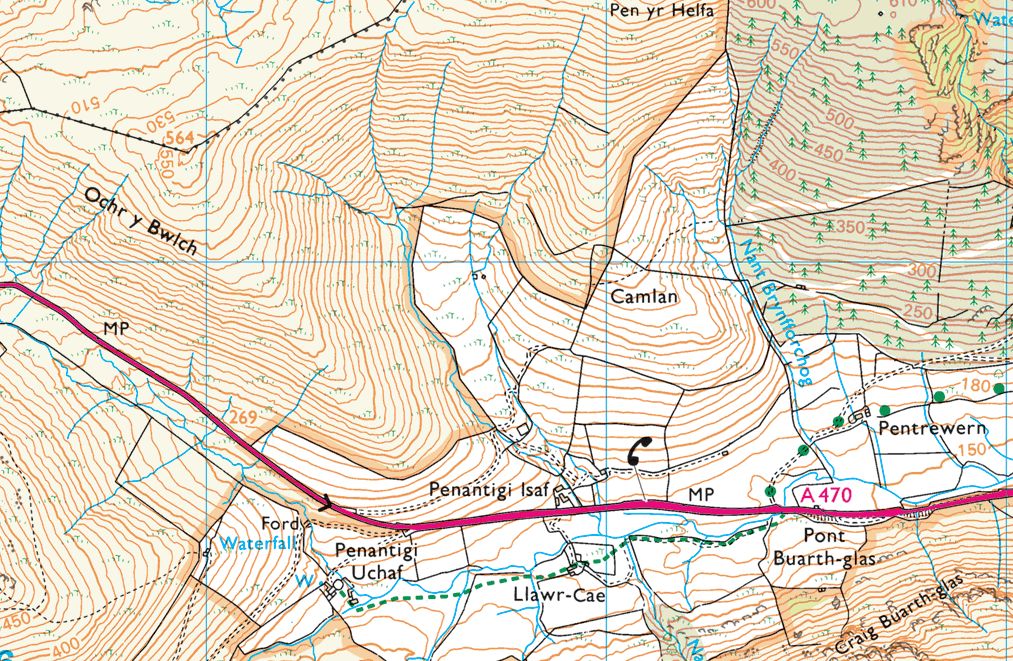
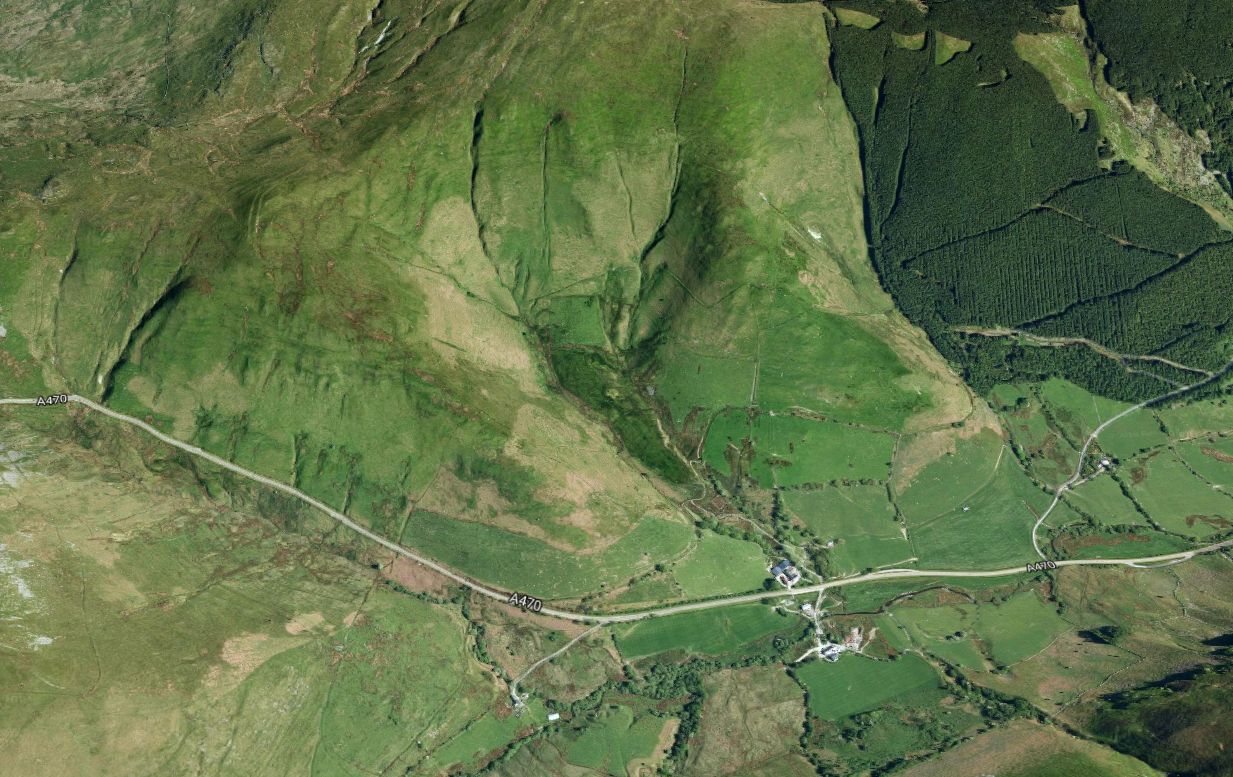
A NEW LOCATION FOR CAMLAN
Following Geoffrey of Monmouth's proposition that Arthur
was from Gwynned we find that there are two isolated locations in North
Wales named 'Camlan'. One lies to the south of Dinas-Mawddwy and the other
on the north side of the road in the Cerist
Valley, in the pass between Dolgelly
and Dinas-Mawddwy. In addition the medieval Cymydau within the hundred
of Gwynned and containing Harlech are named Ardudwy Uwch Artro
and Ardudwy Is Artro suggesting an early
medieval association with Arthur.
|
The Welsh
origins:
A theory on the origins of King Arthur (Artorius Rex) suggests
that he was king of Glamorgan & Gwent (Arthur ap meurig ap Tewdrig*).
This person was an early Christian centred on Caerleon and a
string of hill forts. He died about 575 A.D. possibly at Merthyr Tydfil.
His body was taken to the coast by ship to Ogmore up the River Ewenny. *
Phonetic of Tewdor or Tudor.
The evidence is found in: i) The Llandaff Charters ii)
Nennius MS. in 700's iii) "The Life of St. Illtyd ca.
1140.
Each source refers to "A Holy Man" brought by sea and buried
in a cave by the saint who was Arthur's cousin and his body was left
in a cave for some years in order to keep his death a secret until his son Morgan
came of age.
Alan Wilson & Buram Blackett found a cave in a wood near
the Ewenny River which is called Coed-y-mwstwr and is described as a
man-made cavity or grave. The body was finally buried in St. Peter's
Church4. The church is now roofless. They found a 5
cwt. sword shaped stone with the inscription "REX ARTORIUS FILI MARICIUS"
on it ("King Arthur son of Meurig") the stone was removed to
Cardiff. In May 1986 these two investigators also uncovered a stone
slab which they believe may be part of the burial crypt of Arthur.
However for a different view of Arthur read "Arthur's Britain"
by Prof. Leslie Alcock. |
.
|
Geoffrey of Monmouth11 gives the Welsh
version of lineage and events:
Geoffrey recorded that Arthur lived in N.W. Wales (Gwynedd)
in the 400's and was titled "Prince of Gwynedd", his father was Uther
Pendragon# of Gwynnedd. Nennius in his "Historia Brittanum" in 830
A.D. recorded that the kings of Gwynned originally descended from Cunedda
a warrior from Gododdin the kingdom of the Votadini
tribe in S.E. Scotland.
[# note: Uthr = terrible; Pendragon = head dragon]
The dragon is part of the Welsh flag today. 
The Votadini took control of Gwynedd and the Cunedda family
became the kings.
Archaeology verifies that N.W. Wales was colonised by warriors
from Gododdin in the 460's, Votadini pottery discovered in Gwynedd
dating from the early 400's has been recovered.
The identifying family prefix Cun- (Welsh=Cyn-) of the Cunedda
family are found on tombstones and in the genealogies of Gwynedd.
The Gododdin, a poem now in the Public Library
in Cardiff was probably composed in the early 600's. One passage praises
the courage of a hero saying "although he fought bravely "he was no
Arthur". This war poem was written by the Vodadini suggesting he had
been a member of their tribe.
Powys:
Cuneglasus was king of Powys at the time of Gildas
(ca. 545). Powys comprised the present regions of Central Wales &
the West Midlands, the state of Powys adjoined Gwynedd. Cuneglasus was
descended from Cunedda. In the 400's Viroconium (Wroxeter in
Shropshire) was the capital of Powys. In 1967 an inscribed stone was discovered
commemorating king Cunorix (Cunedda family). This stone
was dated to ca. 480 i.e. he died about this time, this indicates that
the Votadini were ruling then.
From archaeological evidence it is known that Viroconium was
wealthy & powerful at this time. By the 430's Viroconium was being
rebuilt in a highly sophisticated fashion. A massive winged mansion
was built, this could have been a palace of post Roman chieftains. The
city was not abandoned until 520 A.D. There was no threat from the Saxons
for perhaps 20 years and Powys did not fall to the Anglians and Saxons until
the 650's. It is possible Cunorix may have been succeeded by Arthur,
but Geoffrey of Monmouth says Arthur died in 537 at the Battle of Camlann.
Mordred:
Also called Maglocunus popularised as the evil Mordred
Arthur's treacherous nephew or son who killed Arthur in the battle
at Camlann according to Geoffrey of Monmouth. The Annales Cambriae records
that Arthur & Mordred did fall at the battle.
Five miles east of Dolgelly is a remote, bleak valley
called Camlan it lies on the old border of Powys &
Gwynned.
A poem7 written ca. 850 now in the Bodleian
Library at Oxford, mentions Arthur & Cynddylan being "heir
of the Great Arthur". It states that the body of Cynddylan was buried
at the "Churches of Bassa". It may be that Arthur was buried earlier
here. Today this is called Baschurch a village nine miles
N.W. of Shrewsbury.
On the edge of the village is "The Berth" a fortified
hillock surrounded by marshland and linked to the mainland by a gravel
causeway. In an archaeological excavation in 1962-3 pottery from the
500's was uncovered. Most of the Berth has not been excavated, it has
been suggested that one of the mounds may contain the remains of Arthur8
|
|
| A Scottish version of Arthur's
antecedants involves the Old Kingdom of Strathclyde which flourished
after 400 A.D. This kingdom ran S.E. from its capital Dunbarton. Alwyn
og mac Mureadhac's (Murdoch) daughter married Gilchrist Btretnach (The Briton)
in 1193 this led to the Clann-a Bhreatannich (Children of the Britons)
whose arms bore three bears. The British heroic name "Arth"(ur) means
"bear"5 Celtic warlords assumed the battle name of an animal
e.g. wolf, hound, horse. Gildas also mentions a "charioteer of the bears
stronghold" (Cuneglasus) |
Rotunda Tabula -
Medieval Round Table
Celebrations
 |
|
From a manuscript of Edward I's reign demonstrating
a joust using lances. |
A number of records for Round Table celebrations can be
identified during Edward I and Edward II's reigns.
In 1278, the sixth year of King Edward I's reign, 'King
Arthur's' remains were transferred to a new tomb by the prior of
Glastonbury, John de Taunton [prior 1274-1291].
In 1279 a Round Table jousting competition organised by Roger
de Mortimer was held on the tiltyard at Kenilworth Castle. This
was the year following the opening of the supposed tombs of
Arthur and Guenevere at Glastonbury Abbey in the presence of King
Edward I. King Edward was a great enthusiast of the Arthurian
legend and also attended the Kenilworth event. The participating
knights often took the names of the knights of the round table.
These events were accompanied by feasting, splendour and
pageantry well into the night. Edward I who so favoured round
tables over ones with sharp corners and hierarchy also later held
a 'tables roundes' at Falkirk.
Following the defeat of the Welsh by Edward I, an Arthurian
themed round table tournament was held at Nefyn in the Lleyn
peninsula in 1284 to celebrate the conquest. In the same year
Caernarvon Castle was being rebuilt where in April 1284 Prince
Edward (later King Edward II) was born. King Edward saw himself
as an Arthurian figure, re-uniting Britain under one leadership.
In late August 1329 Roger Mortimer earl of March , the
grandson of the above Roger had a Round Table tournament
organised at his castle of Wigmore. Roger acted as Arthur while
his amour, Queen Isabella, took the part of Guenevere. Here during
the two or three day tournament he had himself crowned as King
Arthur, reflecting perhaps the ambitions he had of marrying
Isabella and gaining the kingship. This would have
threatened the young Edward III as it placed Mortimer above
King Edward III as a supposed descendant of Arthur, ostensibly
'King of the Britons'.23
 |
| Late 1300's manuscript illustration. King
Arthur with his knights of the Round Table [Bibliotheque
Nationale Ms Fr 343, f. 3; Bridgeman Art Library.] |

|
|
Runic Script |
Can we
discern fact from fiction?
By
1100’s the folk tales of Arthur were known in Western Europe,
especially in Brittany.19
Interestingly,
speakers of Welsh, Breton and Cornish can converse reasonably
well with each other indicating a common culture in
language, the 'Celtic' language. Some of the
persons mentioned in folk tales and/or history are:
Vortigern
who murdered Constantine, a leader of the Britons, whose two sons
Aurealius Ambrosius and Uther
Pendragon, escaped to Brittany. Apart from existing tribal /
genetic links between Britain and Brittany, this helps to explain
why the tales are known across the channel. Vortigern, who may
have held his capital at Gloucester, invited
Saxon mercenaries to assist him in his struggle against the Picts
who were pushing south. This had the unanticipated effect of
increasing the rate at which the Saxons entered Britain.
Immigration has always been both a curse and a blessing for
Britain, it has displaced or intermarried with the resistant indigenes whilst bringing
in a new genetic pool to create ‘hybrid vigour’ within the
population. Aurelius and Uther returned from Brittany to Britain
and Aurealius then proceeded to remove Vortigern as the leader of
the Britons whilst Uther became Aurealias’ commander-in-chief.
Aurealius Ambrosius
or Ambrosius Aurelianus was possibly an historical personage20
It is suggested that he was a former Roman citizen of Britain
living in the 400’s. In Welsh his name is given as Emrys Wledig who
became high king of the Britons, some have equated him with the
legendary figure of Arthur. As a Briton he opposed the
Picts from the north and the incursions of the Anglians and Saxons who were
streaming in from the east after the Romans withdrew their forces
from Britain in A.D. 420.
Uther
Pendragon
has been described by Geofferey of Monmouth as the father of
Arthur.30
After
Aurelius died Uther succeded him. Uther convened a
meeting of all his tribal leaders one of whom was Gorlois
who was said to hold a fortress at Tintagel and large areas of
Cornwall. This seems to be the reason Tintagel has become
associated with the legend of Arthur for if we follow the
processes of land inheritance taken by the sword, Arthur would
have been the eventual beneficiary. Gorlois was married to a much
younger Ygernia whom Uther greatly coveted, and by
trickery. Uther managed to inseminate Ygernia at Gorlois’
fortress by disguising himself as Gorlois himself whilst the war
lord, who was away from his fortress, was killed fighting
Uther’s forces.
The
resultant child born to Ygernia and Uther was Arthur and
with Gorlois’ death, Uther married Ygerne. Gorlois’ death and
Uther’s marriage to Ygerne would have allowed Uther to take
Tintagel and Cornwall for himself. However, the people were not
convinced that Arthur was Uther’s son, some claiming that he
was Gorlois’ son, either that or Arthur was a natural son, or
at worst illegitimate. For this reason Arthur was not made
Uther’s heir immediately and was despatched with Merlin to
Northern Britain where he was kept in ward to a trusted Briton, Ector
and his wife. This period in the North seems to have left a
trail of oral folk history relating to Arthur in what is now
Cumberland such as at Arthuret, Carlisle, Penrith, the Roman fort of
Camboglanna, Sewingshields etc.
Ygarnia
never had another son by Uther and so as Uther aged he
recalled Arthur to his household where he was finally made his
heir before Uther died. Such a late decision might suggest that
indeed, Arthur was Goriolas' son. It was at this juncture that the young
Arthur is said to have drawn the sword ‘Excalibur’ from the
stone and thus secured his inheritance from rival claimants.
Realistically, and evading any recourse to ‘magic’,
if this did occur it would have been a test of physical
strength for a boy in is nonage who had to prove that he could
defend his father’s lands. The occasion, if it ever occurred
(for Excalibur is a later French addition to the tale by the
writer, poet and troubadour, Chretien de Troyes) would more
than likely to have been one of symbolic ceremonialism signifying
that Arthur, being under the age of twenty-one, was physically
capable of doing so. Again if a smidgin of truth lies within this
oral history, then the iron sword was a long and heavy one,
though it is unlikely that it was sealed within a stone. With
Uther’s death, Arthur would have inherited his father’s lands
which included Cornwall and ostensibly Tintagel.
 |
| An
attempt at a depiction of the sword in the stone, but the
sword is likely to have been of the late Roman type, not
the medieval form which this displays. |
Plausible
The inspiration for 'Excalibur' found in
Chretien de Troye's Morte d' Arthur is thought to have
been based upon a real sword that was struck into the ground in
1180 at the town of Chiusdano, Province of Siena in the region of
Tuscany, Italy by a knight, Senor Galgano Guidotti the year
before his death. During this time of the Crusades, Sir
Galgano rejected war in favour of peace by symbolically striking
the sword into the Earth. Something Vladimir Putin could
seriously consider.
It is speculated that this idea was carried
into Europe by pilgrims/ troubadors travelling from Rome (recall
the mosaic of 'Rex Artvrvs' at Otranto Cathedral, S. Italy dating
to 1163-1166) to France where it found favour in Queen Eleanor of
Aquitane's 'Court of Love' in Potiers. Queen Eleanor was
considered to be the 'queen of troubadours' as well as being
queen of England' at this time, having had her marriage to Louis
VII Capet annulled in 1152, in which year she married King Henry
II of England. Chretien de Troyes was one of the troubadours to
be found in Queen Eleanor's court where he wrote Arthurian
romances about the time of Sir Galgano. Was Sir Galgano the
inspiration for the name Sir Galahad? Local legend, for what it's
worth, at Maleval, Italy, says that St. William of Maleval, a
hermit, was Queen Eleanor's father, William X duke of Aquitane
who had actually died on a pilgrimage to Santiago de Compostella
in 1137.After Sir Galgano died, he was canonised as a saint and
the chapel of Montesiepi was dedicated to his memory. There a
medieval sword was fastened into a stone where it was protected
within the chapel and despite a number of attempts to steal the
artifact, it remains fastened firmly now in place.
Arthur
was crowned as High King of the Britons and began a series of
campaigns with the invaders which on the face of it were very
successful. In the interim, Arthur was ostensibly seduced by Morgan
le Fay his half-sister, Morgan, perhaps trying to give birth
to a son who could succeed Arthur, did in oral history, bear a
son whose name was Mordred, who was to become Arthur’s
nemesis. Morgan went with her child and hid away so that the boy
could not be identified. Arthur realising he had been deceived,
followed King Herod’s example and had all boys, born in the
appropriate time frame, pushed out to sea in a boat. Mordred was
amongst those in the boat but after the boat washed up on rocks,
Mordred alone was saved by a fisherman. Eventually, Mordred was
settled in the household of King Lot of Orkney and his
wife Queen Morgause, Mordred’s uncle and aunt through
his mother’s marriage to Urien of Rheged. Here Mordred was
raised with King Lot’s four sons including Gawain.
Having
won many battles Arthur succeeded in gaining a treaty and an extended period of peace with the Anglians and Saxons. According
to later French versions during this time of peace Arthur
established a fortress, the so-called ‘Camelot’. Local oral history in Somerset says that
this fortress was built on a hill overlooking ‘The Island of
Apples’ which we know today as Glastonbury [known to the Saxons
as Gestingaburg] lying at the foot of
Glastonbury Tor. The hill fort is supposed to be Cadbury Hill
with its Iron Age hill fort, which has archaeologically been
shown to have been occupied in the 500’s by post-Roman Britons
who re-used the site. From this time Arthur is supposed to have
attracted a number of war lords who swore allegiance to Arthur,
including Lancelot du Lake who was said to have been raised as a
foster child of the ‘Lady of the Lake’.
Of course the name 'Lancelot' derives from Normandy where
it also appears as the phonetic variant of 'Anslec'. For
example, in the 900's the father of Ertemberga who married Torf
'The Rich' was Lancelot (Anslec), lord (seigneur) of Briequebec
and a contemporary of Bernard 'The Dane'.
Arthur
was betrothed in an arranged marriage to Guenevere who brought
with her a dowry called the ‘round table’. The possibility is
that this ‘round table’ included a bodyguard of warriors sent
with Guenevere by her father Leodegan. Lancelot was appointed to
escort Guenevere whom Arthur then married, but Lancelot and
Geuenevere were in love with each other. Arthur and Geuenevere
produced no surviving children, this set the scene for Arthur’s
illegitimate son Mordred to begin making claims.
Many indiscretions and family intrigues followed involving
Lancelot, Guenevere and Elaine with Morgan as the trouble-maker. Arthur condemned
Guenevere to the stake for her concubinage with Lancelot but
Lancelot rescued her and took Guenevere off to the safety of his
fortress. Arthur then travelled to war on the Continent. Mordred, who had been left in
charge of Britain now took the kingship for himself. Arthur
returned to Britain and after a number of battles against his
illegitimate son, Arthur met Mordred at Camlann.
Arthur killed Mordred by running him through with his
lance but in his final moments Mordred killed his father with a
fatal blow to the head. In his final order, Arthur instructed
Bedwyr to hurl Excalibur into the lake. Arthur was then taken in
a barge to Avalon, so the story goes, so as to heal Arthur that
he might return one day and save Britain. With such internal
deception and turmoil being exposed, civil war broke out and
disunity allowed the invaders to gather momentum, the kingdom of
Britain was finally lost to the invaders.
Of course much of this oral history
and embellishment is as much metaphorical as it
is morally instructive. Yet the perception remains that at the
heart of the story there was a real person represented by the
folk hero, Arthur.
Evidence
for Arthur’s actual existence is thin on the ground. There are no
historical references to him by:
- Gildas
who
was writing about a generation after Arthur is considered to
have been active. However, he does mention Aurealius
who he
said defeated the Saxons at Mons Badonicus, Mount Badon,
a place never successfully located but perhaps Bath Hill near
Bath..
- Bede
writing in the 700’s again stated that it was Aurealius
who won the
battle of Mt. Badon over the Saxons.
A
work ascribed to Nennius writing The History of the
Britons in the 800’s makes the first mention of Arthur. He
refers to him as dux bellorum who fought with the British
kings against the Saxons in twelve large battles which ended with
final success at Mt. Badon in A.D. 516. here is no reference to
him being a king. It was in the second edition of Geoffrey of
Monmouth's book that Arthur achieves the mantle of kingship. Arthur was said to have
been a warring Christian who carried the image of the Virgin Mary
into battle for three days and nights. Then in the 900’s the Annales Cambriae
refers to Arthur as the Christian leader who succeeded at Mt.
Badon in 516 and was also at the battle of Camlann in 537 where Arthur
and Medraut [Mordred] killed each other.
The
suspicion is that each reference to Arthur was drawing not only
upon oral history but also the works of previous authors along with a
little additional material for good luck.
Most
our ‘knowledge’ of the Arthurian tales comes from Geoffrey of
Monmouth writing in his History of the Kings of Britain, completed
about 1136, long after the action had presumably taken place, by
as much as 700 years! Although
he was not the first medieval writer to mention Arthur, in
England his manuscript was extremely popular and copied by
scribes many times over. As such it popularised the Arthurian
legend in England and became the basis for additional material by
writers who embellished the heroic tales. Thus Geoffrey, if he
was not embellishing the folk tales himself, which is improbable, was giving the whole affair a medieval setting. Here he
introduced gallantry and chivalric behaviour, the White Tower of
London and lances, all trappings of the post-Norman invasion of
1066. There were no knights in Monmouth’s work nor ‘Holy
Grail', the latter was a later addition imported from a French
writer, Chretien de Troyes. The French version also introduced
Lancelot, Camelot and Excalibur* and thus are probably irrelevant in
trying to determine if there was an historical person represented
in the early British folklore. In the common parlance of today,
Arthurian tales from the 500’s underwent a ‘makeover', a
refurbishment of epic proportions by Monmouth and French writers.
France had their hero in Charlemagne, why couldn’t Britain have
one in Arthur too?
*
 On
Scalebar Beck, S.E. of Settle in Yorkshire are Scalebar Force (a
waterfall), Scalebar Pasture and Scalebar Bridge, probably all
commemorating the French addition to the tale.
On
Scalebar Beck, S.E. of Settle in Yorkshire are Scalebar Force (a
waterfall), Scalebar Pasture and Scalebar Bridge, probably all
commemorating the French addition to the tale.
William
of Malmesbury, a near contemporary of Monmouth4
writing about 10-12 years before, saw Arthur as a fable, this
would be supported by the fact that the sources which Monmouth
claimed as the basis of his work have never been located. However
in this respect, some believe that his source may have been Nennius’ History of the Britons
which Monmouth may have been alluding to when he referred
to ‘a certain very ancient book.’ Again, like Gildas
and Bede, Malmesbury refers to Aurealius
defeating
the ‘barbarians’ at Mt. Badon but this time with the
additional assistance of the
‘warlike Arthur.’
In
1133 Henry of Huntingdon re-stated Nennius' claim that Arthur was
a warring Christian, not
a king, who carried the
image of the Virgin Mary into battle and fought in twelve battles
culminating with that at Mt. Badon. In this respect Arthur was
perhaps not unlike the medieval bishop princes of Durham.
From the following
extract, a Malmesbury monk clearly saw the the Welsh under
invasion by the Saxons, which historically is refreshingly
correct.
From
a monk of Malmesbury about 1315 relating to the rebellion of Llewelyn Bren.
THE WELSH HOPE TO RECOVER BRITAIN, ACCORDING TO MERLIN'S PHROPHESIES
Walenses, prius dicti Britones olim dicti quidem erant nobiles et totius Angliae regnum possidentes; sed supervenientibus Saxonibus; terra sterilis et montuosa remansit Walensibus. Porro ex dictis Merlini phrophetae, sperant adhuc Angliam recuperare. Hinc est quod frequenter insurgunt Walenses, effectum vaticinii implere volentes; sed quia debitum tempus ignorant saepe decipiuntur et in vanum laborant.25
|
TRANSLATION
The Welsh, formerly called the Britons and indeed who were also formerly called to be of note among the
honourable, having possessed the whole of the Kingdom of England; But with the incoming Saxon the sterile and mountainous areas remained for the Welsh. Moreover from the sayings of Merlin the
prophet they still hope to recover England. That is why the Welsh frequently rebel, in the hope of completing the prediction; But in vain the appointed time is often mistaken. |
By
the 1400’s Thomas Malory had combined both the romantic French
versions of the Arthurian tales with those of Britain which is the
basis of so many popular imaginings and fiction today.
Historical
evidence for the battles:
Although
there were undoubtedly battles between the Angles and the Britons
during the 400's, particularly after Ida landed at Bamburgh and
Urien of Rheged successfully pushed him back to Lindisfarne, the
earliest historical record for a battle during the 'Dark Ages'
occurred in A.D. 491. This took place at the former Roman
'Saxon shore' fortress of Anderida/Anderitum afterwards called
Andredescester and now Pevensey, Kent. Here the Saxon invader
Aelle was victorious over the Britons. After this the known battles which are
recorded are as follows:
| Locational name - ancient |
Locational name - modern |
Approx. Year of Battle |
Comment |
Source |
| Portesmutha |
Portsmouth/Portchester, Hants. |
501 |
Jutes captured Portchester |
Anglo Saxon Chronicle |
| Natan Leag |
Netley Marsh / Tatchbury Mount, Hants. |
508 |
West of Southampton, a Saxon victory |
Anglo Saxon Chronicle |
| Camlann |
Birdoswald but more likely Castlesteads,
Cumbria. |
537 |
Near Hadrian's Wall. Where folklore tells us
Arthur and Mordred died fighting each other.* |
Annales Cambriae. 900's |
| Searoburg |
Old Sarum, Wilts. |
552 |
Saxon victory. |
Anglo Saxon Chronicle |
| Beranburh/Beranbury/Beran Byrig |
Barbury Castle, Wilts. |
556 |
ENE of Bath, a Saxon victory. |
Anglo Saxon Chronicle |
| Baenesingtun/Bedcanford |
Bedford |
571 |
Saxon victory |
Anglo Saxon Chronicle |
| Armterid/Arfderydd/Arderydd |
Arthuret, Cumbria. |
573 |
Folklore says Arthur or at least his head,
is buried here. Arthuret lies N.W. of Castlesteads. |
Annales Cambriae. 900's |
| Cair Ceri |
Cirencester, Gloucs. |
577 |
Saxon victory |
Nennius, Historia Brittanum, A.D. 830. |
| Deorham |
Dyrham, S. Gloucs. |
577 |
North of Bath, a Saxon victory |
Anglo Saxon Chronicle |
| Fethan Leag |
Stoke Lyne, Oxon. |
584 |
N. of Oxford, a Saxon victory. |
Anglo Saxon Chronicle |
| Wodnes Berg |
Woden's Barrow, Wilts. |
592 |
E. of Bath, a Saxon victory. |
Anglo Saxon Chronicle |
* Briton appears to have fought Briton here.
'Mons
Badonicus' supposedly fought
between 493 and 516, perhaps about the year 500, thus pre-dates most of the known battles in the 500's. Thereafter Saxon and Anglian
victories increased as shown in the table.
Perhaps
any evidence for the twelve battles Arthur is supposed to have
been involved in might be sought by identifying more precisely
where these were located. For example 'Searoburg' in old
English is Saelesberi which rather than being Salisbury could
conceivably be Salesbury in Lancashire which stands on an
important river crossing
of the River Ribble, a long standing boundary between the later
English and Scots. Equally 'Dubglas' could be the River
Douglas ['Duglas'] in Douglasdale, Lancashire. If Lancashire was
the site of battles II to IV then this was fought to retain a
connection between the North Welsh Britons and those of Rheged
[Galloway & Cumbria] and Strathclyde.
However,
there seems little to relate the Arthurian tales to recorded
(historical) events, thus we might suspect that the tales are
metaphorical moral lessons but possibly based upon a real person
who was relatively successful as a minor war leader or
commander-in-chief whom the Britons held in high regard.
Castlesteads
The
more probable site of Camlann known to the Romans as 'Camboglanna' lies seven miles east of
Birdoswald. The Roman fort site is on a high bluff overlooking
Cam Beck, a deeply incised stream with a large headwater that
originates south of Bewcastle. When this stream is in full spate
it is a formidable obstacle. The Roman engineers seem to have
chosen the site for its outlook and impregnability. This
impregnable position commanded:
i)
The gap on the mosses to the N.W. which carried the road from
Brampton to Longtown, an important line of approach to the Roman
wall.
ii)
The east bank of Cam Beck which could impede raiders from the
Bewcastle area to the north.
 |
|
The location of the site of Castlesteads Roman fort,
suggested to be the location for Camboglanna and Camlann |
In
1791 the site was levelled for the construction of gardens near Castlesteads House. The 1934 excavations of the
site
revealed a small stone fort no more than 400 feet square
[3.75 acres]. Walls were found on the south, east and west sides
but the north wall was lost due to the erosion caused by Cam
Beck. The fort walls were defended by a single ditch whilst the
east and west gates were doubled. During the Roman occupation of
Britain, the fort was manned by the 4th cohort of Gauls and later
the 2nd cohort of Tungrians. However, it has been noted that a
whole cohort of 1000 men would not be able to be accommodated in
this small fort.
From
the map above we can see that the site of the fort is also
protected to the south by the Roman vallum which deviates to
accommodate the fort. This is the only fort associated with the
Roman wall which causes the vallum to be deviated. Altars to
Jupiter and Mithras and the North-British god, Maponus were
found during the excavations, the latter dedicated by four Germanic
irregular soldiers. Despite this evidence of Roman occupation,
there is one major obstacle to this
fort being occupied by persons of the supposed Arthurian period,
this being that there have been no known archaeological
remains found from this time. However, the battle of 'Camlann' of
537 may still locate the
site of the battle in the near vicinity. This battle site is
perhaps commemorated in the name 'Conqueror's Bank' [see map
above] to
the S.E of the fort site.
A
STONE AGE ORIGIN?
As
briefly mentioned earlier, the kernel of the tales of Arthur may
have originated far beyond the Iron and Bronze Ages, into
the so-called neolithic or New Stone Age. The British Isles were isolated from the
rest of Europe at the end of the last glacial period about
10-11,000 years ago. At this time the land-bridge was breached
creating the English Channel when the early Mesolithic peoples
would have also become more isolated by the shear physicality of
the event. From recent excavations and isotope analysis of teeth
found on Salisbury Plain we now know that the later genetic and
cultural arrivals, the Neolithic people, were congregating at and
around Stonehenge from all over Britain. If Stonehenge, Woodhenge,
Avebury or any other stone circle were the inspiration for
'Round-Table' meetings, an original 'parly-ment', then this could
conceivably be the beginning of the much accreted tale.
'Politicians' would have been active even in Neolithic times, and
quite likely represented their tribal people at these meetings.
Combine this with some type of religious ceremony and we have a
dangerous mix of politics and religion. If courts were held at
the same time this arrangement would have been even more
powerful. The safer 'separation of powers' was yet to evolve. The
Neolithic people must have revered chalk-lands not only because
they provided a relatively easy, high, dry route for travel from
what are now Yorkshire, Norfolk, Kent etc. but they admired
greatly the abundance of flint from which they fashioned their
polished weapons. This material was won from layers of flint
within the unweathered chalk strata. As at Grimes Graves, winning
the flint from this white chalk rock may be symbolised in Arthur
pulling the sword from the stone. The sword was the flint yet to
be fashioned into a weapon, and the rock from which it was
dangerously and laboriously prised was the chalk. Add Iron Age
lakes and swords and medieval knightly tales to the mix and we
have an historical accretion no different to the ballads of Robyn
Hode.
 |
 |
| Stonehenge looking from the so-called
Slaughter Stone to the Hele Stone 1968 |
Lintel exhibiting entasis as found in Greek
architecture with reused upright showing grooves for
tongue and groove joints, 1968 before the charlatans
appeared.. |
Cornish folk tales
tell us that King Arthur's soul became a Cornish chough, no doubt its red beak and feet representing Arthur's death. In the same vein when the Chough returns to Cornwall, then too will Arthur.24
Choughs did return in 2001 but no one noticed Arthur entering Britain without a visa.
|
Bibliography:
1. The
History of the Britons- Nennius
2. Ordnance Survey map of Dark Age Britain
3. History Today 1988
4. History Today February 1987
5. Moncreife.The Highland Clans. p200
6. The Real King Arthur- London News 1992 p69
7. Song of Llywarch the Old (Canu Llywarch Hen)
8. Phillips, Graham and Keatman, Martin. King
Arthur: The True
Story. Century
1992.
9. Guardian Weekly 26th June 1990.
10. Guardian Weekly 25th March 1991.
11. History Of The Kings Of Britain- Geoffrey of Monmouth
(12th
Century)
12. Guardian Weekly 27th September 1998
13. In Britain, August 1994, p.13.
14.Christopher Saxton's 16th Century Maps, William Ravenhill,
Chatsworth Library, 1992.
15. A Dictionary of Place Names, West Riding, Bingley
1822.
16. Bruce J.C. Handbook to the Roman Wall. Andrew Reid
& Co. 1957
17. Hill, Helen. The Realms of Arthur. 1970
18. Meade, Margaret. Eleanor of Aquitane. (1977), Hawthorn Books.
19. Douglas, Sara. The Betrayal Of Arthur.
Pan Macmillan. 1999.
20.
Geoffrey of Monmouth. History of the Kings of Britain.
21.
Gildas. De
Excidio et Conquestu Britanniae
22.
William of Malmesbury. Chronicle of the Kings of England.
23.
Mortimer, Ian. The Greatest Traitor. 2006, pp. 225-226.
24
Newlyn, Lucy Chatter of Choughs: An Anthology Celebrating the Return of Cornwall's Legendary
Bird. (2005). p. 31.
25.Auctore Malmesberiensi
in Stubbs, William (ed.), Chronicles of the Reigns of Edward I and Edward II.
vol. 2. C.U.P., (Repr. 2012), p. 218.
25.
Trelease, G.M., The History of the Church in Paul Parish. (2006), p. 6.
|
next: Conisbrough Castle,
Yorkshire
| Copyright © Tim Midgley, 1999, revised
15th August 2024. |
 St. George & the Dragon
 The personification of St. George may be based on St.
Michael. St. Michael was born in Cappadocia of Christian
parents. He became an officer of high rank in the Roman Imperial Army and may have torn down Nicomedia Diocletian's edicts against the Christians
which were fixed to church doors. In 303 he suffered martyrdom. During the Crusades he is reported to have appeared to Crusaders
with a red cross. In 1222 The Synod of Oxford made him the patron Saint of England.
This red cross of St. George appeared on the English flag and was retained
on the British union flag.
The personification of St. George may be based on St.
Michael. St. Michael was born in Cappadocia of Christian
parents. He became an officer of high rank in the Roman Imperial Army and may have torn down Nicomedia Diocletian's edicts against the Christians
which were fixed to church doors. In 303 he suffered martyrdom. During the Crusades he is reported to have appeared to Crusaders
with a red cross. In 1222 The Synod of Oxford made him the patron Saint of England.
This red cross of St. George appeared on the English flag and was retained
on the British union flag.