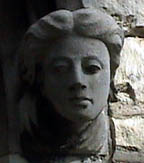
 Skelbrooke church in South Yorkshire exhibits
a number of finely carved heads which for the most part
have been protected from weathering by overhanging building
structures. Their finely chiselled
and memorable features suggest that they have been drawn
from real life, their head dress, where present, is
distinctly
medieval. Face carvings are a
common decoration on
churches and masons
often used a local
person as the model.
Are they representations
of characters from the Robin Hood tales based upon local
characters, perhaps a local family? After
a fire in 1870 the
church was
rededicated as
St. Michael's and
All Angels and
necessitated a
rebuild two years
later. What we
see here may be
either a creation
from 1870-1872
funded by Percy S.
Neville [1840-1919]
or a
recreation of what
was already
present.
Following Joseph
Hunter's two books, Hallamshire
[1819] and South
Yorkshire
[1823-1831] the
church, often
referred to as a
chapel, became
colloquially known
as 'Robin Hood's
Church'. This was
probably a
consequence of being
sited near Barnsdale
Bar and being
associated with The
Priory of St.
Magdalene at Monk
Bretton. Those
familiar with the
ballad A Lytell
Gest of Robyn Hode would
recognise the
reference therein to
Robin having claimed
to have built a
chapel in Barnsdale
dedicated to St.
Mary Magdalene.
Skelbrooke church in South Yorkshire exhibits
a number of finely carved heads which for the most part
have been protected from weathering by overhanging building
structures. Their finely chiselled
and memorable features suggest that they have been drawn
from real life, their head dress, where present, is
distinctly
medieval. Face carvings are a
common decoration on
churches and masons
often used a local
person as the model.
Are they representations
of characters from the Robin Hood tales based upon local
characters, perhaps a local family? After
a fire in 1870 the
church was
rededicated as
St. Michael's and
All Angels and
necessitated a
rebuild two years
later. What we
see here may be
either a creation
from 1870-1872
funded by Percy S.
Neville [1840-1919]
or a
recreation of what
was already
present.
Following Joseph
Hunter's two books, Hallamshire
[1819] and South
Yorkshire
[1823-1831] the
church, often
referred to as a
chapel, became
colloquially known
as 'Robin Hood's
Church'. This was
probably a
consequence of being
sited near Barnsdale
Bar and being
associated with The
Priory of St.
Magdalene at Monk
Bretton. Those
familiar with the
ballad A Lytell
Gest of Robyn Hode would
recognise the
reference therein to
Robin having claimed
to have built a
chapel in Barnsdale
dedicated to St.
Mary Magdalene.


Skelbrooke seen from the Great North Road.
On the morning of the 29th November 1300 King Edward I travelled from Pontefract south through Skelbrooke to Hampole arriving on the same day.1 Neither during this time or before it was there any reference to the ballad hero Robyn Hode in any local place-name. Yet 120 years later we have the first reference to 'Robin Hood's Stone' which was then located north of the vill.
"In August, 1541, Henry VIII. in order to tranquilize the minds of his subjects, made a tour into the north: On his arrival at Barnsdale, in the West Riding [then] of this county, he was met by two hundred gentlemen in velvet coats and suitable accoutrements, with four thousand tall yeomen and three hundred clergymen, who, on their knees, made submission to his majesty,and presented him with £600."2 Others have suggested that this meeting took place at Skelbrooke between King Henry and the York clergy led by the Archbishop of York, Edward Lee [1531–1544].3


Sleep Hill upon which Robin Hood's stone was sited, mentioned in 1422.


The view from near the site of Sayles Wood southeast towards
the Great North Road and Robin Hood's Well.


Robin Hood's Well now represented by an arched shelter designed by John Vanbrugh lies at the southern end of a lay-by, formerly the line of the Great North Road. This is not the site of the artesian spring later formed as a well, which lay further to the North on the opposite side of the River Skell.The well was first mentioned in the 1600s by Roger Dodsworth and became a popular halting place in the 1800s with its two public houses. According to an O.S. map of the 1850s, the original well was sited on the eastern side of the Great North Road opposite Skelbrooke Park Lodge gates on the left bank of the Skell.
Richard Cooper-Holmes who resided in the small farm workers cottage at Robin Hood's Well nearest to the Skell in the 1980s, says the well was artesian and 50m to the north of the Skell in the field adjacent to the road, it was capped off in the 1980s when the use of the field changed from a cricket pitch (Crossfield Lane CC, not Hampole and Skellbrooke over the road) to a working field, Richard adds "the spring on the map is the one I mentioned and the water was sweet as it can be. Both cricket clubs swore it made the best tea!'

The original Well site, look for the green dot
The well is likely to have been used by the occupants of the Roman auxiliary fortlet here as a clear source of non-sideritic water and perhaps later in Edwin of Northumbria's reign when wells with chained drinking cups were established for weary travellers along highways.
The clarity of the spring water was remarked upon by travellers in the 1600s and this along with the remoteness of the area in Brigantian territory [during the Roman occupation] at the junction of the nearby Roman road from Templeborough would have helped to site the Roman garrison. As such the possibility remains, what later became to be known as 'Robin Hood's Well', was a Roman sacred spring similar to that of the pre-Christian Romano-British water goddess, Coventina, near Hadrian's wall. The waters of such wells or shrines were believed to have had healing properties.
.

Source: Bruce, J. Collingwood. The Roman Wall. Andrew Read, 1957, p. 108.
The River Skell, if such a stream can be called a river, would have been a watering place for pack animals and war horses travelling to and from York and the North, whilst the legionnaires would have made offerings here to a water goddess similar to if not indeed, Coventina. Such wells carried votive offerings such as coins, broken brooches, earthenware and incense burners. We still see the practice of coin tossing at the Trevi fountain in Rome and the 'wishing wells' of England which probably evolved from the Iron Age practice of throwing swords into sacred waters and lakes. The British Arthurian tradition of the 'Lady of the Lake' or 'Lady Luck' [from the Norse god Loki] springs to mind.
A little further to the West near Hampole is the so called Little John's Well or Cave. Here a stone and basin has been cut from a rock and purportedly had the outlaws name engraved upon it. Eric Houlder believes it too could have been a Roman headstone but the likelihood is that it was a water shrine. Again, the spring was clear water emanating from the Magnesian limestone which is now quarried very close by. See photograph of Little John's Well
Roman deity musicians portrayed in Roman art are referred to as the Camenae. These women were mythical musicians and water sprites associated with a sacred spring in Rome. They were eventually associated with the Greek Muses, the Goddesses of the arts, history, and music. Poets, musicians, and others held them not only as their patrons but as their inspiration. With the evolution of the Geste the process seems to have come full circle.
Everything you need to know about Coventina of Carrawburgh


Robin Hood's Well in the 1700s, 'Watling Street' seems to be in the background.

Skelbrooke Hall today, the site of the former Butler family home.

Skelbrooke Church Tower, rebuilt following the fire of 1870

The original Butler arms over the doorway to Skelbrooke Church. In 1336 a chantry was established within the north side of the church, the chantry being dedicated to St. John the Baptist.6 This is where daily prayers would have taken place for the founder of the chantry, her husband Edmund their antecedants and heirs. After Agnes l Botiller's demise the presenter of the church was agreed to be the prior of Monk Bretton Priory when it was already in the patronage of the same.
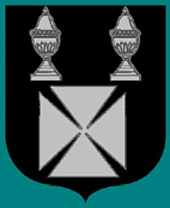
The arms of the Priory of St. Mary Magdalene, Lund [Monk Bretton] are similar with the cup in base replaced with a cross formy. [Sable in chief two cups covered, in base a cross formy, argent]
.  The early Butler arms
of Ireland, Gules three cups covered Or.
The early Butler arms
of Ireland, Gules three cups covered Or.
Genealogists have
not found any definite connection between the Butlers
of Ormonde, Ireland and the Butlers/Botillers etc. of Skelbrooke. However
their coats of arms have the same devices as indicated from
the arms displayed above the church doorway built by the Butler
family of Skelbrooke, butlers to Pontefract Castle. Despite no proven
connection, Joseph Hunter
did state that
the Theobald Butler
of Edlington*, South
Yorkshire who who went
into Ireland with King
Henry II and became the
progenitor of the Butlers
of Ormonde, was the
grandson of a person named
Harvey#. However, Hunter
hastens to add, in an
archaic form, that the
Butlers of Skelbrooke and
those of Ireland were of a
'different race'.5
# Now recognised as Harvey/Hervey I Walter.
* Gained Edlington by marriage to Matilda le Vavasour. She has been linked to 'Maid Marian' by some.
The Botelers of Warrington, Lancashire also
had similar arms as shown below:
 Various branches of the ancestors of the Butlers
spread over England, Wales, Scotland and Ireland. There were
also branches in Wem, Shropshire & Oversley, Warwicks
The tinctures and position of the devices on the coat of
arms of each branch varied. [e.g. royal blue field].
Various branches of the ancestors of the Butlers
spread over England, Wales, Scotland and Ireland. There were
also branches in Wem, Shropshire & Oversley, Warwicks
The tinctures and position of the devices on the coat of
arms of each branch varied. [e.g. royal blue field].
The Butlers, as
they came to be known, were descended from Hervey Walter
who is found in D.B. and who is believed to have accompanied William The Conqueror
in 1066 as a close aide. It appears from what is reasoned
below that Hervey I Walter had a son Hervey II Walter[i] who held lands
in East Anglia and Lancashire.
Hervey II Walteri had
six sons,one was Hubert [a variant of Hervey] Walter who became archbishop
of Canterbury and another was Theobald I FitzWalter. Theobald
was Lord of Preston and appointed as sheriff
of Lancashire for part of 1194. Theobold
[b.~ 1160, d. Feb. 1206] accompanied Henry I to Ireland
in 1177, presumably at a youth. For his services to the king between
1177 and 1185 he was, made hereditary Butler of Ireland and
was granted lands where Trinity College, Dublin now stands. In the latter
year he accompanied Prince John to Ireland. One of his
marriages to Maud [Matilda le Vavasour]
produced a son, Theobald II [b. 1200 d. 1234] who
assumed the name Botillier, today Butler. The herditary
title meant that each succeeding member was permitted to hand
the king the first cup of wine at state banquets and coronations,
a very trusted position, for wine spiking was a common method of
removing one's opponents.
Maud was widowed by Theobald as Maud
[Matilda] FitzWalter, baroness Butler, and when she married
for a second time it was to Fulk FitzWarine, a person associated
in both history and poetry. Some have compared this man and his wife
with the Robyn Hode and Maid Marian of folk tales, but there is little
agreement with the Geste in this respect. It was probably from
this supposed association that Anthony Munday introduced
Matilda Fitzwalter as Robin Hood's [seen as Fulk FitzWarin's]
wife, conflated with the daughter, by the same name, of the leader of the
barons in King John's reign. See: Gestes
of Guarine and his Sunnes
Recent research in the Domesday Book, Hunter's 'South
Yorkshire', C.P.R., C.F.R., C.Cl.R., Burke's 'Dormant and Extinct'
as well as Butler and Vavasour genealogies have indicated that the
Butlers of Ireland are descended from Hervey I Walter who held lands in
Haseley, Oxfordshire and Skelbrooke Yorkshire under the Laci fee. That
is Hervey of D.B. in Oxon. and Herveus of D.B. in Skelbrooke, Yorks. are
probably the same person. Joseph Hunter states in his 'South
Yorkshire' that all the old genealogies of the Butler family in Ireland
give this Hervey as their progenitor and that Theobald, Henry II's butler
was the 'grandson of this Hervey the Domesday tenant'. Most Butler genealogies
also give Theobald's parents as Hervey Walter of East Dereham, Norfolk and
Maud de Valoignes [Valois, Valoines]. Putting this together,
this would indicate that Hervey Walter of E. Dereham was the son of Hervey
of Oxon. and Skelbrooke and also the father of Theobald the butler to Henry
II in Ireland. That is, the Butlers of Ireland are descended from Herveus
who held Skelbrooke.
Thus the genealogy would look something
like this:-
Hervey I Walter===?
of Haseley, Oxon.
& Skelbrooke Yorks.
Butler to Ilbert de Lacy
|
Hervey II Walter==== Maud de Valoignes
of East Dereham
|
____________________________________________________
|
|
|
|
|
|
Hubert
Osbert Roger
Hamo Bartholemew
Walter
|
Walter
Walter Walter Walter
Archbisop of
Canterbury
|
Theobald===1===Matilda* ===2===Fulk
Walter le Vavasour
FitzWarin
|
|
Butlers of Ireland
FitzWarins
Earls of Ormonde
* The connection between the Butlers of Ireland is further
strengthend
with that of the Butlers of South Yorkshire when we find that upon
her marriage to Theobald, Matilda le Vavasour received the manor
of Edlington, South Yorkshire from her father Robert lord of Hazelwood,
West Yorks. This manor became a source of conflict
between the Butlers of Ireland and the FitzWarines until the reign of
Edward I after Matilda married secondly to Fulk FitzWarin, lord of Whittington,
Shropshire, the man some fallaciously equate with the origin for the ballad
character 'Robin Hood'.4
There were four major families of Boteler in the medieval period:
1. Botiller [Butler] of Skelbrooke,
S. Yorkshire.
2. Theobald le Boteler [Butler]
progenitor in Ireland.
3. Boteler/Botiller [Butler]
of Warrington, Lancashire.
4. Boteler/Botiller [Butler]
of Wem Shrops. & Oversley,
Warwicks.
The Vavasour-FitzWarine-le Waleys associations:
If we examine those families more widely associated with
Vavasour we find that the local Stephen
II le Waleys is related to Matilda le Vavasour:
Sir Robert=======Juliana
le Vavasour de Roos
|
_____________________________________________________________
|
|
|
|
Theobald===Maud===Fulk
Sir John===Alice
Malger III
Alice
Botiller le Vavasour FitzWarine
Cockfield
|
______________________
__________________________________________
|
|
|
|
|
Sir Richard II===Eleanor Nichola===Sir William
Sir Malger IV
Anne
|
le Waleys le Vavasour
Stephen II
le Waleys
This is good circumstantial evidence that later local balladeers
certainly knew of the poem to Fulk FitzWarin which vaguely related to Fulk's
activities some hundred of years earlier and this knowledge may have helped
hatch or inspire the storyline of A Lytell Geste of Robyn Hode.

Arms of Vavasour - Or a fess dancettee sable.

The porch to Skelbrooke Church with the original arms of Butler and later effigies.

< Sir John le Botiler from an inscribed slab ~1335 in the church at St. Bride's Major, South Glamorgan, South Wales.
Note the arms of three covered cups on the shield. These arms are not very different in design from those of William fitz Almeric le Botiler lord of Warrington.7 Like his, this effigy wears chain mail, and is covered with the camise, and round it is this inscription :
“ Johan le Boteler git ici
Deu de sa alme eit merci. Amen" 8
Edward
II being at Liverpool, on the 23rd October 1323,
addressed a letter to this
'John Boteler', requiring him to aid in preventing the miracles said to be wrought at the graves of Henry de Montfort and Henry de Wylington, who had been lately executed for rebellion.
9
about 1336-8 although there has been some considerable repair to the church following the fire of 1870.
References:
1. Gough, Henry. The Itinerary of Edward I. 1900, p. 195.
2. Baines Gazeteer 1823.
3. A Topographical Dictionary of England p. 113.
4. Keen, Maurine. The Outlaws of Medieval Legend.
5. Hunter, Joseph. South Yorkshire (1823-1831), vol. II, p. 457.
6. C.P.R., 1334-1338, p, 329.
7. History of Warrington Church, p. 20.
8. Cutt’s Monumental Brasses, xxxii. p. 2.
9. Foedera. ii. 536, 7.
See Coventina's Well