In the ballad A Lytell Geste of
Robyn Hode, the king is referred to as "Edward our comly king"
no less than seven times. Comly meant "handsome". There is no reference
to King Richard I in the Gest, a widely held myth encouraged by John Major,
SirWalter Scott in his Ivanhoe and sundry mass- marketed films. Looking
at their portraits which one might it have been?
The
three Plantagenet Edwards, the Three Neds, reigned in succession from
1272 to 1377:
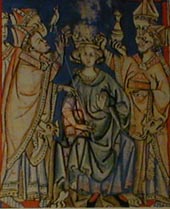
Edward I, 1272-1307 |

Edward II, 1307-27 |

Edward III, 1327-77 |
There is some evidence that Edward I was at Nottingham in 1299
whilst preparing to amass troops throughout England for the siege of Caerlaverock
[1300] which may have given him time to visit the forest around Nottingham.
Joseph Hunter noted that Edward II had in 1324 a "valet de chambre"
with the name of Robin Hood, though there was no indication that he
had been in trouble with the law. Professor James C. Holt discussed the
connection with some scepticism, but also felt that some of the events
in the seventh and eighth fyttes had a basis in historical fact (Robin
Hood, 1989, pp. 155-56). He noted that after the execution of
Thomas earl of Lancaster in 1322, the earl's supporters committed
wide-spread acts of vengeance, including the pillaging of the
king's deer in the royal forests, and that, as in the Gest,
Edward II himself travelled to the area to investigate these disturbances.
There is little doubt that Edward II was a tall, strong king who liked wrestling,
swimming, and oddly, digging ditches, thatching roofs and other physical
pursuits. Despite the fact that he liked acting, playing kettle drums and
enjoyed fine and bizarre clothing he was certainly no effeminate as sometimes
portrayed in mass-media entertainment.
Knight has suggested that Edward IV, may best fit the description
our 'comly kynge' (in lines 1457, 1513, 1549, 1637, 1727), as
his period of rule (1461-83) is not inconsistent with the argument
that the Gest is composed much later than has usually been thought
(1994, pp. 46-48).
We might identify the king in fyttes seven and eight
as Edward III, because Laurence Minot refers to him as
Edward, oure cumly king in line 1 of Poem IV, which was composed
about 1339 to commemorate Edward III's invasion of France at the beginning
of the Hundred Years War (Richard Osberg, ed., The Poems of Laurence
Minot,
1333-1352, Kalamazoo: Medieval Institute Publications, 1996)1.
Another, almost unthinkable possibility, is that the Gest is
referring to two or more 'Edwards' and these have been conflated within
the ballad.
Certainly Edward I was more popular than Edward II, whilst the author
of the Gest may have been purposely vague in order to impress the
then incumbent, Edward III.
8th Fyte of the Littel Gest of Robyn Hode.
"Haste thou ony grene cloth," sayd our kynge,
'Have you any green cloth' said the king'
"That thou wylte sell nowe to me?"
'That you will sell to me now?'
"Ye, for God," sayd Robyn,
'Yes for God's sake' said Robyn'
"Thyrty yerdes and thre."
'Thirty three yards.'
"Robyn," sayd our kynge,
'Robyn' said the king,
"Now pray I the,
'Now I pray to you,
Sell me some of that cloth,
Sell me some of that cloth,
To me and my meyné."1
To me and my many
men.'
"Yes, for God," then sayd Robyn,
'Yes, for God,' then said Robyn,
"Or elles I were a fole: 2
'Or else I would be a fool:
Another day ye wyll me clothe,
Another day you will clothe me,
I trowe, ayenst the Yole."3
I trust against Christmas'
The kynge kest of his cole then,4
Then the king cast down his cowl,
A grene garment he dyde on,
Putting on a green garment,
And every knyght had so, iwys,
And every knight did the same,
Another hode full sone.
with a hood just as quickly.
Whan they were clothed in Lyncolne grene,
When they were clothed in Lincoln green,
They keste away theyr graye:
They threw away their grey:
"Now we shall to Notyngham,"
'Now we shall travel to Nottingham'
All thus our kynge gan say.
was all our king could say.
-------------------------------------------
1. Meyne = many men; company
2. Fole = fool
3.Yole = for Yule = for Christmas
4. Throws off his black cowl. The king adopts Robyn's green livery.
 Home
HomeLink :
The Gest of Robin Hood - The Rochester University Project.
© Tim Midgley, 2000, revised 11th March 2023.