 |
 |
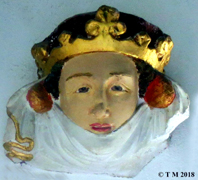
| Queen Isabella of England, formerly the wife of King Edward II | Roger de Mortimer of Wigmore, d. 1330. Queen Isabella's paramour |
|
|
| Queen Isabella of England, formerly the wife of King Edward II | Roger de Mortimer of Wigmore, d. 1330. Queen Isabella's paramour |
 Mortimer's Hole
This is a subterranean passage which formerly had six gates at various
distances, and is 107 yards in length, seven feet high, and six feet wide.
All the way down there are broad steps cut into the rock, and openings on
either side to convey light into the passage, and to serve the soldiers
to shoot their arrows through upon the enemy. On the upper part are cut some
regular port-holes which show that, during civil war, cannons were planted
there, which had a command of all the meadows. Near the port-holes are excavations,
evidently intended for the reception of balls and powder. Collins, in quoting
from Drayton's Barons' War, says, "This wonderful passage had been hewed
and dug during the Danish invasion, by some of the Saxon kings, for the better
security in case of a siege". And, indeed, in times of peace it was useful,
for it afforded a direct communication with the corn-mill, malt-kiln, and
brew-house of the garrison in the Rock yard, now called Brewhouse Yard. About
seventeen yards above the lower entrance to this spacious vault is the entrance
to a dark and narrow passage, which branches off to the right, and formerly
led by secret doors to the keep of the old castle, in which were the state
apartments. This has long been thought to be the passage through which Sir William Eland,
in 1330, conducted the young King Edward III when he seized Lord Mortimer, and brought
him out of the castle, and was afterwards called Mortimer's Hole, in memory
of that unfortunate nobleman, a name which is erroneously given to the principal
vault. All the entrances to these passages are now walled up.
< Lower entrance to Mortimer's Cave
Mortimer captured
In October 1330, [others say about Michelmas, i.e. 29th September] the
King's Court or Parliament came to Nottingham where, in the parlance of
the time, they parleyed. Mortimer and Isabella resided at the heavily defended
Nottingham Castle because they were in fear of their lives. Edward with his wife of two years, Philippa of Hainault, and his infant son, the
future Black Prince lodged in the town, while Mortimer and Isabella
remained in the castle, protected by Welsh mercenaries and 180 knights. Thus
Isabella and Mortimer were well protected while for extra protection Isabella slept with the door
keys under her pillow. However, there was one key of which she was unaware. Edward prince regent needed to surprise them.
Edward had heard a rumour that his Mother Queen Isabella was with child, the
father being Sir Roger Mortimer. The speculated child was potentially a rival
king to Edward and thus he had to act decisively. In the dead of night on
19 October, the king, led by the castle's
constable William de #Eland1 with 24 men entered Mortimer
& Isabella's bed chamber This makes 26 in all, is this the basis of
Edward III's 26 members of the original Garter Knights?
wife of two years, Philippa of Hainault, and his infant son, the
future Black Prince lodged in the town, while Mortimer and Isabella
remained in the castle, protected by Welsh mercenaries and 180 knights. Thus
Isabella and Mortimer were well protected while for extra protection Isabella slept with the door
keys under her pillow. However, there was one key of which she was unaware. Edward prince regent needed to surprise them.
Edward had heard a rumour that his Mother Queen Isabella was with child, the
father being Sir Roger Mortimer. The speculated child was potentially a rival
king to Edward and thus he had to act decisively. In the dead of night on
19 October, the king, led by the castle's
constable William de #Eland1 with 24 men entered Mortimer
& Isabella's bed chamber This makes 26 in all, is this the basis of
Edward III's 26 members of the original Garter Knights?
Also see Buckingham Palace's reply to this
question
The Companions
of the Order of the Garter2
 <
Upper entrance to Mortimer's Cave from Romylow's Tower
<
Upper entrance to Mortimer's Cave from Romylow's Tower
They arrived at a thicket in the park to the west of the castle. In the
dark, they failed to meet up with their fellow conspirators, but undaunted,
they proceeded with their task, entering the castle through a 'postern
in the park'. Then, according to one account, they 'mounted the stairs leading
to the upper bailey and entered the hall where the queen was sitting in
council'.
As the conspirators burst in, two of the queen's supporters cried out
and tried to protect Mortimer. They were struck down and Mortimer was overpowered
as he tried to arm himself and raise the alarm. By morning, he was on
his way to London, and the castle had been secured for the king. The Nottingham
Parliament was adjourned to Westminster.
The following month, Mortimer was executed at Tyburn [approximately where
Marble Arch lies today, not far from Harrod's!],. He was survived by his wife Joan,
by whom he had 11 children.
Isabella
was forced to forfeit her estates, but the substantial annual allowance
of £3,000 she received from the king enabled her to live very comfortably
until, towards the end of her life, she joined the Poor Clares. She has
not enjoyed a favourable press since 1327, and is still widely known by
the appelation given to her by the poet Thomas Gray -- the 'She-wolf of France'.
The capture of Roger Mortimer at Nottingham Castle in 1330
was the culmination of almost a quarter of a century of rebellion and murders.
He is considered to be the 'greatest traitor'6 of the kingdom.
The allegations were that he tried to kill the young Edward III., seduced
Isabella the Queen of England, invaded England, captured Edward II, probably
ordered his death and tried
to cover this up. No doubt Isabella was party
to Mortimer's scheming, but Edward III could not bring himself to execute
his own mother, so he had her kept in great comfort at Castle Rising in Norfolk
from where, despite popular folklore to the contrary, she had reasonable freedom to travel.
 Mortimer's
Hole 3-D flythrough Recently doubt has been cast upon the exact location of
'Mortimer's' Hole'. Archaeologist Dr. David Strange-Walker, project manager of
the Nottingham Caves Survey has been using a laser scanner to map 3-D images of
all the caves under Nottingham and its castle. About the year 2005 an entrance
to a blocked cave was discovered outside the castle in the suburban garden of
Brian Lees. The entrance was partly filled but collapsed when some construction
work took place here. The entrance leads down some rock cut steps through a tunnel
that has been blocked. This tunnel which lies under the edge of the modern
castle wall was at one time believed to have led into the castle. This tunnel,
Dr. David Strange-Walker believes, is the real tunnel through which Edward III
and his men entered the private boudoir occupied by Mortimer and Isabella.
Evidence supporting this hypothesis is provided by:
Mortimer's
Hole 3-D flythrough Recently doubt has been cast upon the exact location of
'Mortimer's' Hole'. Archaeologist Dr. David Strange-Walker, project manager of
the Nottingham Caves Survey has been using a laser scanner to map 3-D images of
all the caves under Nottingham and its castle. About the year 2005 an entrance
to a blocked cave was discovered outside the castle in the suburban garden of
Brian Lees. The entrance was partly filled but collapsed when some construction
work took place here. The entrance leads down some rock cut steps through a tunnel
that has been blocked. This tunnel which lies under the edge of the modern
castle wall was at one time believed to have led into the castle. This tunnel,
Dr. David Strange-Walker believes, is the real tunnel through which Edward III
and his men entered the private boudoir occupied by Mortimer and Isabella.
Evidence supporting this hypothesis is provided by:
1. The tunnel appears to lead from the castle west towards where the hunting park was sited in Edward III's reign.
2. The tunnel used during the coup was, according to the Welsh monk Asser, a secret tunnel unknown to Mortimer and Isabella. It was described as 'a postern open towards the park during the night'. [Brit. Lib., Harl. Ms.]
3. The 'Mortimer's Hole' of today is not oriented west towards the park but towards the south-east and 'The Trip to Jerusalem' public House.
4. The present day so-called 'Mortimer's Hole' was known to Mortimer and Isabella and was not 'secretly known' at all. Its upper entrance was located in the inner ward (part of the upper or inner bailey) of the castle, a courtyard, surrounded by a hall and rooms wherein the royal entourage was domiciled.
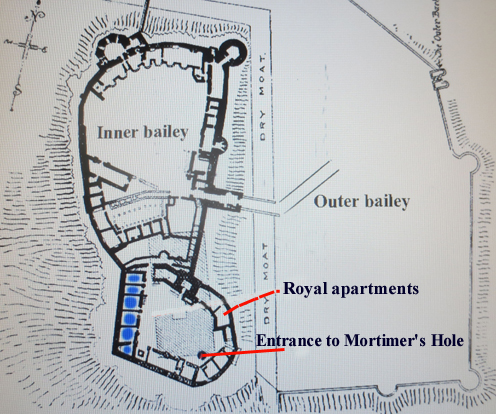 |
| Shown as solid lines are the location of the original walls of Nottingham Castle now mostly lost. The faint building partly within the inner ward is the present building. |
Papal letters to Edward III shows the concern that the pope had for Queen Isabella at the time:
November 1330 -
(f. 39d.) To the king. The pope has heard that on the 19th October about the middle of the
night, the king suddenly seized some princes and nobles of the realm, and imprisoned them. He
exhorts him to deal justly with these persons and to admit witnesses, so that vengeance may have no
place in the proceedings taken. Should any grave matter be proved against them, the pope begs the king to remember that mercy
is shown to those that show mercy ; and hopes that the accused will return to their fealty.
(f.40.) To the same. The pope heard on the third of this month that the king was not showing signs of filial
affection to his mother, queen Isabella. Should she have done anything to
justify the king's behaviour to her, the pope exhorts him to remember what his mother has done for him, and what
enmity and ill will she has provoked against herself in his service, and begs him to show mercy, so that he himself
may find it in the day of judgment.
To the same. Duplicate of the letter on (f.39d.) sent in case the former should be lost.
To the same. Since writing the letter (f. 40) the pope has heard from a merchant of those parts that the king is
behaving with humanity and reverence to his mother, and
commending him for this, urges him to acquiesce in the pope's exhortations.
To queen Philippa. Touching the king's behaviour to his mother. The pope begs queen Philippa to insist with the king
that in consideration of what his mother has done and suffered
for him, his goodwill towards her should be restored.
To Henry, earl of Lancaster. Touching the imprisonment by (f.40d.) the king of certain princes and nobles of the realm, and
desiring him, as one of the king's trusted counsellors, to incline
the king to clemency.
To William, lord of Montacute, to the archbishop of Canterbury,and to John, bishop of Winchester. The like.
[Regesta, Vol. CXVI, p. 498.]
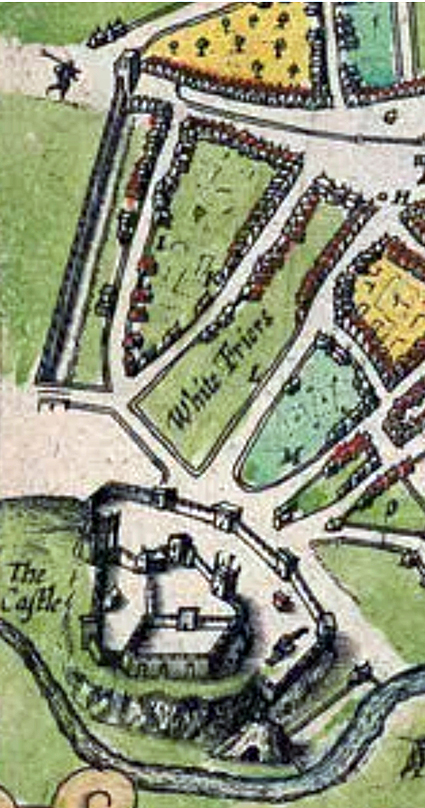 |
| John Speed's Castle at Nottingham with an inner and outer bailey. 1610.11 |
The small group who backed the coup, were
subsequently given rapid advancement.
Some mentioned by the chronicler Geoffrey le Baker are2:
* Henry the earl of Lancaster with the active assistance of two members
of his household.
* William Montague
[Montacute] who gained some of Mortimer's lands was granted a peerage in 1331 and the earldom of Salisbury in 1337
* Simon Montague, a younger son of William Montague 1st earl of
Salisbury, who became a bishop of Worcester and afterwards, Ely.
* Richard of Bury, Edward III's tutor who was the keeper of the
privy seal was made Bishop of Durham in 1333 and chancellor in 1334.
* William Clinton [Fiennes] who later became warden of the cinque
ports and 1st
and only earl of Huntingdon in his line.
* Robert Ufford who became a steward of king Edward III's household and was made Earl of Suffolk.
* William de Bohun, later earl of Northampton, a younger son of Humphrey de Bohun who died at Boroughbridge in 1322.
* Hugh Turplington7 and Richard Monmouth8 died defending Mortimer at Nottingham Castle.
* Sir Thomas Thornham 7th October 1331 at Westminster- As a result of his services at the arrest of Roger de Mortimer in Nottingham Castle, he was permitted to join the Order of St. John of Jerusalem in England for having later taken part in a rebellion with Henry earl of Lancaster and for breaking out of Norwich Castle prison. Similarly for Sir Thomas Wyneman of Thornham.10
* Sir Thomas Wyneman also of Thornham, Norfolk.

|
| The capture of the 'greatest traitor' Roger Mortimer |
Execution of a favourite
The early years of Edward II's reign were bedevilled by quarrels with
the barons who were disturbed as his father Edward I had been by his (possibly
homosexual) infatuation with Piers Gaveston. As soon as he ascended the
throne in 1307, Gaveston, son of a Gascon noble, returned from exile, was
made Earl of Cornwall and was appointed guardian of the kingdom when the
king departed for France to marry Isabella, the daughter of Philip IV and
reputedly one of the most beautiful women of her time. The indignant nobles
combined to compel Edward to banish Gaveston, and he was sent away twice,
but by Christmas 1311, he was back with the king. The earls took up arms,
besieged Gaveston at Scarborough and captured him. Then, in 1312, a group
of them -- led by Thomas, earl of Lancaster, the king's cousin and the richest
noble of them all -- sentenced him, on dubious grounds, to death for treason.
Edward never forgave those whom he held responsible for his friend's execution.
The victory of the Scots at Bannockburn [13141] two years later added to the king's humiliation. As a result of this defeat, he was forced to give in to the de facto take-over of government by Lancaster, the man he blamed for Gaveston's death.
Arrogance and greed
Between 1315 and 1317 the young King Edward gradually formed a
group of allies from among the aristocracy, and by 1318, he was in a position
to reassert his authority. However, the following year, his inadequacy
as a military leader was demonstrated again with the Scots' capture of
Berwick which, with Bannockburn, removed virtually every trace of his father's
conquests in the north. He also showed himself still susceptible to the
blandishments of an arrogant and greedy favourite - this time, Hugh Despenser.
The latter's predations, especially in the Welsh Marches, allowed Lancaster
- despite a personality so alienating that all his previous allies and
his wife had left him to lead a widespread anti-Despenser movement that,
in 1321, resulted in civil war.
Lancaster's popularity was already waning again, he had made a political error in seeking Scottish aid when he was defeated at Boroughbridge. Six days later, Edward had him executed for treason. It had been almost 250 years since a man of his rank had been put to death for rebellion, but the king, determined to avenge Gaveston, would not be stopped. There followed more executions and a reign of terror. After destroying their principal opponents, Edward, Despenser and the latter's son set about enriching themselves with scant regard for law or justice.
Murderers and malcontents
When Charles IV of France seized Edward's territories in that country,
the English king sent Charles' sister Isabella who after Gaveston's
death had managed to bear Edward four children, including the future Edward
III, who now accompanied her to effect an amicable arrangement. She despised
her husband, hated the Despensers and now fell in love with Roger Mortimer
who, condemned to life imprisonment for rebellion, had escaped from the
Tower in 1324 and fled to the French court.
 In Paris, Isabella became Mortimer's mistress. When she refused to return
to England, it became clear to the population, among whom she enjoyed
a great deal of support, that the Despensers' ascendancy had led to the
complete alienation of their queen. In September 1326, Isabella and Mortimer
landed on the Suffolk coast with a small force of malcontents. The Despensers
were executed. Edward, who was so unpopular by then that no one would obey
his orders, fled but was captured and taken to Kenilworth. In January 1327,
Parliament accepted a damning - and largely accurate indictment of
his rule, concluding that, since he was 'incorrigible without hope of amendment',
he should be deposed. Edward abdicated in favour of his 14-year-old son
and was imprisoned in Berkeley Castle in Gloucestershire. However, while he lived, he remained a potential threat to Mortimer and
Isabella, and attempts to rescue him sealed his fate. It was later announced
that he died at Berkeley on 21 September. Almost certainly he was murdered,
perhaps in a particularly gruesome fashion.
In Paris, Isabella became Mortimer's mistress. When she refused to return
to England, it became clear to the population, among whom she enjoyed
a great deal of support, that the Despensers' ascendancy had led to the
complete alienation of their queen. In September 1326, Isabella and Mortimer
landed on the Suffolk coast with a small force of malcontents. The Despensers
were executed. Edward, who was so unpopular by then that no one would obey
his orders, fled but was captured and taken to Kenilworth. In January 1327,
Parliament accepted a damning - and largely accurate indictment of
his rule, concluding that, since he was 'incorrigible without hope of amendment',
he should be deposed. Edward abdicated in favour of his 14-year-old son
and was imprisoned in Berkeley Castle in Gloucestershire. However, while he lived, he remained a potential threat to Mortimer and
Isabella, and attempts to rescue him sealed his fate. It was later announced
that he died at Berkeley on 21 September. Almost certainly he was murdered,
perhaps in a particularly gruesome fashion.
The young king still did as his mother told him, and for three years, she and her lover Mortimer were the virtual rulers of England. However, they were soon faced with gathering resentment of their ostentatious life-style and policies. The avaricious Mortimer exploited his position hugely, taking the bulk of the Despenser estates in south Wales and then, in 1328, giving himself the title Earl of March. Edward II's murder, the humiliating treaty of Northampton in which they recognised Robert Bruce's kingship and renounced all claims to Scotland, in return for £20,000, most of which found its way into their private coffers -- and the execution of the king's uncle, Edmund, Earl of Kent, were all laid at their door. Edward III, now 17 and increasingly asserting himself, was more than aware of the destruction of his kingdom being carried out by his mother and her lover.
2. The first 25 knights ['Founder Knights"] besides Edward III included Prince Edward [The Black Prince], John of Gaunt [Duke of Lancaster] his own sons and:
Earl of Salisbury, William
Montague.
Earl of Stafford,
Earl of Warwyk [Warwick],
Sir James Audeley [Audley],
Balle [Walter Balieley],
John de ?Beauchamp,
Bedivere
de la Boleye,
Sir Batholemew Burghersh
Sir John Chandos,
Sir Hugh Courtenay,
Sir Jean de Grailly [a Gascon],
John Grey,
Henry Grosmont [A Gascon knight], father of Alys who married Earl of
Salisbury
Oties Holland,
Thomas Holland,
Santal Labrychant,
Neele Loring,
John de Lysle,
Roger Mortimer [earl of March]
Percival
Myles Stapleton,
Trotfleur
They filed into St. George's chapel, Windsor Castle on the 10th August
1348 in pairs, the lines parting to seat themselves behind either the king
or the Black Prince. They faced each other across the chapel like the opposing
tournament teams they represented.1
3. John of Gaunt,
the fourth son of Edward III, had the honour of Pontefract and his arms are
depicted in the east window of Elland Parish Church. Elland is one of the Townships [villages] within the Honour of Pontefract.
4. Buckingham Palace's reply:
| January
2001 I asked the following: Q Who were the first Knights of the Garter and why were there twenty-six? I have a hypothesis that the number was drawn from those who entered Nottingham Castle to arrest Mortimer. Is this correct? A The original members of the Order of the Garter were its founder, Edward III, and the Prince of Wales (Edward, the Black Prince), together with twenty-four Companions. These "founder knights" had served in the French campaigns of the time, including the battle of Crécy; the Order was intended as a reward for loyalty and for military merit. There is no definitive
explanation as to why the Various statutes have
altered the constitution of |
11. Speed, John. The Counties of Britain. Pavilion Books. 1998, pp
142-143.
