 |
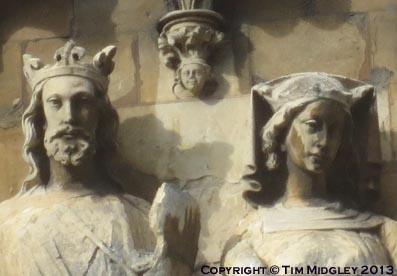
| King Edward I and his great love, Eleanor of Castile. Two of the few medieval statues remaining on the exterior of Beverley cathedral, East Yorkshire. |
 King John Balliol, Earl of Galloway [b.1249, r.1292-6,
d.1315] had been placed on the Scottish throne in 1292, the preferred
regent of thirteen candidates called The Competitors ,one of whom included Robert
de Brus. King Edward I of England had agreed to the recommendations of his commissioners
who had followed feudal law which supported the line of succession
through the eldest son. The strongest candidates were descended from
the brother of King William 'The Lion', David earl
of Huntingdon who had died 70 years beforer8. However
Balliol proved to be a weak Scottish king of what was to become a vassal
state. Edward I of England demanded Scottish services for his campaign
in the wine rich region of Gascony, but Balliol refused, instead making
a truce with France against England which was to last 300 years8.
This initial treaty gave Edward a reason to remove the ever present
danger from the North. Edward moved against Balliol and with the
help of Scottish nobles, including Robert de Bruce, won the Battle
of Dunbar. We can see here like all nobles of his time, de Bruis was
a pragmatist as well as an opportunist, ideology of a Scottish nation
appears to form later.
King John Balliol, Earl of Galloway [b.1249, r.1292-6,
d.1315] had been placed on the Scottish throne in 1292, the preferred
regent of thirteen candidates called The Competitors ,one of whom included Robert
de Brus. King Edward I of England had agreed to the recommendations of his commissioners
who had followed feudal law which supported the line of succession
through the eldest son. The strongest candidates were descended from
the brother of King William 'The Lion', David earl
of Huntingdon who had died 70 years beforer8. However
Balliol proved to be a weak Scottish king of what was to become a vassal
state. Edward I of England demanded Scottish services for his campaign
in the wine rich region of Gascony, but Balliol refused, instead making
a truce with France against England which was to last 300 years8.
This initial treaty gave Edward a reason to remove the ever present
danger from the North. Edward moved against Balliol and with the
help of Scottish nobles, including Robert de Bruce, won the Battle
of Dunbar. We can see here like all nobles of his time, de Bruis was
a pragmatist as well as an opportunist, ideology of a Scottish nation
appears to form later.
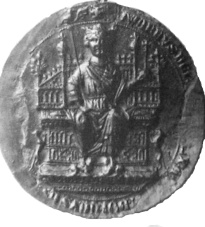
Image from Edward I's great seal
In 1209 Edward expelled the Jews from England. This may be because he
owed so much interest on his national loans. They had originally arrived
like many of the financiers, with William the Conqueror but now usury was
forbidden and Jews were not allowed to act as merchants, France followed
England in 12927. Simon Schama, has called this the "first European
ethnic cleansing"3 Many were killed in York & Lincoln whilst
some were taken in boats down the Thames and left on sand banks to
drown on a rising tide.
Edward having conquered Wales decided that he would emulate
the legendary Arthur, whom we are told by a contemporary historian
Cath, took a great interest in all things Arthurian, and hence had
a desire to unify the whole of Britain. In 1284 Edward held an Arthurian
themed tournament at Nefyn [Nevin] on the Lleyn peninsula to celebrate this
conquest at which Henry de Lacy, earl of Lincoln led one team and Richard de
Burgh earl of Ulster led the other, This culminated in yet another
revival of the "Round Table" in Edward III's, his grandson's
reign and subsequently was used by Henry VIII as a flamboyant show
of supposed genealogical supremacy over his noble counterparts. One
of the earliest historical references to a round table tournament comes from the
reign of Henry III:
|
14th October 1252 -
Grant to Roger de Leyburn of the king's peace, and protection for him, his men, lands and possessions; and mandate to all not to molest him on account of the death of Arnulf de Munteny, lately killed by accident at a round table, because the king has quit-claimed him in respect of that death. [C.P.R., Henry III, vol. 4, p. 154.] |
In 1295 the Model Parliament was established by Edward I. This created a pattern for the House of Commons with two knights from each county and two burgesses from each chartered town7. In 1296 John Balliol attacked England, as a result, Edward I's army headed north to Dunbar to quell the disturbance.
|
| King Edward I and his great love, Eleanor of Castile. Two of the few medieval statues remaining on the exterior of Beverley cathedral, East Yorkshire. |
| Monuments to everlasting love - The Eleanor Crosses |
 |
| This cross was erected in 1291-1294, it is one one of three surviving crosses from the twelve erected by King Edward I at the stopping places of the funeral cortege of his wife, Queen Eleanor, on its way from Lincoln to London. The design of the original top is unknown, the present shaft having been placed in position in 1840. [Plaque nr. Eleanor Cross, Hardingstone, Northampton.] Click for greater detail. |
Panel on a wall near the Eleanor Cross, Hardingstone, Northampton:
In everlasting memory of conjugal love, the honourable assembly of judges of the county of Northampton resolved to restore this monument to Queen Eleanor, when it had nearly fallen down by reason of age in that most auspicious year 1713, in which Anne, the glory of mighty Britain, the most powerful avenger of the oppressed, the arbitress of peace and war, after Germany had been set free, Belgium made secure in her defences, the French overcome in more than ten battles by her own and by the arms of her allies, made an end of conquering and restored peace to Europe after she had given it freedom.
Nearby are three stones set into the same wall which are the original ca. 1291 bases for three of the Queen Eleanor figures which were repaired during the restoration of the monument in 1984 by Northampton Borough Council.
 |
|
|
|
|
 |
|
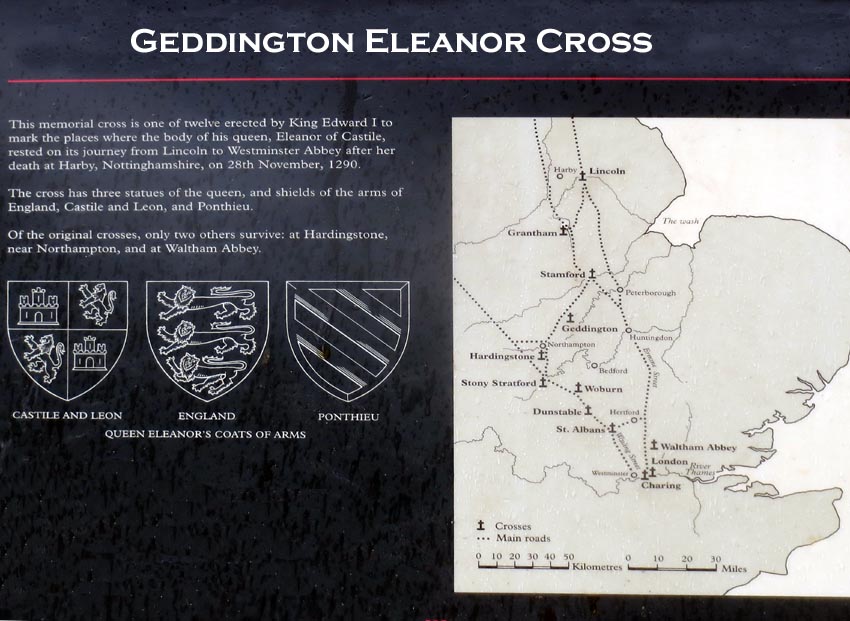
| Geddington Cross, the third resting place after leaving Lincoln. |
THE
SCOTTISH WARS 1296-8
These wars are historically valuable because they were well
documented. One chronicler, Walter of Guisborough priory in the Bruce
territory in England wrote of events from 1066-1312 from the Yorkshire
perspective, using contemporary sources and the previous twenty-two
years.
The Battle of Dunbar 1296
 On the 28th March 1296 Edward now sixty years old, marched
north crossing the then border at Coldstream with a large army
[25,000-30,000 infantry and 5000 cavalry] and headed for Berwick,
a major trading town. On the 30th March he destroyed the town and decimated
the population [11,000-16,000]. This was in retaliation for the widespread
carnage perpetrated on the north of England and the treachery of the Scottish-French
alliance which he determined as a stab in the back. Berwick was rebuilt
by Northumbrians and the Scottish-English border forever after remained
north of this town.
On the 28th March 1296 Edward now sixty years old, marched
north crossing the then border at Coldstream with a large army
[25,000-30,000 infantry and 5000 cavalry] and headed for Berwick,
a major trading town. On the 30th March he destroyed the town and decimated
the population [11,000-16,000]. This was in retaliation for the widespread
carnage perpetrated on the north of England and the treachery of the Scottish-French
alliance which he determined as a stab in the back. Berwick was rebuilt
by Northumbrians and the Scottish-English border forever after remained
north of this town.
The Earl of Dunbar who had some ambition to be a king of
Scotland sided with Edward, however the Countess of Dunbar allowed
the Scottish army to defend the castle..
The main Scottish army of 40,000 men, without King John
Balliol, headed for Dunbar to prevent its fall, but John
de Warenne [8th Earl Warenne of Sandal Magna Castle]
left part of his English forces [12,000 men] to lay seige to
Dunbar castle whilst he headed north to meet this huge array of Scotsmen.
On the 27th April they met in a deep valley. The Scots saw what they believed
to be some disarray amongst the English and began blowing on their horns
and shouting and charged down from their elevated position. This gave Warenne his advantage and his troops moved into
the fray decimating the undisciplined Scottish troops who fled as far
as Selkirk Forest.
| Omissions, exaggerations, the history of battles is never impartial, it is dependent upon which side is writing it |
But a thread of truth runs common to each version. The following day Edward with the majority of the English troops moved up to Dunbar, the castle had to submit. This led to the whole of Scotland coming under Edward's control. King John Balliol, surrendered and was stripped of his office. As a result he was nick-named Toom Tabbard or Empty Coat [from the royal arms stripped from his surcoat]
Edward I managed to travel as far north as Elgin gathering the signatures
of the vanquished, removing the "Stone of Destiny" from Scone and
the "Black Rood of St. Margaret", supposedly constructed from part
of Christ's Cross#, from Edinburgh, whose castle
for the first time was garrisoned by English troops. Following the successes at Dunbar, de
Warenne was given
the wardship of Scotland and he and Sir Hugh Cressingham the
Treasurer for Scotland, were left as commanders of the
English forces in Scotland whilst Edward took ship to France in August
1297.
Throughout the summer of 1296 sporadic outbreaks had occurred
in Scotland, it became the beginnings of a national Scottish uprising.
Scotland had not been defeated since the Romans invaded. Edward had
the acquiescence of land-owning nobles but not the sporadic resistance
under such manorial lairds as Sir Andrew de Moray [Murray] and William de Waleys [Waleis, le Waleys, Walays, Wallace &c.]. Under their influence most of Scotland north
of the Clyde-Forth boundary was gained by the Scots.
On 22nd August 1297 King Edward and many of his knights crossed the sea to Flanders but they soon had to return after the Scots broke the treaty.12
WILLIAM WALLACE
 Shown at left are the probable heraldic arms of Sir
William le Waleys who was knighted in March 1298 following his brilliant success
at Stirling Bridge but before his resounding defeat at Falkirk in the following
June. Blazon: Gules a lion rampant argent and a bordure compony of the last and
azure. The bordure compony, perhaps indicative of Wallace being a second son
was later changed to a bordure counter-compony by a Lord Lyon because of
its later medieval associations with illegitimacy. [As with the Beaufort
line of John of Gaunt and Katherine Swynford].
Shown at left are the probable heraldic arms of Sir
William le Waleys who was knighted in March 1298 following his brilliant success
at Stirling Bridge but before his resounding defeat at Falkirk in the following
June. Blazon: Gules a lion rampant argent and a bordure compony of the last and
azure. The bordure compony, perhaps indicative of Wallace being a second son
was later changed to a bordure counter-compony by a Lord Lyon because of
its later medieval associations with illegitimacy. [As with the Beaufort
line of John of Gaunt and Katherine Swynford].
The Book of Wallace vol. 1 [pdf] The Book of Wallace vol. 2 [pdf]
These are two worthwhile resources describing the supposed family relationships [based upon Henry the Minstrel or ' Blind Harry's' work] and the betrayal and death of the Scottish national hero. William Wallace has more recently been identified not as one of the sons of Malcolm Wallace of Elderslie, Renfrewshire but as the second son of 'Alani Walais', by Dr. Fiona Watson from William's own seal attached to the Lübeck letter.10 As Watson has correctly stated, the Wallaces of Elderslie, Renfrewshire cannot be proved before the late 1300's.11 John of Elderslie appears as the son of John 6th lord of Riccarton and his wife, a Lindsay [married 1371], heiress of Craigie.
Alan may be equated with a crown tenant of Edward I in Ayrshire, 'tenant le Roi du counte de Are'. Alan appears as a signatory to the Ragman Roll* [28th August 1296 at Berwick] as 'Aleyn Waleys'. The Renfrewshire genealogy is garnered from 'Blind Harry's' work, The Actes and Deidis of the Illustre and Vallyeant Campioun Schir William Wallace, written about 1477 which is likely to be, in part at least, erroneous. * This is apparently the origin for the word 'Rigmarole'.
Interestingly, The Book of Wallace [vol.1, p. 12.] following 'Blind Harry' says that this Alan was 'obviously proprietor of Auchincruive'. Could it be that this is William Wallace's father, Alan? The lands of the manor of Auchincruive are now occupied by an agricultural college on a steep river bank overlooking the River Ayr. According to the same source, William, by now outlawed, left the residence of an uncle, Sir Reginald de Crawford of Riccarton , the sheriff of Ayr and sought refuge with 'Aleyn', a homager of Edward I at Auchincruive castle. This was possibly a fortified house, which by 1889 was described as an 'ancient mansion'. But Alan fearing repercussions for actively harbouring him allowed William only to reside on the estate in a woodland called 'Laighlyne' or low-lying woods, perhaps part of Brockle Wood today. Here, according to that old walnut 'tradition', Wallace first drew together the nucleus of a Scottish national army in April or May 1297. "Within the forest of Laighlyne, at a bend of the Ayr stream, and close to its bank, is a spot styled the Wallace Seat. Protected overhead by a projecting cliff, it is approachable from one point only, while by a powerful resistance from within an intruder would certainly be precipitated into the surge." [Book of Wallace, vol. 2, p. 105.] Alan's name at Auchincruive may be commemorated today in Mount Allan Wood.
The location of Ellerslie, Ayrshire, given on a map of 1865 here
identified on a modern O.S. map.
Some of the Wallace family's Ayrshire lands may have been held at Ellerslie north of the River Irvine, a residence not marked on modern O.S. maps but appearing on a map of 1865, a little south east of Crosshouse. However, Wallace's origins are strongly contested by those loyal to their own geographic areas. One occurrence in support of the Ayrshire origin for Wallace is indicated by a skirmish in 1300 following Wallace's defeat at Falkirk [1298]. Here, Prince Edward, later King Edward II, and Piers Gaveston, under the guidance of Henry de Lacy commanded a section of his father's army. This army was styled 'The Shining Battalion', shining perhaps meaning colourful. This battalion was involved in a skirmish with the Scots on the banks of the River Irvine, near Irvine, Ayrshire. [Littell, E. & Littell, R.S., The Living Age. Making of America Project.1863, p.77]
In the interim Edward had formed a treaty with France, and Philip IV abandoned his Scottish allies. By1298 Edward I returned hastily from Flanders and summoned a parliament [French: "parley"] at York, where he was granted money for military engagements in Scotland.
The Errors of Randall Wallace
Much has been written about the technical errors of the film 'Braveheart'. However, the historical errors and inaccuracies are of equal magnitude. Importantly, Edward I was not on his death bed when William Wallace was executed. Wallace died in 1305, Edward died in 1307 both far apart in time and geography. The Scots did not wear woad nor did they at this time wear kilts but instead braided plaid. Many of the knights of Scotland were principally of the same Norman stock as those leading the English armies, that is, they were descendant Normans residing in Scotland. Thus it was really Norman descendant knights of England and Scotland exhorting their feudal subjects against each other for their own purposes. The evolving idea of nationalism was born of a rather more base self-interest held by all medieval knights and barons. To gain and retain land meant wealth and political power. For more detailed errors of the film see:
| The Longbow The Welsh longbow had been recognised Edward I during the Welsh Campaign of 1282 to be a superb weapon. Light, easily transported and devastating in its effects. By the 1350's the longbow was six feet tall or as tall as a man. This longer bow gave greater leverage to the arrow whereas the crossbow depended upon extreme tension of the string to propel the quarrel and consequently took a longer time to 'draw'. The range of the longbow was about 400 metres and could, with a metal tip [bodkin] pierce chain mail. The bow was constructed of yew, maple or oak. Yew from Spain was particularly favoured. A trained bowman could 'loose' one arrow every 5 seconds or about 12 per minute. This rate of firing was the decisive characteristic over the crossbow. A fletcher would ensure the arrow had evenly proportioned flights. These flights were made from goose feathers. A person with the surname Fletcher today can trace the origin of their name back to this time. Again the Welsh archers were used by Andrew Harclay at the Battle of Boroughbridge [1322] to successfully repel the Northern rebels during Edward II's reign. Both these successes at home later led to Edward III deploying archers against armoured knights at the Battle of Crecy, repeating these resounding successes. |
The work of the Welsh archers allowed the mounted knights to enter the defensive structures such that one witness said "that bodies covered the field like snow". Meanwhile, a youth who was to become known as the ballad character, 'Robyn Hode', watched the battle from the hills above Falkirk making mental notes of the efficiency of the longbow. Following this victory, Edward returned to York for another parliament. In the summer of 1300 he had 5,900 Yorkshire-men summoned to serve in the war against Scotland. This would have been like using half of the city of York's population at this time. In 1299 Edward had been forced by circumstances to marry Margaret, the daughter of the king of France, his greatest love Eleanor of Castile having died. Margaret sided against Edward.
By 1304 Stirling Castle had been captured and Edward returned to York.
It was felt that the danger from Scotland was over and as a result
the Courts of the King's Bench and the Exchequer were removed from
the city of York where they had been held for seven years and taken to
the city of London.
For the next eight years until his death, Edward made march
after march from Berwick and Carlisle into Scotland, sacking abbeys
and besieging castles using huge siege engines with pet names such
as "The War Wolf". Even Dunfermline Abbey, a holy site for the Scottish
was sacked in 1303 until eventually "The King's Peace" was signed in
1304 at Strathmore. Lairds of manors who pledged loyalty were given
their lands back. Wallace is considered to have used 'terrorist methods'
8 until his betrayal by his own countrymen when he was taken
to London and after a show trial, in 1305, was publicly executed
and disemboweled, such was the cruelty of the day.
However as one danger from the north disappeared, another
in the form of Robert de Bruce [Bruis], Earl of Carrick, of Scottish-Norman
descent, appeared as a leader for Scottish Nationalism. De Bruce essentially
used guerrilla tactics, living rough, attacking castles by night,
using grappling hooks and setting ambushes. This persisted as murderous
raids into northern England well after Edward I's death in 1307. This
type of un-knightly raiding had long been used by the Scottish
but De Bruce brought it to a fine art. One of the warnings Northern English
mother's would impart to their young sons to prevent them getting into scrapes
was 'be careful or The Bruce will get ye".
 seat his barons around so that they would all be equal1.
A 'Round Table' is then mentioned in the Calendar of Patent Rolls of 1252 during
Henry III's reign. [C.P.R., October 1252, p. 154.] Edward
Hastead also mentions it in his book when he describes Sir Roger de Leyborne, a
Kentish knight, as slaying Ernulf de Mounency [Mouncy] at a meeting of the Round
Table held at Walden, Essex where, for want of a collar, Sir Roger's lance
pierced Ernulf's throat under his helmet. The lance having no socket on the
point, the act was believed to have been a deliberate revenge for a broken leg
Sir Roger had suffered against Ernulf in a previous tournament.13
seat his barons around so that they would all be equal1.
A 'Round Table' is then mentioned in the Calendar of Patent Rolls of 1252 during
Henry III's reign. [C.P.R., October 1252, p. 154.] Edward
Hastead also mentions it in his book when he describes Sir Roger de Leyborne, a
Kentish knight, as slaying Ernulf de Mounency [Mouncy] at a meeting of the Round
Table held at Walden, Essex where, for want of a collar, Sir Roger's lance
pierced Ernulf's throat under his helmet. The lance having no socket on the
point, the act was believed to have been a deliberate revenge for a broken leg
Sir Roger had suffered against Ernulf in a previous tournament.13
This organisational structure, using a Round Table helped to prevent any one baron gaining precedence over
another particularly during heated discussions.
Malory referred to it as a wedding gift from Guinevere's father to Arthur. Edward had a vision of himself as the new Arthur, as a unifier
of all of Britain against France in his claims towards Gascony. At
this time it would be difficult to discriminate between the French leaders
and those who governed England. They all spoke French, the courts were
held in French and the royal families were all from the same basic
stock and well intermarried.
Edward enjoyed staying at Winchester Castle the present
building dating from the early 1200's, however in 1302 Edward I and
his second wife, Margaret of France almost lost their lives at Winchester
Castle when their royal apartments caught fire.
It appears from scientific investigations, such as X-ray
techniques, dendro-chronology and a study of the carpentry, that the
"Round Table" hanging in the great hall at Winchester castle was made
between 1250 and 1280, possibly 1270 although the most recent
provides a date of about 1290.9 This places its construction
about the middle of the reign of Edward I [1272-1307]. The script
is in a form prevalent on brasses of the 1200's. The table later gained painted
embellishments, namely in the time of Henry VIII such as a Tudor rose
in the centre, green and white Tudor colours and a painting of the regent
in the likeness of the young Henry VIII. This suggests Henry was at
pains to impress his legitimacy to the claim that he and his Tudor
family were heirs of Arthur. Both Henry 'Tewdor' and Arthur being of Welsh
or "British" origin. To this end Henry entertained Charles V the Holy
Roman Emperor in 1552
 Some state the Round Table depicts 24 name-places around
the table each named after Arthur's greatest knights [See left], others 25 spaces [which includes the regent] and yet others,
26 shield blazons and summaries,. Two blazons are for the regent, one is three gold crowns on
a red background and the other is 13 gold crowns on a purple or blue
background. The actual summaries or names in script number 24 but
if the alternating coloured blazons or segments are counted this
could be 26, a conundrum created, but also solved by the painting of the
regent over possibly two segments. One segment that the regent's image would
have to be painted over would be the same colour as its adjacent one, hence
it was probably necessary to insert the regent over these two. This gives
the painting a slightly "off-centred" appearance. On the regent's left is
named Sir Galahad and on his right Sir Mordred. The number of knights invested
by Edward III, Edward I's grandson was also 26, this is believed
to be the number of knights in two opposing jousting teams.
Some state the Round Table depicts 24 name-places around
the table each named after Arthur's greatest knights [See left], others 25 spaces [which includes the regent] and yet others,
26 shield blazons and summaries,. Two blazons are for the regent, one is three gold crowns on
a red background and the other is 13 gold crowns on a purple or blue
background. The actual summaries or names in script number 24 but
if the alternating coloured blazons or segments are counted this
could be 26, a conundrum created, but also solved by the painting of the
regent over possibly two segments. One segment that the regent's image would
have to be painted over would be the same colour as its adjacent one, hence
it was probably necessary to insert the regent over these two. This gives
the painting a slightly "off-centred" appearance. On the regent's left is
named Sir Galahad and on his right Sir Mordred. The number of knights invested
by Edward III, Edward I's grandson was also 26, this is believed
to be the number of knights in two opposing jousting teams.
But see
another possible reason- The Nottingham Coup by Edward III
Under Edward III the concept of knights being called to the Order of the
Round Table was compelling, following his father's disastrous reign where
civil war was the disorder. Under Edward II there could have been no Round
Table discussions. To facilitate conflict resolution, from 1344, Edward
III appears to have had a House of the Round Table constructed at Windsor
Castle. Thomas Walsingham claimed that a structure 200 feet in diameter
and capable of seating 300 knights was built here in the castle grounds.
In 2007 an archaeological excavation team prepared the way by using ground
radar in the grounds of Windsor Castle. Here they found a remarkable circular
structure 298 feet in diameter beneath one corner of the upper ward of the
castle grounds. This building structure has been interpreted as the remains
of the Round Table House.9 However, the building may never have
been completed because King Edward required money for his French campaigns,
particularly the battle of Crecy [1346]. After the siege of Calais in 1347
Edward's advisors seem to have reconsidered the completion of such an elaborate
and expensive building which was essentially now purposeless. Instead, Edward
created the Order of the Garter whose ceremonies were held in St. George's
Chapel at Windsor Castle. When Windsor Castle was undergoing reconstruction
in the 1360's the House of the Round Table seems to have been demolished
by the architect William de Wykeham and the remains lay forgotten beneath
the castle grounds until their recent discovery.9
With the glorious victory over the French at Crecy, the baronial disunity
was dissipated and they gladly united behind their 'Perfect King'. From
being on their knees to the combined attacks of the Scots and French, the
English and their indomitable fighting spirit, under the control of their
Norman descendant rulers, emerged as a strong powerful nation.
| 26 Knights of Arthur [Malory] |
26 Founder Kights
of the Garter Edward III |
| 1. Arthur 2. Alynore 3. Bedwere 4. Blubrys 5. Bors 6. Brunor 7. Dagonet 8. Degove 9. Galahad 10. Gareth 11. Gawain 12. Hector 13. Kay 14. La Cote 15. Lamorak 16. Launcelot 17. Libeaus 18. Lucan 19. Lyonell 20. Mal Tayle 21. Mordred 22. Pellinor 23. Percival 24. Plomyd 25. Safer 26. Tristan |
"Fraternity of St George" 25. Sir Hugh Wrottesley. 26. Sir Thomas Wale.
Other names found on other lists: Sir Richard Fitz-Simon, latest notice of him 1348. Sir Henry d'Enne, Bedivere Trotfleur. They filed into St. George's Chapel, Windsor Castle on the 10th August 1348 in pairs, thelines parting to seat themselves behind either the king or the Black Prince. They faced each other across the chapel like the opposing tournament teams they were meant to represent. |
1307-Edward I died at Carlisle whilst on his way to Scotland. He
requested that his flesh be boiled from his bones and that these then
be carried with the English army wherever it went in Scotland. To some
extent Edward the I had reformed the British Isles into what is today
called Britain and achieved the vision of an Arthurian Britain united
eventually in the 1700's under one flag.
# Note: Christ's Cross- It has
been estimated that if all the pieces claimed to be taken from Christ's
Cross as 'Holy relics' were gathered together in one place they could
be used to construct a sizeable ship!
11. Ibid. p. 13.
12. Annales Cestriensis. p. 121.
13. Hasted, Edward. 'Parishes: Leyborne', The History and Topographical Survey of the County of Kent: Volume 4 (1798), pp. 496-508 citing Rot. pat. ejus an. pt. I. Dugd. Bar. vol. ii. p. 13.)
 The British flag of today did not appear until after the unification
of England and Wales with Scotland. This is not the English flag as
commonly misconstrued which is a red cross on a white background, there
is a difference. Within the British flag or Union flag there is also the
Scottish Cross of St. Andrews, white diagonals on a blue background.
The British flag of today did not appear until after the unification
of England and Wales with Scotland. This is not the English flag as
commonly misconstrued which is a red cross on a white background, there
is a difference. Within the British flag or Union flag there is also the
Scottish Cross of St. Andrews, white diagonals on a blue background.
|
|
Was there an original 'Round Table'
Apart from being a possible metaphor for cooperation, some have suggested that the Roman amphitheatre at Chester or that at Caerleon in South Wales are tangible sites for 'Dark Age' and / or medieval round table meetings. Another intriguing suggestion is that Stonehenge may be the original site. Firstly there is a connection between Stonehenge and the blue stones brought 150 miles from South Wales and secondly there are 56 'Aubrey holes' recorded within the henge monument on Salisbury Plain, possibly representing great warriors of the Neolithic period. This number is close enough to the idea of 26 Knights of the Garter paralleled by 26 impoverished knights seated in Edward III's St. George's Chapel. That there was a connection to South Wales suggests a degree of cooperation between the Salisbury Plains inhabitants and those of South Wales. The recent archaeological discoveries at Stonehenge also reveal a level of cooperation between people perhaps from all over the British Isles, the original Britons, who seem to have periodically descended upon Stonehenge setting up temporary shelters and indulging in feasting.

