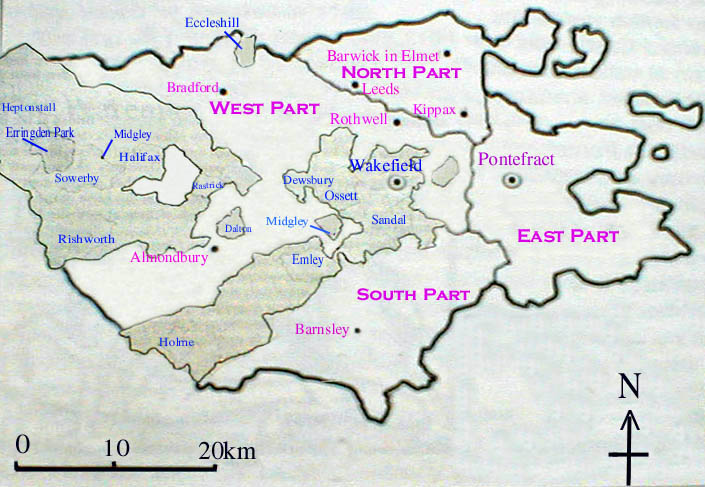
 The Honour of Pontefract
Pontefract Castle -"The key to the North" originally called Kirkby by the Danish invaders but later the town had a name change under the Normans to Pomfret or "Broken Bridge". From Pontefract was administered the vast Duchy of Lancaster.
The Pontefract lands held by the de Lacis were purposely interwoven with
the lands granted to the Warennes of Wakefield Manor by William I. Both
de Laci and Warenne were present at the Battle of Hastings and were
consequently rewarded with such large estates, the latter family having
their main seat at Lewes in Sussex.
Townships [villages] held in the district by Ilbert de Laci
[d. 1089] were Penistone, Thurlstone, Denby, Scissett, Skelmanthorpe,
Clayton, Cawthorne, Silkstone, Chevet ('Chute'), Crofton, Snydale, Whitwood, Heath,
Altofts, Newlands, Carlton, Methley, East Ardsley, Lofthouse, Middleton,
Morley, Batley, Southowram, Elland,
Greetland, Heckmondwike, Mirfield, Nether Midgley,
Over Midgley, Middleton, Thornhill [manor built in 1236], Kirkheaton,
Highburton [Birton], Deighton, Fixby, Bradley, Huddersfield, Almondbury,
Honley and Thong.
|
|
|
The Honour of Pontefract [purple] and the Manor of Wakefield. |
Lords of Pontefract Castle and the honour of Pontefract:
The years denote their
tenure of the honour
Ilbert de Lacy ?-1089
Ilbert was given the task by "William the Bastard" of quelling
the Anglian insurrection in the district during "The Harrying of the
North". At this time English nobles were disposessed of their lands and
titles, de Laci, Warenne, Marmions [Stansfield] and others were given
the spoils.
Ilbert was granted the honour by William I, Ilbert built a castle
somewhere between 1068 and 1080. which was probably started about 1076.
It is known to have been in existence in 1086 [DB] His land ownership
in Domesday covers four pages.
Ilbert de Laci was rewarded for his services at Senlac [Blood
Lake] by the Conqueror with the whole district of Blackburnshire in Lancashire,
and 170 lordships, of which 150 were in Yorkshire. He held the town
and castle of Pontefract ['Brokenbridge'] which became his seat, the
remainder was in Lincolnshire [4 lordships] and Nottinghamshire [10 lordships].
Ilbert founded inside his fortress a collegiate chapel, dedicated to
St. Clement, and also built the foundation for the abbey of St. Oswald
at Nostell, completed by his eldest son and heir,Robert De Laci
Two members of the De Laci/Lacy family, Walter de Laci and Ilbert
de Laci, came to England with William the Conqueror, but in what degree
allied, if at all, has not been ascertained. However, it is known that
Ilbert left two sons, Robert and Hugh. Robert de Lacy, the eldest son,
was known as Robert de Pontefract.
This Ilbert left two sons, Robert and Hugh. Robert de Laci, otherwise
Robert de Pontefract, had a confirmation from King William Rufus of all
those lands whereof Ilbert, his father, died possessed. Attaching himself,
however, to the interest of Robert Curthose, after the death of Rufus,
himself and his son, Ilbert were expelled from the realm by King Henry I.,
and the honor of Pontefract bestowed upon Henry Travers; which Henry, having
shortly after been mortally wounded by one Pain, a servant of his own,
caused himself to be shorn a monk, and so died within three days. After
that the king gave this honor to Guy de la Val, who held it until King Stephen's
time, when, it is stated by an old historian, that Robert de Laci's eldest
son, Ilbert, was restored to the honor
Robert de Lacy 1089-1121
Robert de Lacy supported Robert Curthose and was so caused
to be banished from the realm. for a few years. He was disspossessed
of his lands in 1106 by Henri I His lands were granted to Hugh de Laval
and afterwards William Maltravers. After Henri II's death [1135] he was
pardoned following the murder of Maltravers. He returned to England
where he refounded the priory of St. Oswald [previously St. James]
at Nostell Priory. He succeeded to his estates in 1095.He may have been
banished a second time [Dugdale]. He also fonded the Priory of St. John
at Pontefract and bulit the castle at Clitheroe.
Ilbert de Lacy (2nd) 1136-1141
Ilbert II accompanied his father into exile. He strongly supported
King Stephen against Matilda. He fought at the Battle of the Standard
[1138] at Cowton Moor where David I [Ceannmhor] of Scotland was defeated.
Ilbert II de Lacy died .s.p.
William de Romare, Earl of Lincoln 1141-1146
Henry de Lacy 1146-1187
He succeeded his brother Ilbert II who died s.p. Henri founded
a Cistercian abbey at Barnoldswick which moved to Kirkstall Abbey
near Leeds.
Robert Butiler witnessed a charter of Henry de Laci (Old Mon. [Monasticon],
i, 657). This Robert was probably a member of the Butler or Pincerna
family of Skelkbrooke. Henry founded Kirkstall Abbey in 1152. He was
a campaigner both at home and abroad.
Robert de Lacy 1187-1193
Attended the coronation of Richard I . d.s.p.. 21st August
1193. Robert II was interred at Kirkstall Abbey near Leeds.. He was
the last of the original or true De Laci line.
Roger (Fitz-Eustace) "Helle" de Lacy 1193-1211
As Constable of Chester this family had the earls of Chester
as their overlords. With the constableship went the tenure of Halton
Castle [Cheshire] held by the Dutton family and Donington Castle
near Nottingham. He assumed the name Lisours / Lizours as his grandmother
denied him the Lizours estates and titles. He then assumed the De Laci
name. In 1193 he was accompanied by William De Beaumont of Whitley Hall
on King Richard's Third Crusade [C.T. Pratt] having assisted at
the siege of Acre [but this is now questioned]. He was a sheriff of Lancashire
VII-IX Richard I, Constable of Chester 1209 and possibly a Justicar of
England [1290].
In 1192 the De Lacis are recorded as holding Hooton Pagnell [Hotton Painel]
held from the De Lacis by the Paynell family. Roger took possession
of the honour of Pontefract in 1196 but did not take possession of the
castle at Pontefract until after the death of King Richard I [1199]
who had retained it for his own purposes. Roger's name appears as a witness
to a charter for John Ceann mhor Le Scot and earl David Ceann mhor.
He was much involved with Robert FitzRoger, Lord of Warkworth,
Northumberland who was related to Roger De Laci through Richard FitzEustace
who married twice. Both Roger and Robert [sheriff of Northumberland]
were together, heavily involved in keeping 'lawnorder' in the north
of England. He was a tandem sheriff of Yorkshire with Robert
le Waleys [Walensis] of Burghwallis 1204-1209 and sheriff of Cheshire before 1210
Roger became very close to King John in his reign. Robert Le Waleys was
also Robert's senior steward [seneschal].
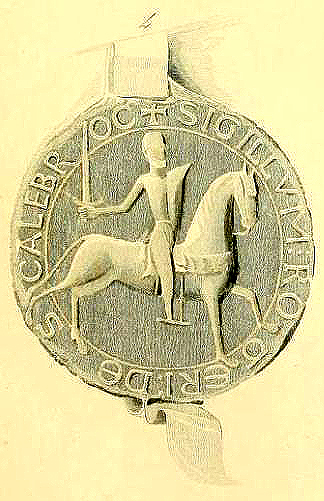
Roger's De Laci's daughter [name not known] married Roland of Galloway [his first wife according to Stringer], Roland and his De Laci wife were contemporaries of this Roger de Skelbrooke. Roger de Skelbrooke may have been introduced to the Galloways through Roger 'Helle' de Lacy. Roger de Scalebroc [Skelbrooke] went to Scotland in the late 1100's. After the suppression of a revolt in Galloway and subsequent treaty in 1186 Roger de Skelbrooke built a ring work castle at Greenan near Ayr. Roger de Skelbrooke was a vassal and tenant of Duncan grandson of Fergus of Galloway, an interesting connection with the Scots.
<Seal of Roger de Scalebroc [Skelbrooke]
John de Lacy 1211-1240
In 1213, John de Lacy agreed to pay King John 7000 marks of silver
in order to succeed to his father, Roger's lands. John de Lacy granted
Whiteley Hall to the De Beaumonts. According to K.J. Stringer, John had
a sister who married Alan of Galloway [no issue]. John went on campaign
to Poitou in 1214 with King John, one of the few barons who did so. All
his debts were cancelled two days after promising to go on a Crusade with
King John in March 1215 but within two months he was part of the insurrection
against the king.
About 1211 John married Margaret De Quincy the daughter
of the countess of Lincoln [Hawise De Keveliock, a sister to the Ranulf,
Earl of Chester] and thereby gained the earldom of Lincoln. He was hereditary
Constable of Chester.
John had a seneschal, Hugh de Buticularius, before John became the
Earl of Lincoln [~1211].
Hugh Pincerna [Butler] b.~1175, of Skelbrooke, Amthorpe and Kirk
[Sandal or Parva] was John's Butler about 1211-1216. Hugh was
of age by 1202 but Holmes refers to him as 'aged Hugh Butler, seneschal
of Pontefract 'for 1216, but there is no evidence that he was aged. Another
source has Hugh as steward to Sir John about 1212 when John would have
been ~ twenty years old. The Chartulary of St. John's Priory in Pontefract
records Robert de Kent being steward about the year 1220. [Pont. Chart. St.
John, ii, pp. 358-359.]
Edmund de Lacy 1240-1258
Edmund was granted a manor at Stanbury near Haworth. This strategically
connected the castles of Pontefract and Clitheroe in the Honour with
a road running
from Pontefract through Bradford Dale, Haworth and over the Pennines
at Colne Edge and Clitheroe Castle, another seat of the De Laci family.
The manor or Stanbury was given a charter in 1234-1235 and with 5 other manors
was granted to Edmund De Laci [November 1249]. From 1240-1246 Walter De
Ludham was steward of Pontefract
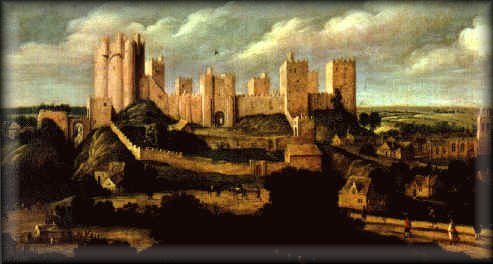
|
Henry (2nd) de Lacy 1258-1310
Henry was a supporter of Edward I. Edward I died in 1307 with
Edward II ascending the throne. He was made Earl of Lincoln about the
year 1280.
In 1294 Alice de Laci was contracted in marriage to Thomas Plantagenet.
During Henry's tenure the Wakefield Court Rolls of the adjacent
Wakefield Manor were begun in 1274. These record that in 1275 the Steward
of Pontefract was a Peter de Santon. Sir John de Hoderode is recorded
as Steward of Pontefract in Henry III's and Edward I's reigns as is
also Oliver de
Stansfield and Peter de Santon [1275]. Henry de Laci died without male
issue in 1311 and the honour then passed to Thomas of Lancaster.
Thomas, 10th Earl of Lancaster 1310-1322 a vexatious
and troublesome time.
In 1314 [other sources say the 12Ed II i.e.1319] John 8th earl
Warenne, as a result of his peccadilloes, was excommunicated by the Pope,
either Clement V
(1305-14) or John
XXII (1316-34) and forced by king Edward II to grant the Wakefield
estates to Thomas who took possession of them to add to the Honour of
Pontefract. This was the first occsaion since William I's time that the
estates were combined and precipitated what "The Conqueror" had
tried to avoid, a challenge to the Crown. Thomas's seneschal or
senior steward was Robert Holland who had gained the earl's respect as
his valet at the Battle of Falkirk in 1298 when William Wallace was
hammered back into his little box. At this battle Wallace had employed
his new invention, the schiltron, a mass of men protected by a bristling
ring of long spears. But Edward, later nick-named 'malleus Scotii', had a
new invention of his own, Welsh longbows, which were employed not as at Crecy, aimed high into
the air to fall as a rain of arrows, but at close range. By 1316 each
township had to provide a knight for king Edward II's army such were the
incursions by the "Red-shanked robbers" from the North. To some extent Thomas
of Lancaster used this situation to his own advantage particularly after
the Battle of Bannockburn in 1314.
.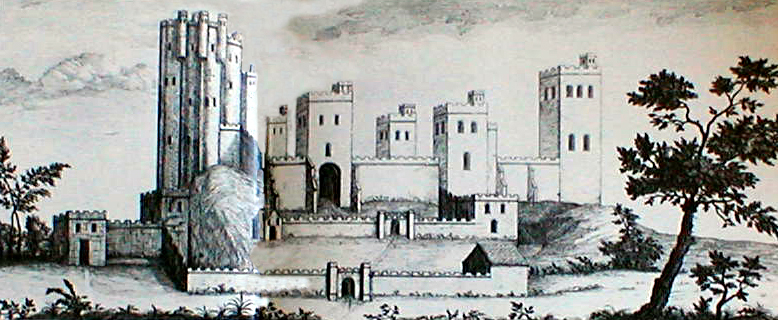
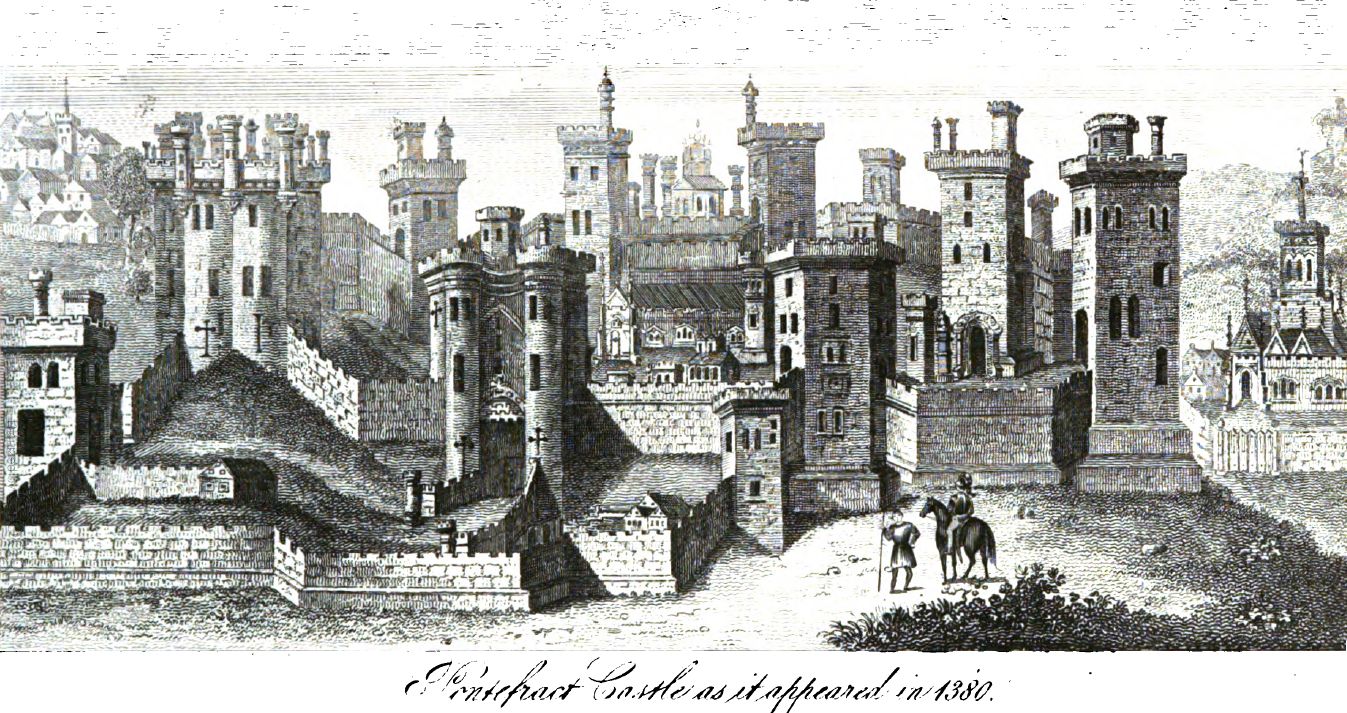
Pontefract
Castle before it was sleighted in 1648
THE SEEDS OF THE ELLAND FEUD.
Thomas Earl of Lancaster, King Edward II's cousin, was opposed
to Piers Gaveston's homosocial influence over the King. John 8th earl
de Warenne was also originally opposed to Gaveston, but when Gaveston
was murdered in his presence on Blacklow Hill near Warwick in 1312
he again sided with the unpopular Ed II. Thomas was becoming
powerful in his own right, he fell out of favour with Ed II because of
his lead in Gaveston's death.
The 8th Earl of Warenne was reinstated to his lands who then
set about, probably with the connivance of Edward II, having Thomas's
wife Alice de Laci abducted whilst she travelled in Dorset. This led Thomas
to lay siege to Conisbrough and Sandal Castle [1317] both seats of the
Warenne'. Sandal Castle was burnt to the ground. By 1320 Thomas had rebuilt Sandal
Castle in stone.
The populace in the early 1300's was continually suffering
famine. Thomas entreated Ed II ostensibly to help, the king promised
much but gave nothing. For this Thomas endeared himself to those under
his lordship. Later after his death, Thomas became revered by the people
locally, almost as a saint and the remainder of Thomas' army, following
his defeat at Boroughbridge, described as "Contrariants" gathered in the
forests, using the watchword "St. Thomas".
Thomas allied with the Scots but was defeated by the king's
army under the command of Sir Andrew de Harclay at Boroughbridge
in March 1322. As a result of his rebellion Thomas was beheaded
outside the walls of his own castle at Pontefract on what is now called
'St. Thomas' Hill'. He was interred at St. John's Priory which lay just
outside the castle walls.
1322 - After the Battle of Boroughbridge the leader of the aborted coup, Thomas earl of Lancaster was arrested while praying in the local Boroughbridge church and taken to York. Here he was mocked by the crowd, thence taken to Pontefract castle where he was confined to the basement of a tower, a tower that he reputedly had built for others. Edward II arrived shortly after Lancaster's incarceration and Lancaster was arraigned in Pontefract's great hall before the king and a tribunal which included John 8th earl de Warenne, Hugh Despenser snr., Hugh jnr. and Edmund FitzAlan, Earl of Arundel. Thomas was not allowed a plea in his defence for in the King's eyes he was a traitor to England. The Great Hall is thought to have stood where the large grassy area now sits within the very much destroyed castle. Beneath this grassy area are the Great Hall cellars which can be visited on occasions through a locked hatchway. Stand there, where the Great Hall once stood and feel the power of this great man who is buried just an arrows flight away from the castle in the former grounds of St. John's priory, now a grassy field alongside All Saints Church. Here the victors could look out every day from the castle walls and remind themselves that they had succeeded where Thomas had failed. But had he? Thomas may have been forgotten but he held the Northern half of England for a large part of Edward II's reign and methinks he had the last laugh, for King Edward 'got it in the end'. Once again, to the victors went the history. Lancaster was paraded on an old horse through the streets of Pontefract with a friar's hood on his head and given many insults. He was taken to Monk's Hill just North of the Castle near where the railway station is located today. Initially he was to be hanged, drawn and quartered but this was reduced to beheading because of Lancaster's Plantagenet blood, after all he was Edward II's cousin. At his execution he was made to kneel towards Scotland before being beheaded as a traitor. Time stood still, Scotland and the North of England held its collective breath, then it was done. The remnants of Lancaster's army were declared 'contrariants', many escaping to the protection of the local district or overseas, dressed as monks before some were later pardoned by King Edward. After Boroughbridge ninety five barons and knights were made prisoners at Pontefract and tried for high treason. Some were executed here at the same time while others were taken to York and executed later. Roger de Clifford of Skipton was hung in chains at York castle. Some say his body was left there for three years as a warning to others. Lesser contrariants were given hefty fines, many of which could not be paid, hence they defaulted and had their lands taken from them. Edward II then held a Parliament at York, reversing sentences that were previously passed by rebel barons against the his new found favourites, the Despensers. A reversal of Lancaster's attainder and a return of the rebels'
forfeited lands was not to occur until Edward III was to ascend the
throne, under the control of two regents, his mother Queen Isabella, and
Roger de Mortimer. |
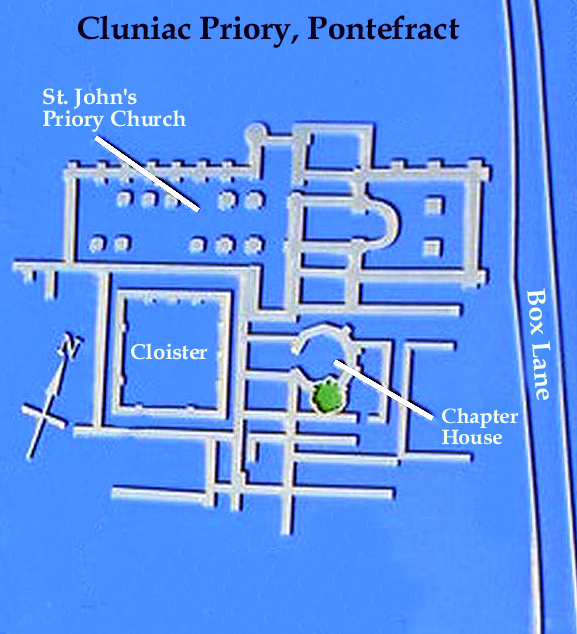 |
| The earl of Lancaster was buried to the right of the altar |
 |
Medieval tiles found at the priory of St. John's, Pontefract
Following Edward II's success at Boroughbridge the honour of Pontefract
then reverted to the king along with the manor of Wakefield.
During the year 1327 Ed II was murdered at Berkeley castle and
Ed III was invested as a young puppet king by his mother Queen Isabella
and her lover Sir Roger Mortimer.
Henry Plantagenet, Thomas's brother was reinstated to the earldom
as the 3rd earl in his line, under a new king, Edward III on March 7th
1327 as the 11th Earl of Lancaster, but the estate of Pontefract remained
in Edward III's hands, probably a strategy to prevent any further rebellion
from this family in the castle dubbed 'The Key to the North".
It was probably about this time that Edward III made William Midgley a knight of the County of York and a reward of land meant to retain his allegiance following the demise of William's overlord, Thomas Earl of Lancaster in 1322 but particularly after Ed II's death in 1327. Edward III who was only 14 or 15 years of age at this time would have been under the control of Queen Isabella and Sir Roger Mortimer. William having been appointed to Parliament in 1335-6 would traditionally have been an elder statesman probably in his 50's and had previously been serving on York County trial courts for acts against the king. |
By 1330 Ed III had overthrown Mortimer with the assistance of 24 knights
about his own age and the steward of Nottingham Castle, Sir
William de Elland. The township of Elland was of course now part of
Ed. III's estates , the constable of the castle at Pontefract being Robert de
Bosville ('Boseville)' in 1338. [C.P.R.]
Henry's son, the 12th earl of Lancaster, also a Henry Plantagenet
bore two daughters, The first had no issue the second was Blanche Plantagenet.
Blanche married John of Gaunt [Ghent] a son of Edward III also a Plantagenet.
In this way one of Edward III's sons married into the House of
Lancaster becoming the first DUKE of Lancaster.
By 1360 Edward III had given the Wakefield Estates, including
Conisbrough and Sandal Castles, to his son Edmund de Langley [Longley]
the earldom was given to Fitz-Alan of Sussex one of the family names
appearing at Thomas of Lancaster's 'trial'.
|
|
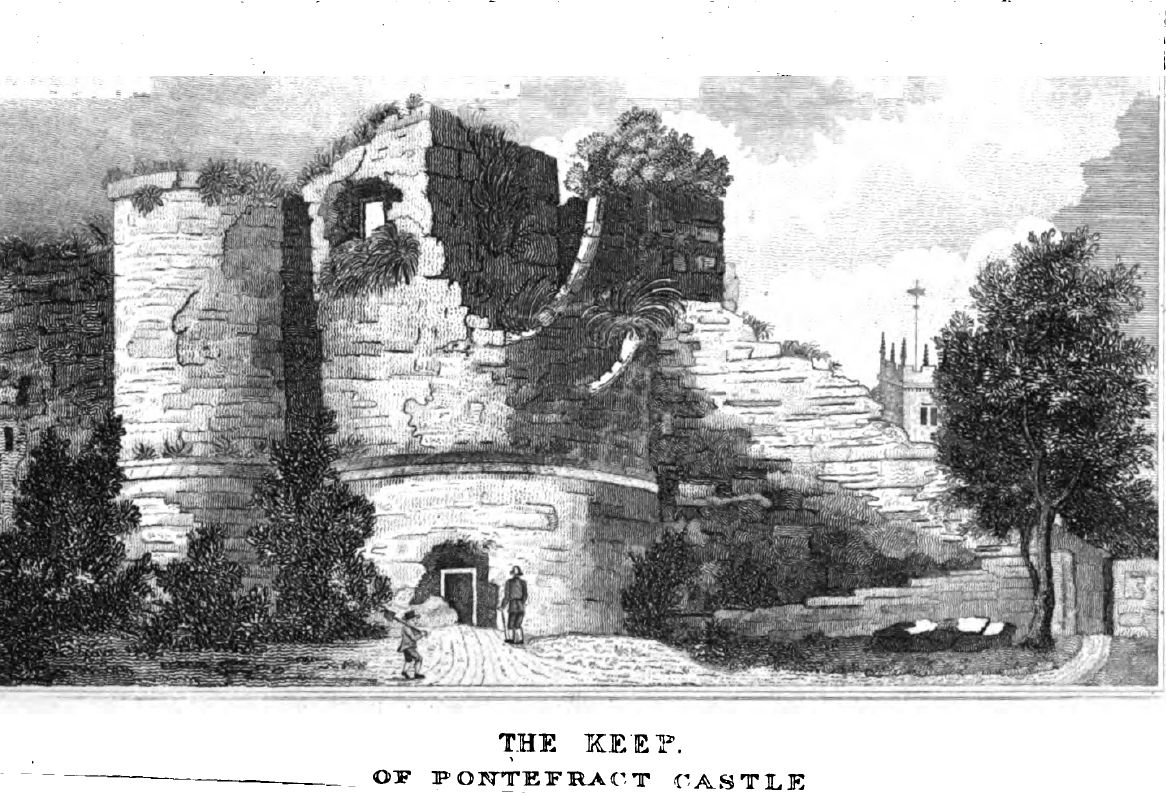
^ Pontefract keep abt 1878.
John of Gaunt [ b. 1340 d. 1399]
John of Gaunt, the fourth son of Ed.III, was given the Honour
of Pontefract by his father.
John's arms are depicted in the east window of Elland Parish Church. Elland is one of the townships within the Honour
of Pontefract.
See John
of Gaunt
DID KATHERINE SWYNFORD'S SON KILL RICHARD II?
In the same year as John of Gaunt's death, King Richard II was
murdered at Pontefract Castle. He is believed to have been starved to
death, under the orders of Henry IV, formerly Henry de Bolingbroke,
in what was later to be known as the Gascoigne Tower. The
evidence comes from Adam Usk, a contemporary chronicler, who says that Richard
II 'died miserably on the last day of February as he lay in chains.... tormented
by Sir N. Swinford with starving fare'. This latter reference is undoubtedly to
Sir Thomas Swynford, eldest son of Katherine Swynford by Sir Hugh Swynford of
Kettlethorpe, Lincolnshire.1 Starvation was
a feudal method used to avoid marks on the body which would indicate foul
play. Only the basement of the Gascoigne Tower can be seen today, and one
can imagine Richard lying there on the floor, where only wind devils now
blow the leaves around, there was much cruelty and death here.
 King
Richard II's ghost [Youtube]
King
Richard II's ghost [Youtube]
One question we might consider, did Katherine Swynford nee Roet know of any intention to debilitate King Richard II through the machinations of her legitimate son, Sir Thomas de Swynford, constable of Pontefract at the time, who ironically had been appointed by King Richard? After all, Henry of Bolingbroke, the son of her beloved John of Gaunt by Blanche was the beneficiary of such an alleged crime while Sir Thomas was rewarded with a shrieval appointment. Sir Thomas de Swynford's grandfather is traditionally said to also be named Sir Thomas who married Margaret ?Darcy. This Thomas was appointed as a sheriff of Nottingham in 1310 but appears to have been deceased by 30th May 1312. As Sir Hugh is said to have been born about 1340, it would indicate that there is either a generation missing here or Sir Hugh's birth year is incorrect. From the ipm of the grandfather Sir Thomas, Sir Hugh's brother Sir John de Swynford, who gained Spratton, Northants. by marriage, was born about 1296.
Interestingly, Thomas de Swynford's half brother, Henry
Beaufort, became a cardinal who interrogated Joan of Arc, while Hillary Roddam
Clinton can claim ancestry from Katherine Swynford as as can five former presidents
of the U.S.A.
Eventually the honour passed to the heirs of Gaunt, the three Harry's,
Henry IV [Bolingbroke], V and VI but by 1471 both Henry VI and his son
[Edward Prince of Wales] both died in the same year., 1471. This was the
end of this particular line descending from John of Gaunt.
Edward IV then succeeded a member of the 'House of York' descending
from Edward III's youngest son Edmund Duke of York. There is some question
over the legitimacy of Edward IV .

|
|
See: Pontefract: Its name, its lords, its castle (1878) |
1.Goodman, Anthony. Katherine Swynford, Lincoln Cathedral Publications, 2004, p. 20.
.

