
|
The Manor and Lordship of Wakefield
Before
the Norman Conquest
The Anglian, Wacca's
Feld later Wachefeld sometimes referred to as 'Merry Wakefield'
was the site of rural festivals or 'Wakes'.
The manor of Wakefield
is the chief place of the lordship of Wakefield which belonged
to the English King, 'Edward The Confessor' and were therefore
"terra regis". King Edward's
wife also held great swathes in Northumberland. The
Domesday Book stated that the Upper Calder Valley had in Edward
the Confessor's time been part of the manor of Wakefield.
Early Anglian settlers had penetrated to the forest of Hardwick (Sowerbyshire, now essentially the parish of Halifax) and it is recorded that in Hardwick there were three Anglian districts or graveships (Anglian : gerefe, or German : graf), these were Fixby, Rastrick and Hipperholme.16 Each one had a collector of the Lord's rents. Hardwick had its western boundary on the present Yorkshire/Lancashire border, its eastern boundary along the Salter-Hebble Brook, its northern boundary with the parish of Bradford and its southern one along the Calder and Riburn rivers. To the south of Hardwick lay the forest of Sowerbyshire.18
The forest of Hardwick or Sowerbyshire contained the following places: Halifax, Ovenden, Illingworth, Mixenden, Bradshaw, Skircoat, Warley, Sowerby, Rishworth, Luddenden, Midgley, Erringden, Heptonstall, Rottenstall (Rawtenstall), Stanfield, Cross-Stone and Langfield16. (Underlined are names of Anglian origin, others are Danish/Scandinavian ('Viking')
The later parish of Halifax
contained 26 townships* or hamlets: Barkisland, Brighouse, Elland,
Erringden,
Fixby,
Greetland, Halifax, Heptonstall, Hipperholme, Langfield, Midgley, Northowram,
Norland, Ovenden, Rastrick, Sowerby, Rishworth, Stainland, Stansfield,
Shelf, Skircoat, Soyland, Southowram, Warley and Wadsworth16.
.
*In this part of England, villages and their surroundings were known as "townships".
There is some evidence that the township of Midgley in the upper Calder
Valley was part of Miclei, the Anglian manor of Wakefield belonging
to "Edward the
Confessor" in 76119.
| Area of land in the manor of Wakefield. | "60 carucates"
or about 10,000 acres [one ox required 2 acres of pasture, one
sheep one acre] "three and a half bovates on which danegeld has
to be paid, wood pasture, 6 miles long and 4 miles broad". |
| number of ploughs | this area might employ 30 ploughs |
| priests (presbyters) | 3 |
| churches | 2 |
| Sockmen(Sokemen)# | 7 |
| Villeins | 4 |
| bordars (peasants or smallholders) | 16 |
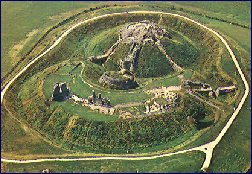 A motte (mount) and
bailey were originally built at Wakefield on the left bank
now called Lowe Hill at Thornes. This may have been built by the
second earl of Warenne before 1138. A later wooden castle of Sandal
was built by the 6th or 7th Earl Warrene from 1240 as the
headquarters for the manor on the right bank which by feudal times
(Ed. III's reign, about 1320) was a stone fortress.
A motte (mount) and
bailey were originally built at Wakefield on the left bank
now called Lowe Hill at Thornes. This may have been built by the
second earl of Warenne before 1138. A later wooden castle of Sandal
was built by the 6th or 7th Earl Warrene from 1240 as the
headquarters for the manor on the right bank which by feudal times
(Ed. III's reign, about 1320) was a stone fortress. | Name in Domesday Book | Domesday transcription in G. Crowther's A Descriptive History of the Wakefield Battles. | Comments |
| SANDALA | - | Sandal Magna near Wakefield |
| SOREBI | TORBE | Sowerby near Halifax |
| WERLA | - | Warley /Werloweley/ Warleyfeslei* Township of Warley Town. |
| FESLEI | FISBE | Werla and Feslei later formed Halifax. |
| MICLEIE | MIELEI | Midgley near Halifax |
| WADSWUURDE | WADESWIDE | Wadsworth nr. Halifax, centred on 'Old Town' |
| CRUMBETONESTUN | CRUMBETONSITON | Crutttonstall, Crompton. ceased to exist, located on Erringden Grange. |
| LANGEFELT | LANGFELD | Langfield, Longfield. |
| STANESFELT | STAINSFELT | Stansfield a township near near Heptonstall. |
| DALE | Swale | Ure | Nidder | Wharfe | Aire | Calder | Don / Dearne |
| CASTLE | Richmond | Boroughbridge | Knaresborough | Tadcaster | Leeds | Sandal Magna & Pontefract | Conisbrough |
| RELIGIOUS HOUSE | - | Fountains Abbey | - | Bolton Abbey | Kirkstall Priory | Kirklees priory
/ nunnery |
Monk Bretton Priory |
The town of Wakefield had two churches, the
parish church, All Saints, in the town and St. Helen's church
at Sandal Magna. The main streets of the town radiated from the
church with gates to the walls at Westgate, Northgate, Kirkgate and
Warrengate. Wakefield was a major centre of the wool trade, the market
place was called Bichill.
The manor of Wakefield
was one of the largest in the country and
comprised 118 towns,
villages and hamlets with Halifax, Wakefield and Dewsbury being
the chief towns. The Manor of Halifax (Feslei)was seen as "a manor
within the Wakefield Manor". The whole Manor of Wakefield stretched
over 30 English miles east-west. William I granted
to Ilbert De Laci (from Lassy, Calvados, Normandy) the nearby
Lordship of Pontefract (Pomfret) castle along with 150 manors in
the county of York as well as Clitheroe
castle.
.
|
|
These estates juxtaposed and interlocked with those of the king's land. It is believed that this was purposely done to ensure a strong hold on sparsely populated land which was strategically important e.g. the De Laci lands came close to the River Calder near Southowram & Elland and crossed the river near Huddersfield and Almondbury.
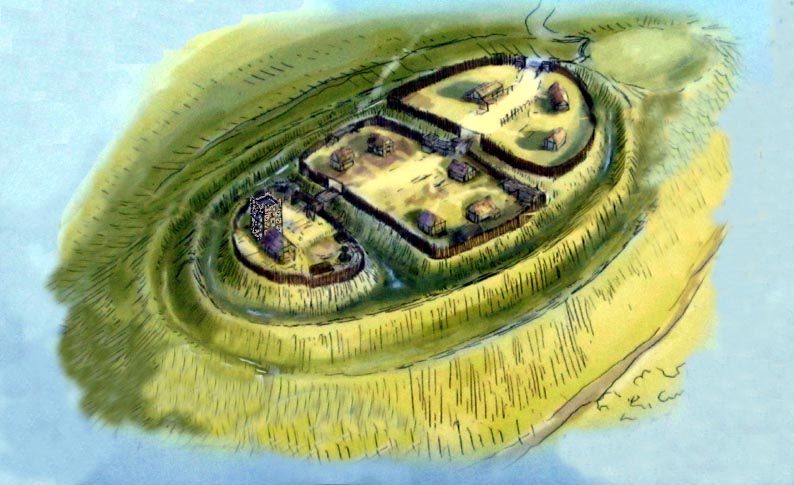 |
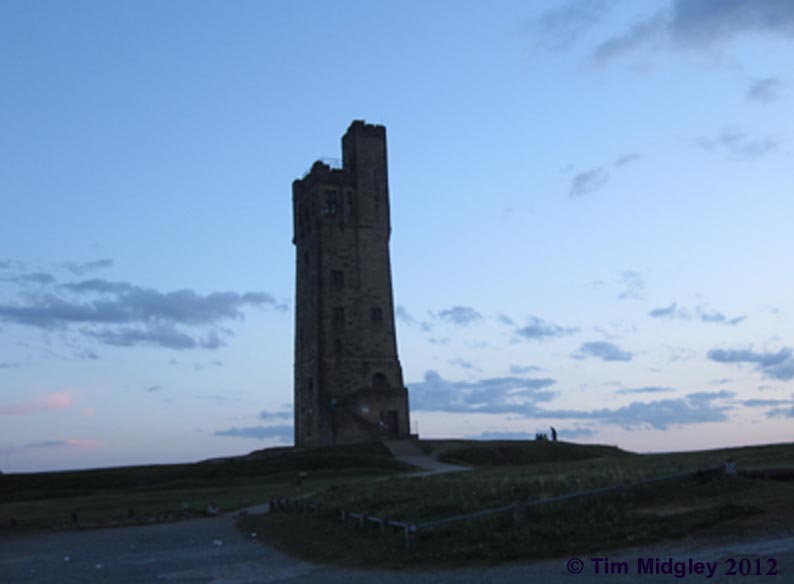
| Castle Hill Almondbury during medieval times. The medieval construction probably took place during King Stephen's reign when many illegal castles were erected, and as with many others, it was demolished during Henry III's reign. Joseph Hunter records that in 1307-8 there was a dungeon at the 'castle of Almonbury', during the later years of Henry de Laci's tenure.39 The medieval tower and motte were located where the more recent Victorian tower (below) now stands. Source: Base image by Kirklees Council on site. |
 |
The De Laci estates may have secured important roads
e.g. from York to Chester and river crossings such as at Battyeford.
The De Laci family also held the
Heptonstall area which controlled the pass
from the River Roch
across to the Hebden and Calder River as well as manors within
the crown land such as at Scissett. The Heptonstall area is one
of the earliest places for the recording of the Midgley name (1100's)
to the north of which lies the high and exposed Midgley moor on the
backbone of England, the Pennines. Later Medieval Packhorse routes
with occasional wayside crosses traversed the Pennines, one such ventured
through the Heptonstall Pass (The Long
Causeway), a strategic link across the Pennines. It was probably
built by the monks of Whalley Abbey, in the Ribble Valley, to link
lands that they held on either side of the Pennines10.
The Long Causeway connected through Halifax to the Magna Via (Highway) to Wakefield
and thence to the wool markets of Europe.
In April 1066 many
people flocked to church at the sight of what was to become known
much later as Halley's comet and on Christmas Day of 1066 William
1st was crowned the new king of England in Westminster Abbey.
In 1068 two earls,
Edwin and Morcar led a revolt against the Normans in Yorkshire.
The revolt did not succeed.
In 1069 William, as
a prelude to the 'harrying of the north' and
in retaliation for
the uprising led by the two earls, sent Ilbert de Laci to
break the inhabitants. Much of the region was destroyed.
In March 1067 William returned
to his Normandy and left England in the hands of his half-brother
Odo. The estates and titles were distributed among the Norman
barons who had backed William.
No man was given too
great a part of the land in one region, the estates being scattered
all over the country so that one baron could not combine
his estates into one
powerful, and possibly rebellious, whole. William soon found that
it was not safe to stay away from England for too long.
The barons, became
powerful and extortionate towards their subjects and quarrelsome
between themselves. They raised taxes to breaking point
until a rash of revolt
broke out across the country. William returned and, although he
recognised that much of the fault lay with his people, burned and
slaughtered his way through any resistance.
'…. Nowhere
else had William shown so
much cruelty. Shamefully he succumbed
to this vice, for he made no effort to
restrain his fury and punished the
innocent with the guilty. In his anger he
commanded that all crops and herds,
chattels and food of every kind should be
brought together and burned to ashes
with consuming fire, so that the whole
region north of the Humber might be
stripped of all means of sustenance. In
consequence so serious a scarcity was
felt in England, and so terrible a famine
fell upon the humble and defenceless
populace, that more than 100,000
Christian folk of both sexes, young and
old alike, perished of hunger.'- Orderic
Vitalis in1069
"....slaughtered
the people…it was horrible to observe in houses,
streets and roads
human corpses rotting…for no one survived to cover
them with earth, all
having perished by the sword and starvation,
or left the land of
their fathers because of hunger… between York and Durham no
village was inhabited.'-Symeon of Durham,
In 1070 Thomas, the
Treasurer of Bayeaux became the Archbishop of York. On his arrival
in this ruined city he found everything deserted and waste.
A Scottish perspective
states that every male from the Humber to the Scottish border who
was over the age of 12 years was slaughtered and the country was
turned into desert.34
The first Earl of Warenne, William, and his
wife Gundreda [of Flanders] had issue, William de Placetis who
was later granted the Wakefield estates for taking Robert Curtois
prisoner in Normandy17. Gundreda died in childbirth
in 1099 [others say May 1085 at Castle Acre, buried Lewes. The year
1085 is more likely if William founded the Cluniac priory at Castle Acre
in 1086]
Besides Castle Acre
[Norfolk] and Reigate [Surrey] this first earl held estates
in Lewes [Sussex], Conisbrough [South Yorkshire] as well as the
Wakefield Manor. In all, the earl was granted 28 towns and estates.William
the first earl died at Lewes in 1088 following a seige at Pevensey.
The succession to
the estates then passed as follows17: Click Here
William II recognised the Warenne's loyalty
during the Baron's revolt and rewarded them by giving them the
Manor of Wakefield which included Upper Calderdale. The grant was
reaffirmed in 1106 in the reign of Henry I. The Warennes built a castle
at Sandal to guard their new possessions, this was likely to have been
a wooden motte and bailey.
Either his father or the 2nd Earl granted
the Parish Church at Halifax and others to the Cluniac order
of Monks who had previously been granted a priory at the mother
house of Lewes.16 The second earl also founded another
daughter house at Castle Acre in Norfolk.36 The 2nd earl
had two children [some sources state six], William and Adeline. Adeline
married Henry de
Huntingdon [b. 1114 d 1152] Earl of Northumbria and Huntingdon.
His fifth child, David became Earl of Huntingdon. One of Henry's
grandchildren, Isabella, married a Robert de Bruis [Bruce] of Scotland,
a forebear of King Robert De Bruce. With David's death in 1219 at Yardley-Hastings
[Northamptonshire] the title Earl of Huntingdon passed to his son
John Le Scot.
With John's death
by poisoning in 1237, the Earldom was held in the crown until
Edward I's time when the title was granted to William Fiennnes
[Clinton].
Third Earl Warenne and Surrey.
[died
1148] The 3rd Earl of Surrey. He married
Adeliade Talvas [b. abt. 1110, Sussex]. They had one child, Isabel de Warenne
[b. 1137, d. 13th July 1199]. Isabel married Hamelyn Plantagenet of Conisbrough
William III de Warenne died in 1147/8, on the crusades in Palestine at Laodicia
[now in Syria]. He left no male heir.
Fourth Earl Warenne and Surrey.
Isabel, daughter of
William 3rd Earl Warenne was given in marriage to William de
Blois [by so doing he became the 4th Earl Warrene], son of King
Stephen. William de Blois died in 1159, Isabel and William had no
issue.
 Hamelyn,Fifth*
Earl Warenne and Surrey [d. 1202]
Hamelyn,Fifth*
Earl Warenne and Surrey [d. 1202]
Secondly, in 1164,
Isabel was given in marriage by Henry II to Hamelin Plantagenet,
the "natural" or illegitimate son of Jefry [Geoffrey] Plantagenet,
Earl of Anjou by whom she had issue, William Warenne or Plantagenet,
later 6th earl. Hamelin was also Henry II's illegitimate half-brother.
Hamelin assumed the titles of 5th earl Warenne and 5th earl of Surrey
through Isabel in 1163. This led to subsequent Earls of Surrey.Hamelyn
is credited with building the very early Norman stone fortifications
of Conisbrough
Castle replacing the earlier wooden motte and bailey built about
1100 and similarly at Sandal Castle.
Hamelin supported Henry II and was one of the nobles to donate to Richard
I's ransom. He attended Prince John's coronation [1199] and
the king of Scotland, William Canmore's oath of homage at Lincoln to
John and England [1200] and played host to King John at Conisbro'.
Hamelin died in 1202 and was buried at Lewes, Sussex. Isabel died in 1203 and was buried next to Hamelin at
the priory of Lewes. * As John Watson in his History
of Halifax p. 404 correctly states.
Sixth Earl Warenne and Earl of Surrey
[1240]
Hamelyn and
Isabel's son, sometimes erroneously described as the 5th earl
[because William de Blois is omitted]. This William married [1225] Maud Marshall*
by whom she had issue, John (7th Earl
Warenne). In 1204 John lost
his campaign in France, and like all the English nobles who supported
John and held land in France, the sixth earl's Normandy estates were
confiscated by Phillip II of France32. William was loyal
for a time to king John against the barons and indeed is one of only four
nobles whose name appears in the Magna Charta for John.
But by the summer of 1216 he had deserted John and was supporting an
invasion by the Dauphin, Louis of France. The sixth earl supported
Edward III and also visited the Shrine of St. James [Santiago] at Compostella,
Northern Spain.
*d. of the great knight William, The Protector, earl of Pembroke.
In 1212, Peter of Wakefield,
a prophet, foretold King John's reign would not last until 23rd
May, 1213 {Ascencion Day], when this date passed without the realisation
of such, King John had Peter and his son hanged32.
William
acted as a guarantor for King John for the keeping of the Magna
Charta32. He became warden of the Cinque Ports in 121632.
In the same year he supported France against King John32.
By 1221 he had his lands restored for he had taken
an active part in politics between 1220 and 123032.
In 1225 he married Matilda the daughter of the Earl of Pembroke [Valence line].
In 1238 he was appointed the treasurer of the Royal Taxes. Their
only son, John [later 7th Earl] was born in 1231. William died
in 124032.
John, Seventh
Earl Warenne and Earl of Surrey [1231-1304]
Sometimes
erroneously described as the 6th earl. [William de Blois is omitted
again] Because his father died when John [really a
Plantagenet through his grandfather Hamelyn] was eight or nine,
his mother Matilda [Maud Marshal] held the estates until later. He became a ward
of Henry III as a result of his father's early death. John
Warenne
7th Earl married [april 1247] Alice/Alicia de Lusignan [de Brun] d.
9th February 1255, they had a son, William and two daughters. Alice,
Henry III's half sister, took Henry III's side against the barons in
1258. John 7th earl [succeeded
1240] and supported Henry III against the rebel barons in 1258 .
However he supported the barons from 1260-3.
But again, in 1263, he returned to king Henry III when he fought
at the Siege of Rochester and the Battle of Lewes [May 1264]. He fled
to France returning to England with the future Edward I in 1265. and
freed Henry III at the Battle of Evesham34. He
was pardoned in 1268.
It was John the 7th Earl of Warenne who completed the stone castle of Sandal Magna, from 1240, making it the chief seat of the manor1 An earlier wooden motte and bailey had been built soon after the conquest. He became involved in a vitriolic land dispute with Henri de Laci of Pontefract in 1268 which spilled over in the king's court. The 7th earl was issued with a writ along with may other barons by the king, Quo warranto? [Who Holds?], in which it was demanded by what authority he held his estates.The earl is said to have drawn the first earl's sword and replied " Gladoi riri, gladio teneo, gladio tenedo" or " I gained it by the sword, I hold it by the sword, I will keep it by the sword". Both barons assembled their armies but Henry III intervened to prevent the situation leading to war. In 1270 John was criticised by the archbishop of York, for the harshness of his treatment of his Yorkshire tenants; this may have coincided with building work at Sandal and also Conisbrough . By 1282 he was styled the earl of Sussex. he assumed this title but the claim was uncertain. In 1296 John joined Edward I's invasion of Scotland where he took Dunbar Castle in April 1296. From 1296-7 he was Warden for Scotland.
John 7th earl had issue:
William de Warenne married Joan the daughter of Robert de
Vere, Earl
of Oxford, but William died at a tournament at Croydon** in the
life time of his father hence he was not created earl. He left a wife
and child, John, later 8th Earl. **This is mistakenly identified by Simon Schama with
William de Warenne a nobleman of Yorkshire mentioned by Schama
as Edward I's administrator in Scotland who suffered defeat at Stirling
Bridge in August 129721 However
Bulmer's
Gazeteer and many other sources state that this is
John de Warenne
[ 7th ] Earl of Surrey, earlier rewarded for success
at the battle of Dunbar with the wardship of Scotland.22
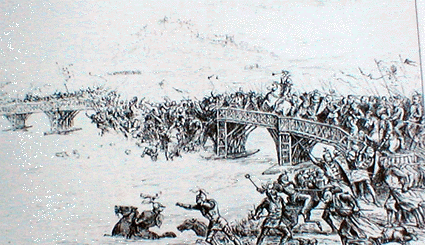
|
By 1297 [11th September]
William Wallace had routed the English army at Stirling Bridge,
but within a year John seventh earl helped Edward defeat Wallace
at Falkirk and and the Scots at Caerlaverock [1300].
Throughout their conflicts with their Southern neighbour,
every brilliant success brought the Scots a pattern of resounding defeats.
After Edward I's success at Falkirk in July 1299,
Yorkshire was called upon in the summer of 1300, to provide 5,900
fighting men to serve in the war against Scotland, by 1304 Stirling
Castle was captured and the battle with Scotland was ended for a time22.
During the time of John
7th Earl of Warenne, and in the 3rd year of Edward I's reign Alexander Lucas
was the steward for
the Wakefield manor, later that year the steward was John de Ravensfeud20.
John died in 1304 in London and was buried at Lewes.

|
John, Eighth Earl
Warenne, Earl
of Surrey and Sussex.
29
June 1286- 1347
In 1304 he had assumed the title Earl of Sussex,
which his grandfather had also titled himself. John Earl Warenne
8th, grandson of John 7th Earl,
at the age of 19, married the 10 year old Joan de Bar [Barr], grand-daughter
[some sources erroneously say daughter] to Edward I. The childless marriage was
not successful and both sued for divorce and as a result the Pope
excommunicated John. John produced many "divers
bastards" and left no lawful issue, the estate was thus transferred
to King Edward II17.
At Whitsuntide 1306 Warenne and
his countess Joan of Bar were present at Prince Edward's investiture
as a knight at Caernarvon Castle. In 1310 John joined
Edward II in an invasion of Scotland.
However in 1312 he
rebelled against Edward II . John quarrelled with Piers Gaveston,
Edward II's favourite, and joined the party of barons at Scarborough
[Knaresborough32.] in 1312, when Gaveston was taken
prisoner.
See Bulmer's Gazeteer.
But John capitulated
and was pardoned with about 300 others in 1313 after Gaveston
was murdered by the Earls of Warwick, Lancaster, Hereford and Arundel
[Beauchamp, Plantagenet, De Bohun and FitzAlan respectively] and returned
to supporting Edward II, a king unpopular with half of the people.
By 1314 John had been
proceeded against for divorce17. [others say both
parties filed for divorce] Whatever the case, the
eigth earl was living in adultery with Maud de Neirford in 1313.
In 1318 John quit
claimed the castles of Sandal and Conisbrough along with estates
at Sowerby, Dewsbury, Halifax and estates in other counties17.
At this time earl
Warenne's steward was probably John de Doncaster25.
In 1316 John 8th Earl Warenne was excommunicated for adultery by pope John XXII32
with an Isabel de Houland [Holland daughter of Lancaster's favourite]
and Matilda de Neirford17[Maud de Neirford of Castle Acre,
Norfolk]. Both produced illegitimate children. In 1317 Edward II granted
the manor to Matilda and her two natural sons by John [John and Thomas
de Warenne]. Later John 8th Earl Warenne is claimed to have married Matilda. [others mistakenly
say Isabel de Houland.]
John 8th earl Warenne had a disagreement
with Thomas the earl of Lancaster  over the death of Gaveston
some suggesting that Warenne helped Thomas's wife
to elope with her lover. However, she appears to have been a willing
captive. This dispute led to Lancaster laying siege to Sandal Castle in 1317. Lancaster
reportedly burnt Sandal to the ground, however the archaeology does not necessarily
support this.36
over the death of Gaveston
some suggesting that Warenne helped Thomas's wife
to elope with her lover. However, she appears to have been a willing
captive. This dispute led to Lancaster laying siege to Sandal Castle in 1317. Lancaster
reportedly burnt Sandal to the ground, however the archaeology does not necessarily
support this.36
Thomas had succeeded
to the lands of his father-in-law, Henry de Laci, at Henry's death
in 1311. Between 1317 and 1319 Thomas Plantagenet, Earl of Lancaster
seized much of John's land.
J.W. Walker states that at this time a Robert Hood of Wakefield
was on a roster to join the army against Scotland but apparently
did not appear.24
In the 12th year of Ed. II (1318) this John de
Warenne was forced to grant the manor to Thomas Earl of Lancaster,
probably because of Earl Warenne's infidelity and resultant ex-communication
by the Pope [remember his wife, Joan de Bar was a relative of Edward
II]. From 1320 Thomas Earl of Lancaster built a stone
castle at Sandal Magna.
Following the short tenure of the estates by Thomas,
John who had 'married' Matilda de Neirford, his concubine,
received back the estates, whilst the remainder were given to their
two sons, John de Warenne and Thomas de Warenne [both born before the
marriage].
Thus John 8th earl, Lord of Wakefield manor,
died without lawful issue in the 21st year of Ed. III* (1348)17
possibly as a result of contracting the "Black Death". This
is the same year that Joseph Hunter, the Yorkshire Antiquarian, calculated
the death at Kirklees Priory of a non-historical figure, 'Robin Hood'26, 1347 being the same year
that Sandal ended its association with Castle Acre.36,p47
Matilda (now Countess
de
Warenne
) lived until the 33rd year of Edward III (about 1360),
her two sons John and Thomas dying before her. The Wakefield Manor
reverted to the crown in 1362 and the barony and revenues were now
given by Ed. III to his six year old son Edmund de Langley/Longley
[later the Duke of York], who later died at the Battle of Agincourt (others
say his birthplace, Kings Langley). The Earldom of
Warenne
was now granted by Edward III to Richard Fitzalan II, Earl of Arundel. John
8th earl is thought to have owned the Macclesfield Psalter which was rediscovered in 2004
and with strong public support has been reconditioned and is
now on show at the FitzWilliam Museum, Cambridge.
EXPOSÉ - LANCASTER'S POSSIBLE CONCUBINE
Like John de Warenne [d. 1347] who had no legitimate children, there is some evidence that Thomas of Lancaster had at least two illegitimate sons. One was Thomas de Lancaster and the other John de Lancaster. As adults, both appear to have joined the clergy. Importantly in a papal record we are given a clue to the identity of the concubine or mistress of earl Thomas, John de Lancaster's mother. She is described as being a spinster who was related to the earl [probably numerically inaccurate] in the third degree. However, this is a very strong indication that the lady in question was from the aristocracy. After an exhaustive study of the various genealogical lines for the early Plantagenets it is evident that Alice de Warenne is a strong candidate for concubinage*, a younger and only sister of John 8th earl Warenne.* Ockham's Razor is operating here.
Alice was born on 15th June 1287 whilst earl Thomas was born about 1278. Alice's father had died on 15th December 1286 d.v.p. at the Croydon tournament, she was thus born exactly 6 months after his death. Her ancestry like that of earl Thomas is clearly Plantagenet, she having descended from Hamelin Plantagenet, half-brother of King Henry II, who assumed the name Warenne after his marriage to Isabel de Warenne. Thus Thomas and Alice's common ancestor was Geoffrey de Anjou, the progenitor of the Plantagenet line in England. Thomas earl of Lancaster had many dealings with Alice's brother John and until his falling out over the death of Gaveston in 1312 they were compatriots. After 1312 John became a king's man and joined with Edmund FitzAlan against earl Thomas. In 1322 Edmund and John were two of earl Thomas' judges at Pontefract after which Thomas was executed. Edmund FitzAlan was later also executed, like Despenser, at Hereford in 1326 probably with the assent of Mortimer and Queen Isabella. Like earl Thomas, a cult developed around Edmund in the 1390's which projected him as a martyr, although like Thomas, he was never canonised.
Alice de Warenne married in 1305 at the age of about eighteen, Edmund FitzAlan, earl of Arundel. Although it is recorded that Edmund had been made a ward of Alice's brother, John de Warenne in 1302 Edmund initially refused to marry her but the reason is not evident. Speculatively, the reason Edmund refused her was that she and earl Thomas had produced a child, John de Lancaster. This has never been suggested before and is highly contentious for Alice, as her brother's heir, with Edmund went on to produce at least nine children including Richard 'Copped Hat' [b. 1306] who led to the later FitzAlan earls of Arundel. By extension this would make John de Lancaster an older half-brother to Richard 'Copped Hat', earl of Arundel.
| Thomas earl of Lancaster |
Alice de Warenne Predicted concubine |
| A legitimate Plantagenet and potential contender for the throne. | Descended from Geoffrey de Anjou 'Planta genista' through his illegitimate son Hamelin, half-brother of King Henry II. |
| Born: ~ 1278. | Born: 1287. |
| Betrothed: 1292. | Betrothed: ~ 1304. |
| Married: Alice de Lacy on or before 28th October 1294. | Married: Edmund FitzAlan 1305. |
| A compatriot of John de Warenne in the Scottish wars of King Edward I. | Sister of John de Warenne. |
| 1312 - Rebelled against king Edward II and had Gaveston killed. | John de Warenne turned to the king after Gaveston's execution. |
| Divorced his wife in 1315 and took over earl Warenne's estates in Yorkshire 1318. | Alice's brother John and her husband Edmund were two of the judges with Hugh Despenser at Pontefract who condemned earl Thomas to death, March 1322. |
Sowerby
Park
The Earls of
Warenne
had a castle in Sowerby for hunting & hawking. In the 1800’s
remains of it could be seen in the fields12. The exact
date when the deer park at Sowerby was created is not known but
most scholars agree
that the mid 1100's
is probable. It occupied most of what became the township of
Erringden and was created out of part of the then "Forest of Sowerbyshire".
This was an enclosed park, like Wakefield park, for breeding deer.
It was ditched and paled around its entire perimeter.
The fence was kept
back from the River Calder when a strip of land approx. 100 yards
wide was created which remained part of Sowerby township and was
known as the Sowerby Ramble. One section of the fence in the
Cragg Vale valley crossed and recrossed the Elphin Brook presumably
to allow the deer access to water. The deer were probably
bred for both hunting
and for meat. The Earl Warrene also had a large vaccary
or cattle farm here. The Lord's keeper of the park lived in the
forest. The Earl received 100 shillings per annum from tenants in
the Sowerby manor to send pigs into the wood for food19.
Surnames such as, Hunter and Forrester appeared in the 1300's. The chief
forester for the forest of Sowerby in 1275 was John de Miggeley who resided at Hathershelf, now a farm
west of Sowerby.
 In 1313 it is recorded that the 8th earl, John de Warenne had a
garden at Sowerby.40
In 1313 it is recorded that the 8th earl, John de Warenne had a
garden at Sowerby.40
On the first year of entry 1274, for the
Wakefield Manor
Court Rolls a John de Miggeley (sic) is fined 12 pence for calling
another man a usurer.
Perhaps the same John de Miggeley on 22nd
November 1274 (Ed I) was made surety for a man who helped to eat
a stag, stolen from the forest of Sowerby19. Even Sir
Richard de Thornhill was charged in the same year with hunting the
Earls stags at Sowerby, he was later pardoned. In the same year John de
Miggeley, the forester of Sowerbyshire [the forest of
Hardwick] was residing at Hathershelf now located by
Hatheshelf Lane east of Sowerby.
In 1296 a John de Midgley was fined two shillings for
carrying away the Earl of
Warenne's timber19.
At a criminal court
(Tourn) in 1307 one juryman was Adam de
Midgley. Jurymen were usually trusted community members.
In 1313 Adam at Townend, Midgley was mentioned in the Wakefield
Court Rolls regarding a tree from the Lord's forest needed to repair
a house19.
On October 18th 1314,
in a court at Halifax, a John de Miggelay
was charged with receiving two oaks worth ten shillings to repair
a chapel and kitchen built by the earl's grandfather. Not having
completed the work he had to pay twenty shillings19.
By the late 1300's
the fencing for Sowerby Park was in disrepair and it was said
that the park held as many sheep as deer, this could have been the
result of demands being made by Edward I on the manpower in Yorkshire
for the fight against Scotland22.
About 1332, Edward
Baliol resided at Sandal Castle with John 8th Earl Warenne whilst
an army was raised to establish him on the throne of Scotland. Edward
was the son of John Baliol (1249-1315) who had competed with Robert
de Bruce for the Scottish throne. Edward I decided in John Baliol's
favour but John only reigned four years before Edward deposed him,
eventually banishing him to Normandy.
John's son Edward
Baliol recovered his fathers kingdom in 1332 and was upheld by
Edward III whilst very unpopular for having relinquished south
Scotland to England.
In 1336 John 8th Earl
Warenne was created Earl of Strathearn by Edward Baliol,
king of Scotland as a reward for his help.
In 1449 during the
reign of Henry VI when Richard Duke of York was Lord of the Manor,
the park was dispaled and the land rented out for farming.
Following the removal
of the fence, Erringden became a separate township but the strip
around the perimeter known as the Sowerby Ramble still remained
part of Sowerby township.
The boundary of Sowerby
Ramble was marked with large stones in which was carved a letter
S and many of these stones still survive. About the middle of
the last century Sowerby Ramble was absorbed by Erringden.
Sowerby Ramble can
still be found on older maps. There is some speculation regarding
the eastern boundary of the park. It is generally shown as following
Elphin Brook before crossing the stream at Mytholmroyd but there
is evidence to suggest that a substantial area within Sowerby township
in the Hall Lane area lies to the east of the stream. This area
is located at the end of the old road from Sowerby township and could
well have been a rendezvous and camp site for hunting parties.
The survival of some
of the S marked boundary stones around this area support this
theory13.
 In 1138 The Battle Of The Standard was
fought near Northallerton between King David
of Scotland and The English under Geoffrey of Anjou, the Scots
were defeated but in the negotiations which followed David gained
almost the whole of Northumberland.1 In this year Earl
Warenne died (probably at Northallerton) and willed the church at Halifax
to the monks (O.E. munuc) of Lewes in Sussex where he held his seat
at Reigate Castle.
In 1138 The Battle Of The Standard was
fought near Northallerton between King David
of Scotland and The English under Geoffrey of Anjou, the Scots
were defeated but in the negotiations which followed David gained
almost the whole of Northumberland.1 In this year Earl
Warenne died (probably at Northallerton) and willed the church at Halifax
to the monks (O.E. munuc) of Lewes in Sussex where he held his seat
at Reigate Castle.
 The Lordship and manor
of Wakefield included almost the whole of the Calder Valley from
Normanton through Wakefield, Dewsbury and Halifax to the borders
of Lancashire. The estates remained in the Warenne's hands for eight
generations, about 300 years, until the last legitimate male heir,
John 8th Earl de Warenne , died in 1347.
The Lordship and manor
of Wakefield included almost the whole of the Calder Valley from
Normanton through Wakefield, Dewsbury and Halifax to the borders
of Lancashire. The estates remained in the Warenne's hands for eight
generations, about 300 years, until the last legitimate male heir,
John 8th Earl de Warenne , died in 1347.
In 1340 at Wakefield the Chantry Chapel of
St. Mary was built on the old Wakefield Bridge and is
one of the only four still surviving in England. The great pestilence reached European countries
from Asia and spread right across Europe reaching England in 1349.
It spread desolation everywhere.
Consternation reigned
for some months-rents were uncollected; courts suspended in several Yorkshire manors; half the
priests died; the poorest suffered more severely. This terrible
Black Death was succeeded in 1379 by another plague in Airedale.
The population was never lower in number or prosperity than at this
time, and the subsidies imposed by the king and his parliaments
were outrageously heavy.
We are able to give
two of these, and thus discover the names of the wealthier men
residing here in those dark days, but the most interesting list
is afforded by the Poll Tax fifty years later. These heavy burdens
were then extended to every householder and person of sixteen years
of age, except the clergy and slaves. The insolent and exacting manner in which they
were collected roused Wat Tyler
and others to rebellion, they were branded as 'Roberdsmen'. A silver
groat (4d.) was equal to 10s. of our money probably, and where there
were two or three children over 16 to pay for it was insupportable."3
| "We are historians we believe no one" |
In 1311 Thomas and fellow Ordainers banished
Gaveston and when he returned to England, had him killed in 1312.
Thomas was eventually forgiven by Edward II for he too was a Plantagenet,
receiving the king's full pardon in October 1313..
Later in 1313 Thomas
refused to accompany Edward II on campaign in Scotland and after
Bannockburn in 1314 rested control of England from Edward III32
In 1318 the king and
Thomas reconciled once again and campaigned together in Scotland,
but they failed to regain Berwick from the Scots. Many towns suspected
Thomas of conniving with Scotland and King Robert Bruce I to further
his own political ends.
In 1321 Thomas led
a force to London and made Edward II dismiss the Despencers [father
& son]
As a result of Edward
II's failures, in 1321 and again in 1322 Lancaster attempted
to call a parliament at Doncaster but to no avail. Consequently,
in March 1322 Lancaster mounted a rebellion. However the
barons were not as united as they had been in Edward I's reign and
Thomas's army which marched north to join with Robert the Bruce's army
on the 15th of March 1322 had only travelled 50 miles when it was
defeated by the king's forces at Boroughbridge. [Burton-on-Trent according
to Hallam but then she or her sources appear incorrect on a number
of issues regarding the Warennes 32]
Thomas had been ambushed
by Sir Andrew Harclay and his bowmen, showers of arrows had scattered
the knights, cavalry and footsoldiers.
Lancaster took refuge
in a local chapel but the army took him from the altar steps
to York and then back to his seat at Pontefract Castle.
Following the battle
John regained some of his estates, he recovered the remainder in
1326 when he supported Edward II during Isabella's invasion. In 1327
when Edward II was forced to abdicate, John made his peace with
Isabella32.
Bitter rivalry must have existed between the
De Laci family of Pontefract and the Warennes at Conisbrough and Reigate in
the early 1300's.
Alice the Countess
of Lancaster (of the De Laci line) was abducted forcibly from her
husband's castle at Pontefract whilst he was still alive, by the
Earl Warenne of Conisbrough, probably with the connivance of Edward
II, Edward was much despised by noble and commoner alike.
She was taken to the
Warennes Castle at Reigate in Surrey. This gave rise to a private
war between the houses of Lancaster and Warenne.
Later, as already stated, Alice's husband
Thomas Earl of Lancaster surrendered to Edward II at Boroughbridge
and was tried at Pontefract and beheaded outside the castle walls
for treason on the 23rd March 1322.
One of the judges
at Lancaster's trial
at Pontefract was John Earl Warenne, to whom Edward II returned
Sandal Castle and manor.
A fellow Yorkshire
baron, Robert de Clifford of Skipton was hung in chains in York
Castle tower. The people determined Thomas was a martyr and called
him "St. Thomas", declaring miracles at his tomb and "St. Thomas" as
a watchword for liberty. All the estates of the Earl of Cumberland including
the former De Laci estates were forfeited to the crown5.
At about this time
John de Warenne began rebuilding Sandal Castle in stone (the ruins
seen today), being the last castle built in England which included
a state-of-the-art defence system.
It was at this time
that many of Thomas's followers were outlawed and fled to forests
such as Barnsdale, and may be the time when a person of these "Contrariants"
called Robertus
Hode of Wakefield appeared as a leader against the king14.
SEE: STEWARDS OF WAKEFIELD MANOR.
A Thomas de Midgley of Halifax appears associated with the Stansfield family of Stansfield Hall, Todmorden when his daughter Agnes married Edmund de Stansfield. This marriage is estimated from other associated genealogies to have occurred in the first half of the 1300's. Thomas may be the progenitor of family lines of Midgleys, spreading out from Halifax and surrounding areas into The West Riding. Stansfeld (Stansfield) is claimed to have been granted to the Norman, Wyan Maryons (created Lord Stansfield) a follower of earl Warenne, by King William I early after the conquest.
From 1348 to 1349 about half the population of England died from "The Black Death" or great pestilence, some villages were wiped out altogether. It took another 200 years for the population to rise to that of 13481
In 1371 during the 45th year of King Edward III's reign the Wakefield Manor Court Rolls record that John de Midgley was the Constable for Midgley. This may be the same John Midgley who in a return was said to have the occupation of a "cisor" or woollen cloth maker19. Being elected a constable would be a trusted position for a person of some standing in the community who would keep law & order.
In 1381 a Poll Tax was taken and gives details for The West Riding inhabitants. As a result of this tax there was a revolt which "set the country ablaze from coast to coast"
From Yorkshire Dictionary 1822:
Wakefield and Sandal
In 1460, a bloody
battle was fought at this place between Richard,
Duke of York, and
Margaret, [Lancastrian] the Queen of Henry VI. The Duke
had not been in his Castle of Sandal with his men, more than two
days before the Queen approached, at the head of 18,000 men [some
say 20,000], and much sooner than the Duke expected.
[Richard Duke of York
had declared himself king and entered Sandal Castle on December
21st with a force estimated to be around 3000 to 5000 men]
She appeared before
the Castle with a small party of her army,
and tauntingly
upbraided him with being afraid to face a woman. Her insults
repeated, the Duke could refrain no longer, but four days after
his arrival,drew up his men upon the Green facing Wakefield, and
after marching a little way down the hill, the battle began.
It should seem
that two detachments were sent to lie in ambush to attack the
Duke in the rear. It is, however, certain that the Duke was
deceived in the number of the Queen's troops.
The ambush parties
were commanded by the Earl of Wiltshire, and Lord Clifford.
These two parties attacking the Duke on the right and left at the
same moment, quickly surrounded him. The battle lasted half
an hour, and it is probable that the Duke was killed, about 400
yards from the Castle, by Clifford who had sworn destruction to every
member of the House of York. He, however, cut off the Duke's
head when slain, placed on it a paper crown, and carried it on a pole
to the Queen, who, rejoicing as much as himself, caused it to be placed
on the walls of York. In this fatal conflict fell Sir John and
Sir Hugh Mortimer, the Duke's uncles, Sir David Hall, Sir Hugh Hastings,
Sir Thomas Neville, and about 2800 men. The Earl of Salisbury,
Sir Richard Limbric, and others, were taken prisoners and beheaded,
and their heads placed on Micklegate Bar, York. --Hall --Holingshed
--Rapin.
The Earl of Rutland [Edmund, Richard
of York's son], a child of 12 years old, probably remained
in the Castle with his tutor, Mr. Aspell; but when the battle was
lost, he fled for safety, without knowing wither to fly. The
savage Clifford had intelligence; in a fright the child ran into the
house of an old woman, near the bridge, begging protection, which
the woman durst not grant. He then hastened down a footpath,
by the river side; the furious Clifford overtook him and his tutor.
The child fell on his knees, wrung his hands, but could not speak.
The tutor begged for mercy to the child, but the monster, with more than
savage ferocity, stabbed him to the heart. The place where he
fell is called The Fallings.
[Edmund's head, as
with his father's was placed on the walls of York]
Edward IV. in commemoration of this battle,
erected a beautiful
little Chapel upon
the bridge, in which, two priests sung requiems for the souls
of the slain. The Chapel is ten yards long, and six yards
wide. One end of the building constitutes part of the bridge.
It is three stories high, and has nine rooms, three on each floor.
On the outside is curious Gothic work, but some of it is gone to decay.
The front is divided into compartments, with arches in relief; their
spandrils are richly flowered, and over each compartment, are five
shorter ones, with historical relics.
In one is a woman
reclined, lamenting a youth, who, at her feet, sits wringing his
hands: this is probably the Earl of Rutland, begging
protection of the
old woman at the foot of the bridge. The buttresses are beautifully
carved, the windows have a rich tracery, and the whole has a charming
effect. Since the priests left it, the place has often changed
its use. --Hutton.
 John
the deputy steward had at least two children, John
Midgley the younger [d. 1669] and Mary. Mary married
John Murgatroyd of East Riddlesden and Hollins [aka
Murgatroyd], Luddenden. John Murgatroyd was an
older brother of Thomas Murgatroyd of Kershaw House,
Luddenden. John who died in 1669 had a son , Josias
[Of Headley Hall, lord of Thornton]. In
1695 Mr. Josias Midgley of Headley subscribed 3 pounds
with others to purchase the vicarage house in
Goodmansend.41 Midgleyana also
tells us that in 1715 the whole of the Headley estate
together with the manor of Thornton was sold by Josias
Midgley to John Cockcroft, a Bradford attorney who had
married Ann Ferrand. Following the enclosure acts
which enclosed the moors and wastelands in 1771 the
manor was dispersed. Records show that one of the
largest freeholders of an enclosure allotment was made
to a Miss Midgley. Some say that Josias [d. 1718] was
the last Lord Midgley of the manor of Thornton but
technically it was Josias' son, the armigerous William
Midgley, the curate of Sowerby who died of the 'palsie'
[paralysis], predeceasing his father in 1706.
John
the deputy steward had at least two children, John
Midgley the younger [d. 1669] and Mary. Mary married
John Murgatroyd of East Riddlesden and Hollins [aka
Murgatroyd], Luddenden. John Murgatroyd was an
older brother of Thomas Murgatroyd of Kershaw House,
Luddenden. John who died in 1669 had a son , Josias
[Of Headley Hall, lord of Thornton]. In
1695 Mr. Josias Midgley of Headley subscribed 3 pounds
with others to purchase the vicarage house in
Goodmansend.41 Midgleyana also
tells us that in 1715 the whole of the Headley estate
together with the manor of Thornton was sold by Josias
Midgley to John Cockcroft, a Bradford attorney who had
married Ann Ferrand. Following the enclosure acts
which enclosed the moors and wastelands in 1771 the
manor was dispersed. Records show that one of the
largest freeholders of an enclosure allotment was made
to a Miss Midgley. Some say that Josias [d. 1718] was
the last Lord Midgley of the manor of Thornton but
technically it was Josias' son, the armigerous William
Midgley, the curate of Sowerby who died of the 'palsie'
[paralysis], predeceasing his father in 1706.
William's 'Coat of Arms appear in Halifax Parish Church cut on a blue stone within a raised border, painted over, and fixed to the north wall of the Rokeby Chapel. This lies beneath the second window from the west where are found the arms in memory of Mary Midgley, who died 7th November 1704, daughter of William Midgley, M.A., curate of Sowerby, who died on 10th May, 1706, and according to Watson, late of Headley near Thornton, Bradford. William the Curate is also described as "Mr. William Midgley the minister at Sowerby who died on the 7th May 1706 aged about 30 of the "palsie" (paralysis). [Dickenson's Register-burials.]
AN ATTORNEY IN BRADFORD
William had at least three children, John of Scholesmoor and Horton, an attorney [b~1675, d. 1730.] and Mary and Martha who both died young. John of Scholesmoor etc. carried the arms sable, two bars gemels argent, on a chief argent, three calraps sable and married Bathsheba Hollins. John James pointed out that "there is a handsome mural monument of marble, bearing the above arms, and those of Hollings, at the east end of the north aisle of Bradford Church, to the memmory (sic) of John Midgley of Scolemore, gentleman, who died 23rd of June, 1730, aged 55 years, and of Bathsheba his wife, daughter of John Hollings of Crossley-hall, who died August 29, 1736, aged 49. From the words (in the Latin inscription" 'Juris et Legum peritium' I infer he was an attorney."42
About 1695 Dr. Samuel Midgley (son of William Midgley who was buried 21st August 1695) wrote a history book "Hallifax and its Gibbett Law Placed in a True Light" Samuel was a man of letters, who practised "Physic" in Halifax for a long time, but he was imprisoned for debt in York Castle in 1684. He was incarcerated in Halifax jail three times for debt and on his last sojourn in order to help pay his debts he wrote his treatise and thereafter, shortly died in jail on the 18th of July 1695 and was buried at Coley Chapel aged 66. A William Bentley assumed the authorship as a result of Samuel's untimely death and had it published under his own name.
 HOME
BACK TO TOP
HOME
BACK TO TOP Sources:
1. Rayner R.M., A Concise
History of Britain, p97, 1934
2. Topographical
Dictionary of Yorkshire, Wakefield 1822.
3. History
of Bingley
4. Bedingfield
Henry, Heraldry, Bison Group
1993
5. Pratt Rev. C.T.,
History of Cawthorne, 1881.
6. The History
of the Principal Cities &Towns of Yorkshire
7. Banks, W.S., Walks
in Yorkshire, Wakefield and Neighbourhood, Longmans, London.
8. Waller B., Wakefield,
Field & Innes.
9. I.G.I.
- The International Genealogical Index 1994 version.
10. The Dalesman,
February 1976 p.870
11. Relics of the
Ancient Mother tongue The Dalesman, December 1976,p.709
12. A Dictionary
of Place Names, West Riding,
Halifax, 1822.
13. Calderdale
Family History Society.
14.Phillips G. & Keatman M. Robin Hood The Man behind the Myth, 1995.quoting Joseph
Hunter.
15. Taylor Thomas. The
History of Wakefield, The
Rectory Manor, 1886.
16. Thomas
Baines,Yorkshire Past and Present.
17. Crowther G.,
A Descriptive History of the Wakefield Battles.
18. Watson's Halifax,
1775.
19. Midgley, John Franklin. Midgleyana, . LMills
Litho Pty Ltd. Cape Town, South
Africa, 1968, taken from Wakefield Court
Rolls.
20. The Wakefield
Court Rolls for 1274-97
21. Schama, Simon. A
History of Britain, BBC Publications, 2000.
22.
Bulmer's
Gazeteer for 1892,
A History of Yorkshire.
23. The Yorkshire
Dictionary-GENUKI
24. Walker, J.W. The True History
of Robin Hood, 1952.
25. Harris, P.V. The Truth about Robin
Hood, 1951.
26. Hunter, Joseph. The Ballad Hero:Robin
Hood, London, 1852.
27. Walker, Sheridan, Sue; Wakefield
Court Rolls vol. III, 1331-3, Yorkshire Archaeological
Society, Leeds, 1982.
28. The Bradford
Antiquary, issue 4, 1989. pp. 44-52.
29. Andrews, Allen. Kings
& Queens of England & Scotland, Times Media, 2000.
30. Faull, M. L., & Stinson, M. (Eds.), Domesday Book For the County of Yorkshire,
Phillimore, Chichester,1986.
31. Early Yorkshire
Charters, Y.A.S. Record Series, viii, 2-5 & 238-241
32. Hallam, Elizabeth [Ed.], The Plantagenet Encyclopaedia, Tiger Books, London, 1996.
34. MacDonald, Micheil. The Clans of Scotland, Brian Trodd, London, 1991.
35. Planche, J.R. The
Conqueror and His Companions, Tinsley Bros., London, 1874.
36. Butler, Lawrence. Sandal Castle Wakefield. Wakefield Historical Publications, 1991.
37. Watson, John. The History and Antiquities of Halifax.
1775.
38. Midgley,
Samuel. History of Halifax, 1789, p. 71.
39. Hunter, Joseph. South Yorkshire, vol. ii. p. 424.
40. Wakefield Court Rolls 1313-1316, p. 144.
41. James, John. History of Bradford and its Parish, (1866) . p. 205.
42. Ibid., p, 331, footnote.
