The Kirklees Connection - A HOAX
And dyde pore men moch good1
Kyrkely, Kirkly, Kyrkesly, Kirkleahs, Kyrkesley, Church Lee, Churchlee, Church-lees, Churchlees9, Kirklees, the clearing with a church.
'Kyrkely' of the Robyn Hode ballad A Lytell Geste of Robyn Hode has long been thought to be Kirklees in West Yorkshire. The ballad collector Child in fact used 'Kyrkesly' and 'Kirklees' interchangably without any corroborating evidence. There is good reason to doubt this connection.
At Kirklees lies the site of an early Anglian church and a later priory or "nunnery". Kirklees as it is known today was situated in the what was the western division of the manor of Wakefield. In later embellishments to the tales Robin Hood allegedly shot his arrow from the nunnery's gatehouse window, just before his death, the arrow's resting place being also that of Robin's2. This fanciful tale helped to build a mountain on an already doubtful foundation. If Robin had loosed the arrow from the priory gatehouse, then the grave should be further north. The present grave site is some 650 yards11 away which is believed to be far too distant for a longbow shot, especially uphill. Pointedly, some have claimed an upper limit of 200 yards for the flight of an arrow from a longbow. If the hilltop had been cleared at the time of interment then the grave would have had a commanding position looking eastwards into Calderdale and this is probably the reason why it is so located, not because of an apochryphal tale, requiring an as yet, unimaginably powerful longbow.

 |
| Key: A = Nunnery Gatehouse [mostly Tudor] B = Former nunnery cemetery C = Iron Age fort D = 'Robin Hood's Grave' |
This indicates that the presently accepted burial site on the ridge was deliberately chosen for its vista and position rather than being chosen by an arbitrary and impossible bow shot. The nearby earthwork as described on Ordnance Survey maps has been suggested by some as the site of a "Roman encampment". However, little evidence substantiates this assertion. It does not appear as a site on the O.S. map of Roman Britain nor early Anglian times and is therefore more likely to be the site of a pre-Roman British [Iron Age] encampment situated in an elevated position guarding the entry to the upper Calder valley. In this case it is likely that the inhabitants would have been able to communicate with the British encampment at Castle Hill near Almondbury. The site of this so called Tower Hill would bear suitable archaeological excavation in its own right, as has occurred at Castle Hill.
In relation to the supposed site of the ballad hero's burial,
"In 1795 The late Sir Samuel Armytage, owner of the premises caused
the ground to be dug a yard deep and found that it had never been
disturbed"4. It could be argued that perhaps the stone
had been removed from an original site nearby. This would appear to
solve the arrow distance problem as well as the lack of any skeletal
remains and gives greater prominence to the siting of the supposed
grave. However, the lack of evidence for a body renders the Corpus
delicti of low quality.
The proximity to the grave of the pre-1815 "Kings Highway",
now a track, was mentioned in Grafton's Chronicle of 1562:
| "The prioresse of the same place caused him to be buried by the highway-side where he used to rob and spoyle those that passed that way." |
Grafton (1562) also states:
| "And upon his grave the sayd prioresse did lay a very fayre stone, wherein the names of Robert Hood, William of Goldsborough and others were graven. And the cause why she buryed him there was for the common passengers and travailers knowing and seeying him there buryed might more safely and without fear take their jorneys that way, which they durst not do in the life of the sayd outlawes. And at eyther end of the sayd tombe was erected a crosse of stone, which is to be seene there at this present" |
However this seems confounded later by the following in Camden's
Britannica, 1607 7 :
| "At Kirklees nunnery Robin Hood's tomb with a plain cross on a flat stone is shown in the cemetery. In the ground at a little distance by two grave stones, one which has the inscription for Elizabeth de Staynton, prioress there" |
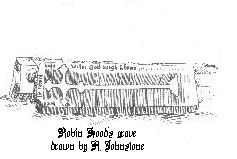
In 1665 almost 100 years after Grafton had recorded his comments, Dr.
Nathaniel Johnston3 made a drawing at Kirklees in which the
Robin Hood grave slab bore an inscription which was much weathered by
the doctor's time:
| "Here lie roberd hude, Willm Gold burgh*, Thoms..."-------- |
 Note that the crosslets on the Armitage Coat of Arms appear
to be taken from the purported grave slab of Robert Hude. That Elizabeth
de Stainton's grave is now in the priory garden there is no doubt, so
was one of the graves moved? Certainly they now are separated and it is
unlikely that an outlaw's grave would be included in consecrated ground.
The ridge position for the present site of Robin's supposed grave is set
amongst other gravestones, perhaps this is a later cemetery for the
laity who died at Kirklees priory and were buried either side of the
roadway. We can perhaps exclude the Armitage family using this cemetery
as they appear to have had their vault at St. Peter's, Hartshead. There
is a definite need for a grave site map and list. Steven Hill's
grandfather worked on the Kirklees estate as a tenant farmer and left
letters which described how he ploughed a field and turned up some bones
at the lower end of this field. Sir George, the owner at the time,
indicated this could have been the site of a cemetery. Steven describes
this site as being in the field just below the wood before The Three
Nuns. Barbara Green states that part of a stone cross originally
described as being part of the grave of Robin Hood may be found in the
cemetery of St. Peter's, Hartshead and that the grave may have been
moved during the English Civil War.7 By the 1800's the grave
slab [on the ridge?] had been cut off by railway workers and later in
the century the grave was excavated [by Sir Samuel Armytage7]
but nothing was found. An iron railing fence on a low brick wall was
placed around the grave site on the ridge by Sir George Armytage. There
are numerous other stone crosses, empty stone coffins and sarcophogi on
the same hillside, nothing has been done to catalogue or conserve them7.
Note that the crosslets on the Armitage Coat of Arms appear
to be taken from the purported grave slab of Robert Hude. That Elizabeth
de Stainton's grave is now in the priory garden there is no doubt, so
was one of the graves moved? Certainly they now are separated and it is
unlikely that an outlaw's grave would be included in consecrated ground.
The ridge position for the present site of Robin's supposed grave is set
amongst other gravestones, perhaps this is a later cemetery for the
laity who died at Kirklees priory and were buried either side of the
roadway. We can perhaps exclude the Armitage family using this cemetery
as they appear to have had their vault at St. Peter's, Hartshead. There
is a definite need for a grave site map and list. Steven Hill's
grandfather worked on the Kirklees estate as a tenant farmer and left
letters which described how he ploughed a field and turned up some bones
at the lower end of this field. Sir George, the owner at the time,
indicated this could have been the site of a cemetery. Steven describes
this site as being in the field just below the wood before The Three
Nuns. Barbara Green states that part of a stone cross originally
described as being part of the grave of Robin Hood may be found in the
cemetery of St. Peter's, Hartshead and that the grave may have been
moved during the English Civil War.7 By the 1800's the grave
slab [on the ridge?] had been cut off by railway workers and later in
the century the grave was excavated [by Sir Samuel Armytage7]
but nothing was found. An iron railing fence on a low brick wall was
placed around the grave site on the ridge by Sir George Armytage. There
are numerous other stone crosses, empty stone coffins and sarcophogi on
the same hillside, nothing has been done to catalogue or conserve them7.
Three side-linked maps of Kirklees from 1855:
Map 1
Map 2
Map 3 [detail]


![Map 3 [detail]](https://www.midgleywebpages.com/kirkleeslge.gif)
Repair and conserve the site:

The site of the 1800's edifice purported to be Robin Hood's grave is shown on the map at + The grave site lies between 200'-250' above sea level near the S.E. end of a spur or ridge of land. This spur has been given a very steep S.W. slope by the lateral N.E. migration of the river Calder. This steep slope, a formidable six foot wall, almost impenetrable undergrowth and wooded cover have frequently sheltered the site from the ravages of historic invaders, plunderers and later, cultists and souvenir hunters.
In an effort to protect such a precious site, the present owner, Margarete Armytage has maintained until now a stoical resistance towards the invasion of tourists and other interested parties, although as the owner who runs the estate as an agricultural business, she states that visits may be granted by appointment only. The state of the grave in recent times would indicate that it requires some urgent repair work.
Perhaps a more fitting investigation may be
caried out by archaeological excavation of the priory and its
foundations in order to determine, without preconception, the history
and function of this relatively undisturbed former religious site. On
the death of her husband, Lady Armytage sold Kirklees Hall in 1983 which
now forms luxury residential units. Her new residence is on the site of
the priory and garden. Elizabeth de Staynton's grave is now in the
residence garden6. This "new site" is approximately
where the original Armytage residence at Kirklees was established in
Elizabeth I's time [Baines-see below]. The
original priory cloister, church, garden and consecrated cemetery were
situated on the north side of Nun Brook. Any archaeological study is
likely to reveal more about the legend of Kirklees as the death place of
Robin Hood, rather than the area being used by local entrepreneurs
trying to make money from tourism or even, God forbid, a Theme Park.
Please leave the theme parks in Nottingham !
KIRKLEES HALL [Description from Baine's Directory of the County of York 1823]:
| "The seat of Sir George Armitage [Armytage], Bart.
in the township of Hartishead [Hartshead] with Clifton. This place is memorable, on account of a Nunnery founded here in the reign of Henry II. for Benedictine Nuns. After the dissolution, the site and demesnes about the house, were granted to the Ramsdens. In the 1st of Elizabeth [1558], it became the property of the Pilkintons [Pilkingtons], and in the 8th of the same reign [1564], was alienated by Robert Pilkinton to John Armitage, and in this family it has continued to the present day. The site of the Priory appears to have been inhabited by the family during the rest of Elizabeth's reign, and an uncertain portion of that of King James [1603-1625], when, as appears from his arms in the hall, they removed to their present more airy and conspicuous situation. The situation of this Nunnery was in a warm and fertile bottom, on the verge of a deep brook to the south, and on an elevation just sufficient to protect the house from inundations. A square depression in the ground distinctly marks the cloister court, nearly thirty yards square. North of this was the body of the Church, and eighteen yards or thereabouts, to the east, are the tombs of Elizabeth de Stainton, and another protected by iron rails, immediately eastward from which, the choir has evidently terminated. The nave, transept, and choir, must have been at least 150 feet long. Kirklees is also famous for being the sepulture of the renowned Robin Hood, an out law and free booter, who lived in the beginning of the thirteenth century, and who, according to tradition, was suffered to bleed to death by one of the Nuns, to whom he had applied to be bled. The spot pointed out for the place of his interment, is beyond the precinct of the Nunnery, and therefore not in consecrated ground. --Whitaker's Loidis et Elmete. The following inscription over his remains, preserved by Dr. Gale, Dean of York, Thoresby says, was "scarce legible," and Dr. Whitaker seems to think spurious: [various authors state anywhere from 1500's-1700's- T.M.]
Font size 8 type other sources. A statue of this renowned free booter, large as life, leaning on his unbent bow, with a quiver of arrows and a sword by his side, formerly stood on one side of the entrance into the old hall. " Does anyone have any knowledge of the whereabouts of this statue? See Guest book on the main page |
 |
The date from the epitaph above puts the death date in Henry III's
time. The oldest reference to the above epitaph comes from Martin
Parker in 16318 who apparently saw it and gave it a death
date in the time of Richard I.
Parker gave the following rendition:
| "Decembris quarto die 1198, anno regni Richardii primi
9 Robert, Earl of Huntington lies underneath this little stone No archer was like him so good, His wildness named him Robin Hood, Full thirteeen years and something more, these northern parts he vexed sore Such outlaws as he and his men, may England never know again" |
The similarity to the epitaph stone now in the brick wall of the
"Robin Hood" grave on the ridge is strong, which may indicate
that the present epitaph may be a copy of this apparently earlier
version. The reference to Robin Hood being the 'Earl of Huntington' is
taken straight out of Anthony Munday's plays, there is no evidence that
the ballad hero was such, it being a later embellishment of the story.
Was the ballad hero buried here?
English folklore is an extremely colourful if misinformative portrayal
of historical events. One might surmise that the hero is purely a
character of The Geste, the imaginings of the ballad-muse based
on [a] real-life inspiration[s]. The Kirklees connection in the Geste
with Barnsdale seems incongruous. This connection is made in the later
verses of the ballad and is likely to have been added as an after
thought, perhaps by a different person to the one who began the tale.
Why would Robyn and Little John have travelled all this way from
Barnsdale when there was an equally suitable Cistercian nunnery at
Hampole? It seems that the person who completed the Geste
was using his local Barnsdale knowledge and shifting it to Kirklees.
Why? Perhaps to avoid a legal suit or more likely it cast, once again,
dark clouds over the lands of the manor of Wakefield, within whose lands
the Kirklees nunnery lay. Scandalous behaviour in the monasteries at
this time was rife, and this helped move the spotlight from Hampole to
Kirklees, neither of which were blameless. The two nunneries were in
contact with each other for in history there appears to have been an
exchange or transfer programme operating between one Cistercian nunnery
and the other. This was probably carried out to move the scandal away
from its source. In the 1300's the prioresses were very busy covering up
their in-house scandals, something certain aspects of today's tabloid
media would welcome if only to increase the sales of their lurid
efforts. In 1323 a nun, Agnes de Swystane, was sent from Kirklees, for
an unknown reason, to Hampole nunnery. The prioresses at the time were Margaret
de Screvyn [Kirklees priory] and Margaret de Hecke [Hampole
priory].
If the author of the Geste was resident in Burghwallis as we have
suggested elsewhere, then they were writing from the perspective of a
liegeman of the De Laci family or their inheritor within the honour of
Pontefract. The manor of Wakefield, under the Warrenes and Pontefract
under the De Lacis and later Thomas earl of Lancaster had been in
constant local dispute since at least 1317 after the 'abduction' of
Thomas Plantagenet's wife, Alice de Laci, heiress to Pontefract. There
were plenty of persons appearing in the Wakefield Court Rolls in the
late 1200's and early 1300's with names similar to 'Robert Hood' of
Sowerby, Wakefield and Newton near Wakefield. This allowed the
author/compiler to again utilise the poor social behaviour of the manor
to castigate his local opposition whilst garnering a name for his hero.
When we feed in the name 'De Doncastre' of the later verses we also see
the use of an actual persons name, Roger De Doncaster, who was most
probably related to John De Doncaster, a local justice and steward to
the abbot of St. Mary's York and John the eighth earl of Warrene in the
manor of Wakefield . It was earl Warrene's knight who had Alice De Laci
'abducted' and taken to the Warrene castle at Reigate in Surrey.
Thus it is considered here that from the ballad and the ballad only, the
notion that a non-historical character called Robyn Hode was
buried here, gained momentum and was greatly enlarged upon in
subsequent ballad renderings.
SOME TRIVIA FROM AROUND THE TRAPS.
Found on a British tourist site the following:
1. To be confirmed: "Easter 2001 to 1st October 2001. Tours of Robin Hood's grave at Kirklees in Yorkshire conducted by Lady Armytage. Prospective visitors should contact Lady Armytage in advance by telephoning 01484 713016. Important - The grave is on private property and visits must be arranged in advance by telephoning the above number" - One Foot on the Grave for the public! Since 2013 the Kirklees estate and Hall have been sold by the Armitage family.
2. In the list of Yorkshire
sheriffs there are named:
Joh. Armitage, de Kirklees, arm.1614
Sir S. Armytage, bart.1740
Sir George Armytage 1775
Sir George Armytage /Armitage, bt.1791
Also a Welter Fawkes esq. in 1789 [This Fawkes name is in the Fawkes
Middlesex household which the Armytage's were visiting during
the1881 census]
These appointments would no doubt have spurred them on to investigate
the nexus between the title and the local stories and structures
concerning "Robin Hood" and "The Sheriff of
Nottingham" Did their titles also include that of the Sheriff of
Nottinghamshire as with some other sheriffs? [Note There was never was a
sheriff of Nottingham but there was a keeper of Nottingham Castle
[constable] and a Sheriff of Nottinghamshire and Derbyshire - the
counties]
3. From : Bibliomania.
"Bow and arrow of Robin Hood: The [supposed] traditional bow and
arrow of Robin Hood are religiously preserved at Kirklees Hall,
 Yorkshire, the seat of Sir George Armytage; and the site of his grave is
pointed out in the park".
Yorkshire, the seat of Sir George Armytage; and the site of his grave is
pointed out in the park".
This rivals Little John's bow at Hathersage Church which was later moved
to Cannon Hall, Cawthorne. The last I heard, the bow of Little John was
held by a laird in Scotland. Does anyone have any more recent knowledge
of this?
See Guestbook on main page
Steve who at one time operated the Hartshead web site says that in
1938 his grandfather was invited to take up the tenancy of Home Farm,
on the Kirklees Park property. Steve's father recalled a room in the old
Gatehouse. This was a small room with a bed in the centre, by the window
to the right a small table with a candle. To the right of this stood a
full suit of armour beside which stood a bow and three arrows. Ritson in
1795 mentioned, that Robin's bow and arrows were preserved at Fountains
Abbey. Thus it is likely that the alleged bow and arrows were removed,
perhaps by one of the new land owners. However according to the ballad,
Robin asked Little John to bury him with his sword, bow and arrows.
A comparison of two images of the Gatehouse:
 |
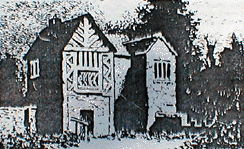 |
Note that Ritson's 1795 drawing [right hand image] probably appears closer to the appearance of the original gatehouse. Its form is essentially Tudor and thought to be post dissolution12 but may have been extensively modified over the period of its life ending in 1538. The gate can just be seen between the left and right wings. There seems to have been considerable modification to the right wing and the upstairs windows of the left wing and the gateway seems to have been filled in.
4."The extensive family and estate papers of the Armytage family
of Kirklees Hall are already held in  West Yorkshire Archives, but an item recently received refers to the
very early period of Kirklees Priory. It is a facsimile of a quitclaim
dated 1234 by Sibil, prioress of Kirklees, to the monks of Rievaulx
Abbey, relating to lands in Harden, Cullingworth and elsewhere. The
small Cistercian priory of Kirklees was founded in 1155. At the
Dissolution there was a scattering of its lands and possessions. The
site of the priory was granted in 1544 to John Tasburgh and Nicholas
Savile. The Saviles were a noted family in the area and much of the
Kirklees estate was acquired by various family members. In 1565 Robert
Pilkington and his wife, Alice Savile, conveyed the manor of Kirklees to
John Armytage of Farnley Tyas, and the Armytage family maintained
possession until the twentieth century.
West Yorkshire Archives, but an item recently received refers to the
very early period of Kirklees Priory. It is a facsimile of a quitclaim
dated 1234 by Sibil, prioress of Kirklees, to the monks of Rievaulx
Abbey, relating to lands in Harden, Cullingworth and elsewhere. The
small Cistercian priory of Kirklees was founded in 1155. At the
Dissolution there was a scattering of its lands and possessions. The
site of the priory was granted in 1544 to John Tasburgh and Nicholas
Savile. The Saviles were a noted family in the area and much of the
Kirklees estate was acquired by various family members. In 1565 Robert
Pilkington and his wife, Alice Savile, conveyed the manor of Kirklees to
John Armytage of Farnley Tyas, and the Armytage family maintained
possession until the twentieth century.
Note: A Margaret de Savile was at one time a prioress at Kirklees. Her
father was Sir John Savile who married the heiress Isobel de Eland,
relative of Sir John de Eland, the wicked Yorkshire sheriff and John
earl Warrene's steward for the manor of Wakefield. See
Elland Feud.
5. At the Heritage Web the following reference was found :
:"[1760] ARMYTAGE, G. ACCOUNT OF THE EXCAVATIONS AT KIRKLEES
PRIORY,
YORKSHIRE. Proc. Soc. Antiq. 21, (1),1905-1906. 14pp, 2b/w pls, 1
folding plan, £4.00"
6. Dr. David Hepworth of Huddersfield University has taken photographs of the "Robin Hood" grave. His photographs definitely look better than those taken in the previous decade although there is some evidence that the best aspect has been portrayed.
False Trail
Further recent investigation indicates
that the Kirklees burial site is a false trail perpetrated,
knowingly or unknowingly by one of the early owners of the dissolved
priory. These have included Nichoas Savile and John Tasburgh, Sir
Thomas Saville of Thornhill, the well-known historical figure, Sir
Thomas Gargrave, Robert Pilkington and Alice his wife (dtr. of Sir
Thomas Savile) and John Armitage, sheriff of Yorkshire in the 1600's.
| OWNERS10 | RELEVANT YEARS |
| The Priory of Kirklees | Until dissolved ~ 1538/1539 |
| The Crown in King Henry VIII | 1538/9-1544 [1542 - John Leland in his Collectanea mentions the presence of Robin's grave.] |
| Nicholas Savile^ and John Tasburgh13 | 1544 |
| Sir Thomas Savile of Thornhill | ? -? |
| Sir Thomas Gargrave | ? - 1548 |
| Robert Pilkington of Bradley and his wife Alice (daughter of Sir Thomas Savile) | 1548-1565 |
| John I Armytage, clothier of Farnley Tyas. | 1565 |
^Ritson says 'Henry Savil' and John Tasburgh
Having acquired the Kirklees estate the previous owners assumed 'Kyrkely'
in the Geste to be Kirklees. From this nucleus of conflation a
false burial site was constructed to commemorate the supposed outlaw's
last resting place. This falsity has created a monster in itself, not
the least for the Armitage family, who whilst trying to run a farming
business have been inundated and bombarded with requests for entrance to
visit the site by the superficially curious and the downright mentally
unhinged. In fact the person who inspired the ballad hero is buried far
away in another county, lost, forgotten and profoundly uncelebrated.
 Home
Home Sources :
1. Copeland,William., A Mery Geste of Robyn Hood, 1550.
2. Death and Burial of Robin Hood in "A Geste of Robin Hood".
3. Gough, Richard., Sepulchral Monuments of Great Britain,1786.
4. Ritson, Joseph., Robin Hood: A collection of all the ancient poems, songs and ballads now extant and relating to that celebrated outlaw,1795, Reprinted E.P. Publishing, 1972.also a facsimile reprint of the 1865 edition, Broomhead Publishing*. 2000.
* From Broomhead Publishing, 1, Cromwell St., Heaton Norris, Stockport, Cheshire, SK4 1LY
5. Email communication with Barbara Green who kindly supplied information from the Yorkshire Robin Hood Society.
6. Green, Barbara., Secrets of the Grave, Palmyra Press, 2001.
7. Ibid. p. 21.
8. Parker, Martin., A Tale of Robin Hood, about 1631.
9. A late and fragmentary version of the death of Robin Hood, preserved in the Percy Folio Manuscript, ed. Hales and Furnivall, I, 53.
10. West Yorkshire Archive Service. Reference KM [Kirklees Manuscripts].
11. Harris. P. V. The Truth about Robin Hood, p. 34.
12. Ibid.
13. W.Y.A.S. WYHER/10267.
 Other references if you can find them:
i] Pobjoy, Harold, Rev., A History of the Ancient Parish of Hartshead cum Clifton, 1930's. Reprinted. in Ridings Magazine 1972.
ii] Pobjoy, Harold, Rev., The Merry Pageant of Robyn Hode, 1929.
Copyright © 1998. Tim Midgley, links revised July 2023.
Robin Hood search for the Truth | Robin Hood Places | Hood surname statistics | Robin Hood of Wakefield | Robert Hood of Newton | The Pinder of Wakefield | Marian | Friars | Loxley and 'Huntington' | Myriads of Robin Hoods | Ballads of Robin Hood | Kirklees | The Armytages of Kirklees | Little John | Roger De Doncaster | The Penurious Knyght | Our Comly King | Shire Reeve | Priory of Kirklees | Wakefield Rolls | Saylis of the Geste- a new site | Robert III Butler of Skelbrooke | Barnsdale and the Geste | De Lacis of Pontefract | Alice De Laci and John of Gaunt | Barnsdale Gallery | A suspected compiler of the Geste | Images of Robyn Hode