| The Penurious Knyght |
Like Robin Hood and Little John, there have been many attempts to link the "gentyll knight" mentioned in the ballad, "A Lytell Geste of Robyn Hode" who had on his person "but even halfe a pounde", to a real person.
The knight is captured and given a meal at the outlaw's camp and then asked to pay for the meal.
He is described in the latter part of the "Gest" as "Sir Richard at the Lee" after giving Robin Hood and his followers refuge in his castle at "Uterysdale"1 or "Verysdale"3
The following are some pieces of evidence which have been used in an attempt to link this character.
1. Uterysdale has been identified by some as relating to the village of Lee in the Wyre valley- Wyresdale [Lancashire]1 and references to Richard de Leghs [Leghe] in Lancashire one in the village of Woodhouses.5.
2. The knight's son had killed a knight of Lancashire, Joseph Hunter was not convinced that this knight is the same one mentioned later in the "Geste"
| I had a sone, for soth Robyn, That sholde have ben myn eyre, When he was twenty wynter olde, In felde wolde juste full fayre; He slewew a knyght of Lancasthyre, |
3. Uterysdale identified as Yrewysdale [Ywerys] in the vale of Erewash-between
Nottinghamshire and Derbyshire2. According to Bellamy
there were only four castles which fitted the description
in the 1300's found in the "Gest" near Nottingham. Annesley
Woodhouse castle was the only one which appeared to be within Sherwood
at this time, closer to Mansfield than Nottingham.
4. Some have associated the ballad knight with a family
living at Middleton, West Yorkshire.
5. Also with Sir Richard Foliot a knight of Nottinghamshire4.
6. A Richard Lee of the mid 1300's
7. Sir John de la Lee, a vicar, whose nephew was a steward
in the king's household.
A West Yorkshire solution has:
1. Uterysdale could be "Huddersfield-dale", [Huddersdale],
usually pronounced without the "H".
2. Sir Richard of the Lee was Sir Richard de Thornhill who
lived at Thornhill Lees near Huddersfield.
3. Sir Richard de Thornhill
was a real knight who appears in the Court Rolls for Wakefield
as a person who transgressed the laws of Lord Warrene's hunting forest
of Sowerby in 1274.
He was the eldest son of Sir John de Thornhill [b. abt.
1180]. [Sir] Richard de Thornhill was born ca. 1228 at Thornhill
and died 1287 at Fixby. He married first Margaret [Maud] de Bedall
[Bedale- North of Ripon] and secondly about 1228, Matilda de Fixby [b.
ca. 1240 Thornhill] The first marriage led to a large line of de Thornhills
who intermarried with such luminous names as de Laci, de Eland and later
Saviles.
4. A Richard of the Lee appears in the Court Rolls for Wakefield
in 13171 as suing William Waterhouse. The Lee here according
to Phillips and Keatman could be Kirklees.
5. The knight had to sell his goods to pay the abbott of
St. Mary's in York 400 pounds which might indicate that there is a
Yorkshire connection. Robin gives the payment to the knight who repays
the abbott. Later Robin according to the ballad steals 800 pounds
from the monks of St. Mary's. Robin according to the ballads had an
uncle as a prior at York.
6. There is a place called Le Leghes in the graveship of
Alverthorpe mentioned in the Wakefield Court Rolls for 13326.
Leghe is a common name occuring in the W.C.R.'s.
7. After the archery contest at Nottingham in the "Geste"
the band flee to Sir Richard at The Lee's castle which is interpreted
as being at Thornhill, West Yorkshire.
8. The Greenwode or Greenwood is an area in Calderdale between
Heptonstall and Widdop. It is also a surname popular in the
area Greenwood - first recorded in 1275 possibly from Wyomarus de Greenwod
who established his home at what is now Greenwood Lee in 1154 AD. A William
of Grenewode is mentioned as holding land and tenements called Leyrynge
- or Learings - at Heptonstall in 1439. The name is later recorded
as Grenewod and Grenewodde.
See Midgley-Greenwood
Arms combined
A more recent South Yorkshire solution
has emerged for the origin of the character, Sir Richard atte Lee,
and seems more in keeping with what we know historically.
This person was Richard Foliot, d.1299, of Norton, Cowesby, Fenwick
[Yorks.], Grimston & Wellow [Notts.] who at the beginning of Edward
I's reign in 1272, sheltered Roger Godberd and Walter Ewyas from the Sheriff
of Yorkshire. In 1263 he was granted permission to restock his Grimston
Park property and a year later was permitted to crenellate the manor house
here. In 1264, Richard had sided with Henry III serving in the king's army
at the seige of Kenilworth [1266] and he helped to restore order in Nottighamshire,
Derbyshire and Yorkshire. Richard Foliot held lands as a tenant of the De
Laci family of Pontefract [Holt p98]. He was also a patron to St. Peter's
Church at Kirk Smeaton, Yorkshire in 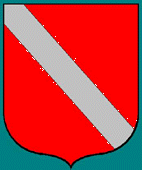 1238-9, 1270-1 and 1289. By 1268, he had been rewarded with a charter
to hold a fair at Wellow [Wellhaugh] by Henry III. and during this time
was granted arms of "de goulz ung bend d'argent" [Roll of Arms Henry
III] i.e. gules a bend argent.
1238-9, 1270-1 and 1289. By 1268, he had been rewarded with a charter
to hold a fair at Wellow [Wellhaugh] by Henry III. and during this time
was granted arms of "de goulz ung bend d'argent" [Roll of Arms Henry
III] i.e. gules a bend argent.
Above the village of Wellow lies the site of Jordan Castle where
a 'motte and bailey' manor house was once extant from the 1200's. The
right to fortify the manor house was granted by king Henry III
to 'Richard Foliat' (father of Jordan after whom the castle was named)
in 1263.
Molyneux-Smith suggests that Foliot means 'greenleaf'* the
name Little John gave as an alias and could well be the Geste author's
attempt at using his knowledge of latin to 'create a name' for the ballad,
A Lyttel Geste of Robyn Hode. *Feuille verte,
from phyllo [leaf] and vert, a common medieval word for standing
[vertical] green trees.
J.C. Holt sees it as significant that the Foliots who
held Fenwick, [Walden] Stubbs and Norton [Went Valley] before the Hastings
family had other holdings on the eastern margin of Sherwood Forest [Grimston
& Wellow Notts.] thus linking Sherwood with Barnsdale [if we recognise
Barnsdale as that area west of the fenland between Doncaster and Pontefract].
The Foliots married into the Hastings and thereby Fenwick came into
the hands of Sir Hugh Hastings d.1347. Sir Hugh was the son of a Competitor
for the Scottish Crown, John I Hastings, the great-great grandson of
Ada Ceann mhor De Huntingdon, third and youngest daughter of Earl David
De Huntingdon and sister to Isabella De Huntingdon.
The Leys
Richard Foliot's Yorkshire properties included Norton, near Campsall and Walden Stubbs ["Stubbs']. The early manor house lay a little to the north of the vill of Walden Stubbs. To the west, we find a large area of farmland known as Smeaton Leys, through which passes an ancient connecting lane known as Leys Lane. This travels west until it turns north through Darrington Leys all the way into Knottingley and Ferrybridge, the lower crossing point for the River Aire. The Leys provide the clue to Richard's name found in the Geste. The Geste author must have lived locally and after the exploits of Richard Foliot, for he knew of Richard's exploits in order to write Richard into the ballad as an eventual companion of the outlaws. Locations with the name 'Lees' are in abundance in the region, from Scawsby Lees in the south to Great Leys and Leys Lane , the Hampole by-road to the Leys of Smeaton and Darriungton. The author of the Geste has 'Richard at the Lee' alongside the outlaws, defending his castle in Nottinghamshire [probably seen by the author as Wellow*] against the Sheriff of Nottinghamshire. Of course this differs from the historical version which locates the defence of the moated manor house at Fenwick whilst the outlaws were Roger Godberd and Walter Ewyas. This does not make Roger Godberd "Robin Hood" as some researchers have surmised, the author merely utilised what he vaguely knew and wove in into a story about a person who lived in 'Barnsdale' at the same time, a person who was tried as a thief and murderer.
* Jeffrey Stafford in an unpublished work7 states that the Rufford Abbey Charters Vol 3 provide the location of 'Verysdale' of the Geste as the phonetic variant 'Ferresdale' in Nottinghamshire, about a mile N.W. of Wellow. [Jeffrey supplied prof. J.C. Holt with information re Eustace De Lowdham in Holts 1982 book, p. 60]
However, despite all these possible
inspirations for the poor knight, there is a far better solution to the
likely inspiration for Sir Richard of the Geste. He was a knight,
he did reside in Yorkshire and he was a strong supporter, 'merry man'
of the person who inspired the Robin Hood ballads, he has yet to be announced.
 HOME
HOME
Sources :
1. Child, Francis, James. (Ed.) The English and Popular Scottish Ballads, New York, 1955.
2. Bellamy John. Robin Hood an Historical Enquiry, London, 1985.
3. A Lytell Geste of Robyn Hode, 2nd edition.
4. Green, Barbara, The Outlaw Robin Hood, His Yorkshire Legend, limited pub.
5. Harris, P.V., The Truth about Robin Hood, Mansfield, 1973.
6. Walker, S.S., Wakefield Court Rolls 1331-1333, Leeds, 1983.
7. Email comm. Jeffrey Stafford, September 2006.
8. Holt, J.C. Robin Hood. Thames and Hudson. 1982.
Copyright © Tim Midgley 2001, links revised July 2023.