 Midgley of the Selby District in the 1700-1880's
Including Burn, Brayton, Thorpe Willoughby, Hambleton,
Copmanthorpe, Elvington, Colton, Ottringham, Acaster Malbis, Acaster Selby,
Wistow, Colton, Huntington, York &c. with links to Midgley of Normanton,
Cawthorne, Castleford and also Midgley of Bolton, Lancashire, Palo Alto and
Auburn California and Saskatchewan, Canada.
| 1. North Elmshall White Hart Farm (up to 3 inhumations) 2. Womersley (up to 3 inhumations) 3. Knottingley (secondary barrow inhumation) |
The battle of Winwaed (Winn wood) is also sited in the area, possibly
on the river Went near Wentbridge 3km to the N.W. of Middle Field.
This battle according to The Anglo-Saxon Chronicle took place
on the 15th November 655 A.D. between the Anglian Northumbrians under
Oswy (Osuiu) who were the victors and 30 legions of Mercians, East Anglians
and Welsh under the pagans, Penda, Athelehere and Difid (David)
respectively who met at the river.
It was normal for the Welsh Britons to fight on horseback
but for the Anglians it was not a tradition. It was also common to
attack on river crossings where a tactical advantage could be gained. The area may have remained pagan longer than other areas
as it lay beween Mercia and Northumbria, forming part of Loidis Elmete
(Elmet).
The area has been historically important as it controlled
a narrow strip between the Pennines and the Humber marshes and acted
as a route through to York and the North.
Other Derivations:
From Old English (formerly called Anglo-Saxon):
Mycg: a persons name
Micg(e) or Mycg leah a wood or clearing infested with
midges (gnats) in West Yorkshire,
Old English “gnoet” or “gnatt” middle high German “gnaz”.
This derived from the Danish “Myg” and the old high German
“Mucca” (Collin’s English Dictionary).
In Danish the word Myg means Mosquito
Possibly from Scandinavian "Migge" (= large)
Another spelling, Miggeley appears to be Norman/French.
In Norse mythology the dwelling place of mankind was called Midgard, Midgarthor, (Mithgarthr, Old Norse). It was formed from the body of the giant Ymir and linked by the bridge Bifrost to Asgard the home of the gods.
There are two places called Midgley in Yorkshire, one near Wakefield and the other near Halifax. Midgley is an English habitation name from several places in West Yorkshire, one of seventeen most distinctive names in 1319 when it was associated with a justice of Common Court Pleas, William Midgley, later Sir William de Midgley.Previously the river Ouse was navigable by ships to York. For example,
in 1066 Tostig ( King Harold's brother) anchored 300 sailing
ships at Riccall, upstream from Selby and defeated Edwin Earl of
Morcar, the Earl of Northumbria and the Earl of Mercia at Fulford
(south of York) on 20th September 1066. This caused Harold Godwinson
(King Harold) to march North with his huscarls, exposing the S.E. of
England to the invasion by the Norman forces. A major and tragic
turning point in English history, for the English were dispossessed
of their lands and suffered the tyranny of the French-Normans,
which even today finds its influence in the landed or wealthy aristocracy
and the quasi-French snobbery of the English class system.
The earliest foundation of Selby Abbey is said to have originated with
Germain/Germanus [b~AD 378, d. 448], a French nobleman and soldier.
He learned Roman law and became governor of Amorica, later becoming
a Christian and by AD 418, Bishop of Auxerre. Bishop Germain visited
Britain twice. Over 600 years later, Benedict [Benoit] experienced a dream
at Auxerre Abbey in which St. Germain instructed him to build an abbey
at what was then the Anglo-Danish settlement of Seleby, the year
was 1069, [4Will.I]. Benedict had brought St.Germaus' dried middle right
finger with him as a holy relic and using this and his powers of persuasion,
convinced the local lord and sheriff of Yorkshire, Hugh son of Baldric to
establish a church on this isolated gravel knoll beside the river Ouse. The
church being set on the King's land, Hugh felt it prudent to present Benedict
to King William. William was so impressed by Benedict that he agreed
to the immediate establishment of the monastery [no doubt with control of
the recently subjugated North on his mind] and endowed the church with lands.
Selby Abbey played in the North, the equivalent of Battle Abbey in the
South, both can be visualised as thanksgivings for Norman victories.
It was during the unrest of 1068 in the North that his queen,
Matilda is believed to have stayed in Selby where she gave birth to Henry
[Beauclerc], the Conqueror's son. The Benedictines played a large
part in the development of the local area until about 1539 when Thomas
Cromwell helped to engineer the demise of the Pope's influence in England
under thge aegis of Henry VIII.
 We have a reference to a
possible John Midgley ['Mitteley'] of Selby in 1503 when 'John Goldall and John Mitteley had a dispute about the drainage from a
pig sty, upon which the jury adjudicated:
We have a reference to a
possible John Midgley ['Mitteley'] of Selby in 1503 when 'John Goldall and John Mitteley had a dispute about the drainage from a
pig sty, upon which the jury adjudicated:
|
April, 18th Hen. VII. (1503). Also the wtin wrytten Jur' are |
Robert Midgley the last Prior of Selby Abbey.
On the 6th of December 1539 the last abbot and prior
with their twenty three monks surrendered the abbey into the hands
of King Henry VIII.10 Unlike the abbots of Fountains
and Rievaulx, who were beheaded for their part in the uprising which
came to be known as 'The Pilgrimage of Grace', the Selby incumbent
was treated more kindly. The records indicate that the abbot, Robert
Rogers received an annual pension of £100, the prior, Robert
Midgley, £8 and the remaining twenty-two members between £5
and £6 per annum.11 Two days after the surrender of
the abbey, five of Henry VIII's commisioners staying in Selby recorded
'we have dissolved the houses of Hampole, Sancte Oswaldes, Pountefract,
Fountaunce, Sancte Maries in Yowrke, Nonappleton and Selby'. The church
however survived by becoming the parish church when in1618 it was officially
declared as such. The church structure is mainly Norman, purposely built
on a cruciform ground plan. After a fire in 1906, the church was completely
restored. It contains a perpendicular font cover of the 1300's and stained
glass Jesse windows. To the N.W. of the town of Selby lies Selby Common
a large tract of common grazing land to the S.E. of "The Owt Wood".
The barony of Selby was created under Henry de
Beaumont
in 1307 with Edward
II's ascendancy. By the 1700's the 9th Baron Beaumont [Henry Stapleton]
was resident at Carlton Hall, Selby9.
Midgley of Selby 1700's-1800's Both Selby and Brayton churches start with a Midgley Christening in 1782 suggesting that the parents were not resident until about that time in both parishes.
Brayton
Parish Church of St. Wilfrid's.
Coats of arms in the windows of Selby Abbey
Selby meets Crawley
John Seakins has found a link between one branch of his Midgley line from South Duffield, ph. Hemingborough near Selby which moved to Crawley in Sussex via Walpole St. Peter, Norfolk* Using a variety of resources John has put together a pedigree which has not yet been linked to other Midgley families in the Selby district. So far John's family tree looks something like this: Word Document
One link may occur through John Jackson, farmer of Menthorpe, who may be related to John Jackson Ch. 4th July 1735 at Wistow, the latter being the father of Elizabeth Jackson who married William Midgley of Hambleton (m: 1791). Other key words: Newrick Midgley, Newrack Midgley, Joseph Midgeley, Mary Jackson, Wistow, Menthorpe, Martha Thornton, Ham Coates, Lincolnshire.* There has been a link between Hemingborough and Walpole since about 1290 when Bogo de Clare, son of Richard de Clare earl of Gloucester, held the church at Hemingborough and the church at Walpole St. Andrew. [History of Hemingborough]
Contact: John Seakins
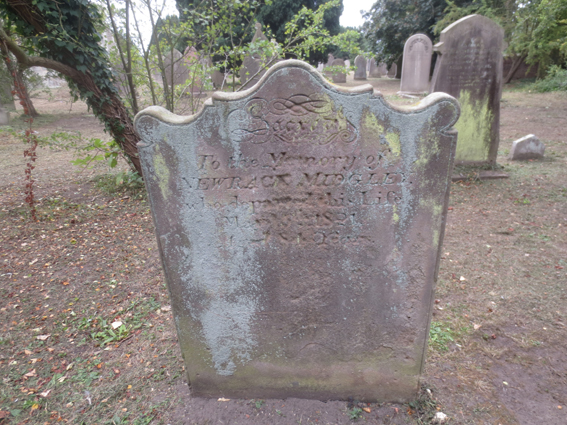 |
| Headstone for Newrack Midgley, d. 1821 in Hemingborough Churchyard |
Other villages in the Selby district:
Brayton
About 1030 Breithe-tun, meaning ""broad farm"
or "farmstead of a man called Breithi" OScand. breithr or personal
name. O.E. -tun. Bretone in 1086. In December 1318 it was recorded that in the time of King Edward I, William de
Langley was presented to the church of Brayton 'by reason of the voidance of of
the abbey of Selby'. [C.P.R] In 1575 Brayton was recorded as Braton.
Brayton has two moated sites on either side of the village. An easy
one mile walk to Selby from here. The parish church with spire is set
outside the village towards Selby.
Midgley of Brayton 1700's-1800's - Additional records for Midgley of Brayton (Added Oct. 2019)
Burn
About 1030, Byrne probably "area cleared by
burning", O.E. Byrne. Today it is a hamlet.
Hemingbrough
Hemingburgh in 1080-6, Hamiburg 1086
Probably "stronghold of a man called Hemingr", OScand. personal
name and O.E. burh. In 1579 recorded as Hemyngburgh. Here
is the church of St. Mary, a cruciform planned structure of the
1200's-1400's. It boasts a squat central tower and a lofty spire. There
is good medieval woodwork in the screen, benches, roofs and misericords,
the pulpit dates from 1717. The village lay in the East Riding but now
in Humberside. Nearby at Babthorpe is the moated Hemingbrough Grange.
Hemingbrough Hall lies near the periphery of the village. The River Ouse
used to pass much closer to the village, its path now marked by a much
reduced meander cut-off.
Lund
Meaning small wood or sacred grove, OScand. Lundr.
1066-9 Lund, 1086 Lont. A hamlet between Selby and
Hemingbrough which lay in the East Riding, now Humberside.
 Hambleton [Hamelden]
"Farmstead at the crooked hill", O.E. hamel+tun. 1086
Hameltun. There is indeed an asymmetric hill to the south
called Hambleton
Hough.

Hambleton Hough from Hambleton a typically glaciated crag and tail
To the N.E. of Hambleton lay The Owt Wood shown on Saxton's map of 1579,
a large woodland region stretching to Cawood remnants of which
are found today in Bishop Wood. Both Selby and Hambleton were part
of the Honour of Pontefract, very much separated from the estates further
west: William
de Hambleton, king's clerk.
| "Robert de Lacy*
confirms to the abbey of Selby the manor of Hamelden, given by his
father for the soul of Hugh his brother. Lands quit claimed here by
John son of Hugh de Lacy, of Gateford8".
* Robert de Lacy 1089-1121 |
Thorpe Willoughby
OScand. Thorp, "an outlying farmstead or hamlet",
"a dependent secondary settlement". 1086 Torp, 1276 Thorp
Wyleby. The manorial affix originates from the Willeby family
who were resident here in the 1200's. In the Brayton parish register
of the 1700's it is referred to as Thorp.
Like Hambleton, Thorpe Willoughby has a hill to the
south of the village, Brayton Barff. These two prominences
appear to be the only high ground in the Vale of York, which is at
its widest here until the land rises towards Monk Fryston in the
West. Both prominences may represent the remains of "crag and tail"
structures from the Wurm glacial episode 10,000 years ago, the Escrick
moraine lying further north at York. The Vale of York is underlain
by New Red Sandstone, but this is covered almost everywhere by alluvium
or glacial deposits. The ground upon which Selby is built is glacial
boulder clay over which lies two feet of outwash sand and one foot of
topsoil. The water table lies three feet down here on the upper surface
of the boulder clay. This has caused the Selby Abbey tower to sink early
in its history thus producing noticeable distortion in some of
the nave's arches. Much of the land around the head of the Humber was
once "fen country", but it has been drained and is now rich agricultural
land. It has the most northerly extension of wheat farming in England.
Today, barley, oats and rootcrops are cultivated and in addition much
market gardening to supply the industrial centres of West Yorkshire.
.
Selby
and district 1579
William Midgley of Brayton [Braton]
Described as a 'farmer of Braton', possibly
born about 1710. He married Elizabeth Fielder, daughter of William
Fielder, labourer of Hemingbrough. William's forbears are still being
researched and so far he is the earliest of this Midgley line found in this
area. See
VCH for
Hemingborough
Steven Midgley has found in the records for Brayton at the Borthwick
Institute in York an entry in the Brayton Parish Church register for William
Midgley and Elizabeth both of Thorp [Thorpe Willoughby, near Selby] married
24th June 1731 and William Midgley of Brayton buried 1st February 1759.
Brayton Church is huge and exhibits plenty of Norman architecture with a recent riebeckite granite headstone for some Midgleys on the left of the entry path about half way from the gate to the south porch – A William Midgley d. 22 Feb 1937 aged 74 years , Annie his wife d. 3 April 1964 aged 97 years and William their eldest son d. 13 Sept 1957. There may be some living relatives in the parish as the grave site is relatively kempt.
William Midgley of Burn [Burne]
Probably born about 1732 in Burn. The son of William
Midgley of Brayton. Later when married in 1763 he is described
as being "of Thorp of this parish" (Thorpe Willoughby of the parish
of Brayton). Occupation in 1763 is described as a labourer. Banns were called on the Sundays of 16th, 23rd, and
30th of January 1763.. He married Mary Wilson on 15th February
1763 at Brayton parish church. William signed the register and Mary
used a cross. Witnesses, Thomas Smith and Thomas Wright, service by
M. Teasdale.
Mary of Thorp was baptised on 10th July 1737 at Brayton
parish church, she was described as a spinster, daughter of Samuel
Wilson of 'Thorp' [Thorpe Willoughby] and Eliza Mary ['Leazay'] Clarkson,
who in turn was the daughter of George Clarkson of Lund, Farmer.
Steven Midgley also found William son of William Midgley of Thorp
baptized 27th August 1732, David son of William Midgley of Brayton
baptized 25th May 1746 and William Midgley of Burn son of William Midgley
of Brayton and Elizabeth Fielder of Hemingborough died 7th May 1792 of
smallpox aged sixty-one
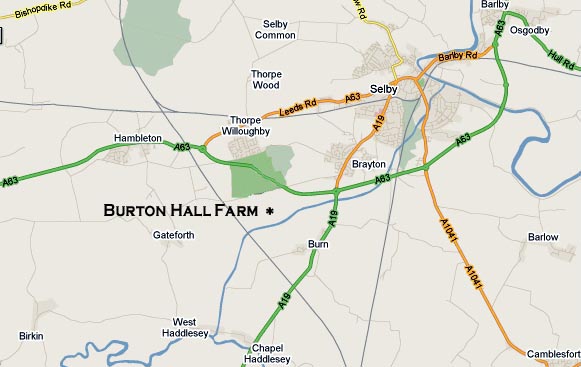
BRAYTON HALL COTTAGE A son of William Midgley of Burn and Mary Wilson of Thorpe Willoughby, Samuel, died at Burton Hall Cottage on the 20th February 1838, the first mention of this residence in the Midgleys of Brayton-Burn area. Burton Hall Cottage was probably an attachment to Burton Hall.[corruption of Brayton Hall?]
 |
Joseph Midgley of Hambleton
The son of William Midgley of Burn. Baptised 15th
October 1771 at the parish Church at Brayton. On the 1851 census,
Joseph recorded his birth as being at Hambleton. According to his headstone
in Normanton parish churchyard, Joseph died shortly after the 1851
census on April 30th 1851 aged 80 years. Joseph may have had older siblings
as nine years elapsed between his father's marriage and Joseph's birth,
but these siblings have not yet been identified.
Later Joseph became a farmer of 106 acres at Normanton
near Wakefield, where he was married to Susannah Cheesbrough of
Kirk Smeaton on the 17th December 1799 at the age of 28. According
to the same headstone in Normanton churchyard, Susannah died about
six years before Joseph on the 26th June 1845 aged 68 years.
Samuel Midgley
Son of William Midgley of Burn. Baptised 20th June
1777 at Brayton parish church. He married Mary about 1797-8 They
had eight children, all christened at Brayton parish church*.
i Elizabeth Ch. 30th September 1798, Brayton.
ii William Ch. 26th August 1800, Brayton.
iii Samuel born about 1804, Brayton.[1881 census
place: Askham Bryan]
iv David Ch. 10th September 1805, Brayton.
Died young?
v Joseph Ch. 4t August 1807, Brayton.
vi Mary Ch. 1st December 1809, Brayton.
vii David Ch. 13th July 1813, Brayton.
viii Elija Ch. 10th October 1815, Brayton.
* All records from I.G.I.1994 version except Samuel from 1881 census.
Dave Sunman has added more information to the Midgley line of Burn, Hambleton. Dave's predecessors descend from William Midgley b. 1731/2 and Mary Wilson, William Midgley of Burn b. 1774 and Elizabeth Jackson d. 1802 to John Midgley b. 1792 at Brayton and his wife Hannah Haggitt of Ottringhan, Holderness, East Yorkshire, they had ten children.
Download a zipped gedcom file of the Midgleys of the Selby area that includes Midgley of Burn, Brayton, Thorpe Willoughby, Hambleton, Copmanthorpe, Elvington, Colton, Ottringham, Acaster Malbis, Acaster Selby, Wistow, Colton, Huntington, York &c. with links to Midgley of Normanton, Cawthorne, Castleford and also Midgley of Bolton, Lancashire, Palo Alto and Auburn California and Saskatchewan, Canada. This file links these various Midgley branches. [File updated 13th December 2010.] Many thanks go to Steven Midgley who has gathered many of these branches together from the records at the Borthwick Institute of the University of York
A broad outline of the families stemming from William Midgley and Elizabeth Fielder are as follows:
William Midgley ==========Elizabeth Fielder
Farmer of Brayton d. 1759
|
_______________________________________________________
| | |
Joseph==Susannah Cheesbrough William===Elizabeth Jackson Samuel ===Mary Stow
| | |
__________________________________________ Midgley of Ottringham _________________________________________________
| | | | | |
William Walter==Sarah Peace David==Elizabeth Crowther William==Elizabeth Samuel==Hannah David Elijah
| | Hanbey Atkins
_______________________________________ Midgley of Normanton
| | | | Ledston, and Auburn, California. |
Benjamin Joseph William==Martha Thomas====Elizabeth Hill _____________________________________________________________
Waller Waller Farmer of Kinswoman of | | | |
Midgley Midgley Cawthorne Sir Rowland Hill William==Mary Wood Joseph== Ann Haddington Thomas==Mary Haw Samuel
Publican of 1st curator of Bolton | |
Castleford Museum, Lancashire Midgley of Cawthorne Midgley of Elvington |
__________________________
| |
Thomas Midgley George Midgley
Farmer of Colton, Yks. Emigrated to Canada
SELBY CUM MEMBRIS (The earlier court rolls cover the parishes of Brayton, Hambleton, Hillam, Monk Frystone, Selby and Thorpe Willoughby. Later the practice appears to have been to hold separate courts in the outlying parishes and to treat them as separate manors. Court rolls and other records for these 'manors' appear under the following headings:- Brayton, Brayton and Thorpe Willoughby, Hambleton, Hillam, Monk Frystone, Monk Frystone and Hillam, and Thorpe Willoughby) (West Riding)
Reference: DDLO/21 and DDLO(2)/10/1-14
Court rolls (181): 1322-1366, 1328-1329, 1342, 1346,
1349, 1358, 1359,1364-1368, 1380, 1383, 1388-1391, 1395-1400, 1415-1416,
1418-1419, 1422-1424, 1434, 1447-1448, 1464-1465, 1467-1468, 1471-1518,
1521-1524, 1527-1537, 1540-1562, 1564, 1567-1569, 1582, 1584, 1586-1588,
1593, 1595-1596, 1598-1599, 1605-1609, 1611, 1614-1615, 1620, 1625-1628,
1630, 1673-1950
Pains (3): (circa 1540), 1669, 1682
Rent account: 1515
Court book recording surrenders and admissions: 1598-1671
List of presentments, jurors and tenants: 1590
'Alterations founde by the Jury (Alienations in Selby):
April 1668
Account of fines due: (circa 1812)
List of admissions: 1816-1843
BRAYTON See also SELBY cum MEMBRIS, which originally comprehended Brayton, and also see BRAYTON AND THORPE WILLOUGHBY (West Riding)
Reference: DDLO/1 and DDLO(2)/1
Court rolls (15): 1485-1486, 1512, 1515, 1516, 1517,
1520, 1521, circa 1525, 1541, 1542, 1547, 1548, 1550, 1901-35
Lists of pains (3): 1638
Files of verdicts (2): 1815-1852
Verdicts (57): 1853-1913
Files of extracts from Court rolls (2): 1865-1890
Precept for holding court: May 1864
Notice of holding court: December 1892
BRAYTON AND THORPE WILLOUGHBY See also SELBY cum MEMBRIS, which originally comprehended Brayton and Thorpe Willoughby, and also see BRAYTON, and THORPE WILLOUGHBY (West Riding)
Reference: DDLO/2
Court rolls (27): 1440-1445, 1446-1463, 1447-1449,
1454-1456, 1458, 1461-1466, 1465, 1466-1470, 1471-1472, 1473-1476,
1477, 1477-1479, 1479-1485, 1493, 1494-1497, 1497, 1497-1499, 1503,
1506, 1508, 1511, 1512, 1513, 1519, 1544, 1604, 1615
Jury lists (2): (circa 1816), 1823
THORPE WILLOUGHBY See also SELBY cum MEMBRIS, which originally comprehended Thorpe Willoughby, and also see BRAYTON and THORPE WILLOUGHBY
Reference: DDLO/25 and DDLO(2)/11/13
Court rolls (39): 1449/50, 1473, 1511, 1515, 1518,
1520-1521, 1524, 1528-1537, 1545-1551, 1609, 1933-1950
File of jury verdicts: 1815-1846
Jury verdicts (61): 1721, 1847-1913
Estreat of fines: April 1658
Files of extracts from court rolls (2): 1864-1890
Notice of holding court: December 1892
REGISTRATION DISTRICTS IN YORKSHIRE WEST RIDING
Selby
Created 1st July 1837. Mainly in West Riding, but
also included parts of East Riding.
Sub-districts : Carlton; Riccall; Selby; Snaith
GRO volumes : XXIII (1837-51); 9c (1852-1930).
Barlow, Biggin (from 1869), Brayton, Burn, Camblesforth,
Carlton, Cawood, Drax, Gateforth, Haddlesey Chapel, Hambleton,
Hirst Courtney, Little Fenton (from 1869), Long Drax (Langrick),
Newland, Ryther cum Ossendyke (1837-69), Selby, Temple Hirst, Thorpe
Willoughby, West Haddlesey, Wistow.
Registers now in North Yorkshire and York districts.
13. A Volume of English Miscellanies Illustrating the History and Language of the Northern Counties of England.
Surtees Misc. (1830), pp. 30-31.


