~Barnsdale and an Origin
for the Geste ~
'Robyn
stode in Bernesdale' - A Lytell Geste of Robyn Hode
'My name is Robyn Hood of Barnesdale'
-
Robin Hood and Guy of Gisborne.
'The wooddi and famous forest of Barnesdale,
wher they say Robyn Hudde
lyvid like an outlaw'
- John Leyland's
Collectanea, Itinerary
c.
1540.
|
Looking
in
the
time
of
Robert
II
de
Laci,
lord
of
the
honour
of
Pontefract,
we
find
a
family
living
at
Skelbrooke
manor
called
Butler.
Their
pedigree
provides
a
family
pedigree
over
a sustained
time
in
a
fixed
geographic
location,
an
area
in
which
came
to
include
the
Great
North
Road
and
'Barnsdale'.
It
has
been
suggested
that
the
Butlers
of
Skelbrooke
may
be
descended
from
Herveus [also
Herewig,
'
Herveus
the
Commissioner',
Herveus
de
Campeaux/
Campellis
etc.]
who
held
lands
in
Skelbrooke
in
D.B,1086
from
Ilbert
de
Laci
as
part
of
the
honour
of
Pontefract.
It
was
A.S.
Ellis
who
first
suggested
that
Herveus
of
Skelbrooke
was Herveus
'the
commissioner'
who
came
to
England
with
the
Conqueror.
 Although
there
is
no
known
prima
facie
record
that
the
Butlers
of
Skelbrooke
are
descended
from
this
Herveus
the
Commissioner,
(the
latter
commonly
believed
to
be
the
progenitors
of
the
Butlers
of
Ireland),
there
appears
to
be
a
link
between
the
Butlers
of
Skelbrooke
and
Armthorpe
and
Ranulph
de
Glanville
who
was
the
uncle
of
Theobald
I
Butler
of
Ireland
(who
married
Matilda
e
Vavasour)
and
his
brother
Hubert,
archbishop
of
Canterbury.
Both
of
these,
as
boys,
were
raised
in
Glanville's
household,
while
Thomas
de
Armthorpe
was
assisted
by
Glanville,
a
member
of
the
judiciary
in
the
North,
in
his
dealings
with
Roche
Abbey. Although
there
is
no
known
prima
facie
record
that
the
Butlers
of
Skelbrooke
are
descended
from
this
Herveus
the
Commissioner,
(the
latter
commonly
believed
to
be
the
progenitors
of
the
Butlers
of
Ireland),
there
appears
to
be
a
link
between
the
Butlers
of
Skelbrooke
and
Armthorpe
and
Ranulph
de
Glanville
who
was
the
uncle
of
Theobald
I
Butler
of
Ireland
(who
married
Matilda
e
Vavasour)
and
his
brother
Hubert,
archbishop
of
Canterbury.
Both
of
these,
as
boys,
were
raised
in
Glanville's
household,
while
Thomas
de
Armthorpe
was
assisted
by
Glanville,
a
member
of
the
judiciary
in
the
North,
in
his
dealings
with
Roche
Abbey.
In
addition
the
Butlers
of
Skelbrooke
have
a
locational
link
with
the
Scalebrocs
of
Skelbroke
who
aso
held
manors
in
Oxfordshire,
viz:
Little
Haseley,
Warpsgrove,
Brightwell
and
Thomley all
being
outliers to
the
honour
of
Pontefract
of
Ilbert
de
Laci
[d.
1093].
Ilbert
had
probably
been
rewarded
with
the
honour
after
assisting
King
William
I
in
the Harrowing
of
the
North
during
the winter
of
1069.
See
the
evidence
for
these
four
families
that
may
be
related
in
some
way
to
Hervey,
a
Commissioner
for
William
the
Conqueror.
|
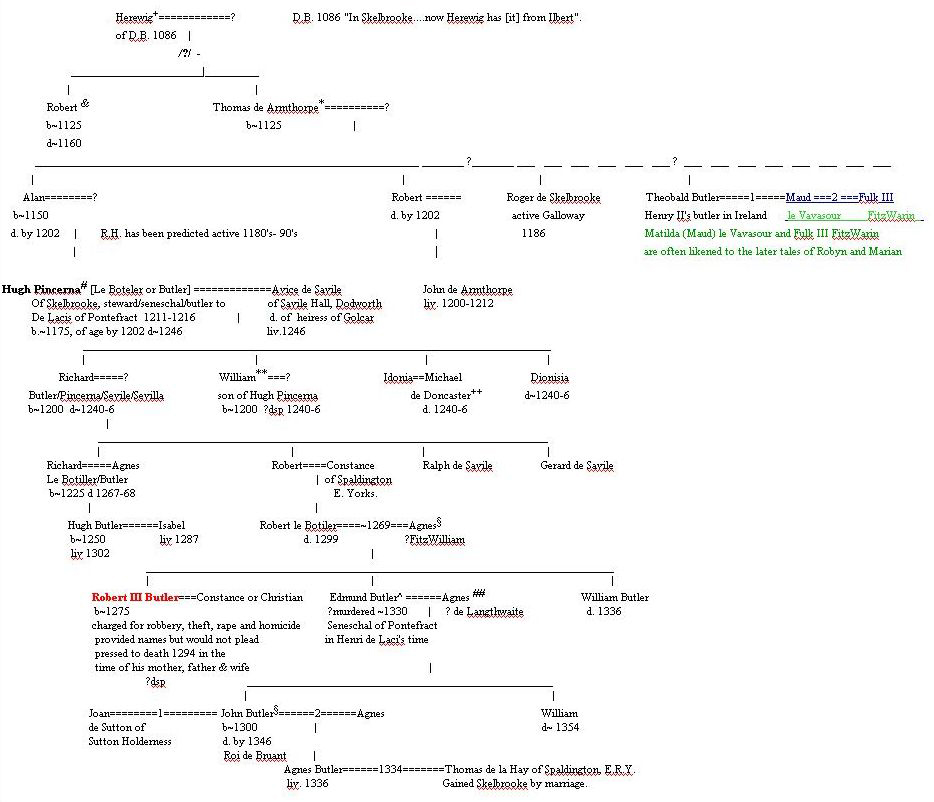
Thomas de Armthorpe
of
Armthorpe,
Kirk
Sandal and
Skelbrooke
[nr. Doncaster]
born ~ 1125, d aft. abt 1195 appears as the progenitor of the Butlers
of
Skelbrooke..
'Thomas de
Arnelthorpe'
gave to
Roche
Abbey the
grange of
Arnethorpe,
the grant
being
confirmed
by Pope
Urban III
in 1186
[Mon.
Ebor., p.
319.] In
the time
of William
de Warenne
3rd earl
[b. 1118,
d. 1148,
Holy
Land],
Armthorpe
was also written as
'Hernaldesthorpe'.
(Mon. Ang.,
v, 505).
Thomas was
certainly
the
grandfather
of Hugh
Pincerna. [Hunter,
South
Yorkshire,
vol. 1, p.
87.]
According to
an analysis of the genealogy
by W.P. Baildon [1926] Thomas
produced two sons:-
1. Alan [?de
Skelbrook]
born ~ 1150 d. by 1202 [alt. Thomas' brother]
probably
of
Skelbrooke.
The
Butler
pedigree
[Y.A.J.,
v. 24, p.
82. ] has
Alan as
the father
of Hugh
Butler,
the
steward of
Pontefract
c.
1211-1216.
According
to Baildon, Alan's son
was Hugh Pincerna [i.e. Butler]
of Skelbrooke, Armthorpe
and [Parva or Kirk] Sandal. He was
born about 1175 and was of age in 1202.
According to Holmes, Hugh had tenure of
office as seneschal/butler 1211 to 1216.
After John
II de
Lacy's
death, his
widow
Margaret
de Quincy,
'Lady of
Bradford'
[Pont.
Chart.
vol. 2.]
continued
to employ
Hugh
Pincerna
of
Skelbrooke
as her
butler
perhaps
until his
death
about
1246..
1211-1216
were the
last four
years of
King
John's
troubled
reign.
Hugh was the butler to
John II de
Lacy, lord of
the honour
of Pontefract
and Constable of
Chester.
Hugh le
Pincerna is described
by Holmes for the year 1216 as the "aged Hugh
Butler, seneschal of Pontefract." at this time. [although
the Pontefract Chartulary is much devoid of
dateable charters so this might be suspect].
Also
see
Barnsdale
Gallery.
Some
have even
suggested
that Alan
may be the
son
of Robert
de
Armthorpe.
[YAJ, vol.
29, p.
69.]
2. Robert
de
Armthorpe d. by 1202
[alternatively
Thomas'
brother]
A chapel
in
Armthorpe was
given to
Lewes
priory before
1202, with
the
advowson
being given
to the
Armthorpe
family.
Robert,
had a
dispute
with the
monks
relating
to common
pasture
that was
resolved
in court
in 1187 at
Doncaster.
Robert was
the father
of John de
Armthorpe
[See
Butler
pedigree
YAJ., xxix,
p. 82.]
Robert
de
Armthorpe was living
in the
time of Ranulf
de
Glanville,
King's
justice,
whose
sister-in-law,
Maud de
Valoignes,
married
into the
line of
Hervey [Herveus,
Herewig] the
Commissioner.
Added to
this
Glanville
was a
custodian
of
Theobald
and Hubert
Walter,
his
nephews
and it is
Theobald
who is
often
cited as
being a
descendant
of Hervey
the
Commissioner. Hunter
suggests
that
Theobald
was the
grandson
of Hervey
but he is
more
likely to
have been
the great
grandson
of Hervey
the
Commissioner
who held
in
Oxfordshire
and
Skelbrooke,
South
Yorkshire
and
grandson
of his son
Hervey who
held in
Lancashire.
Ranulf was
often in
the north
of England
as sheriff
of
Yorkshire
[1st:
1163-1170;
2nd:
1175-1176]
and
Justice
Itinerant
on the
northern
circuit
[1176-1189].
In
fact while
he was
Chief
Justicar
of England
[1180-1189]
and three
years
before his
death in
Palestine,
Glanville
did have
some
involvement
in the
arrangements
between
Robert de
Armthorpe
and the
monks of
Roche: -
17
Sept.
1187. In
the king’s
court at
Doncaster,
before
Godfrey de
Lucy,
Jocelin
archdeacon
of
Chichester
and
William
Vavasour,
king’s
justices.
Between
the monks
of Roche
and Robert
de
Armthorpe
for common
pasture
held by
them of
him in
Armthorpe,
whereof an
assize of
novel
disseisin
had been
summoned
between
them in
the king’s
court by
the writ
of Ranulf
de
Glanville.
Robert
gave
facilities
and
entered
into
arrangements
specified
in great
detail. [Y.A.J.
40, p.
87.]
This
involvement
suggests
that like
Theobald,
the Butler
of
Ireland,
Robert de
Armthorpe
was
receiving
assistance
from a
family
member
rather
than a
successor
of land
title.
The
grange of
Armthorpe
had
previously
been
given to
Roche
abbey by Thomas de
Armthorpe
and was
confirmed
by pope
Urban III
in 1186
(Mon. Ang.,
v, 505).
Robert was
probably
the
younger
son of
Thomas de
Armthorpe,
possessing
an
interest
in
Armthorpe
which
passed to
his son,
John, who made
an
agreement
with
Thomas’s
other grandson,
Hugh
Pincerna and heir
in 1202. [Y.A.J.
, v. 24,
pp. 70,
72, 89;
Ibid. v.
40, p.
88.]
1187
- The
monks of
Roche and
'Robert de
Ernaldtorp'
agreed
concerning
pasturage
in
Armthorpe:-
499. Final
agreement
made in
the King’s
court at
Doncaster
on
Thursday
after the
Exaltation
of Holy
Cross 33
Henry II,
before
Godfrey de
Luci,
Josceline
archdeacon
of
Chichester,
William
Vavasour
and
others,
between
the monks
of St.
Mary of
Roche and
Robert de
Ernaldtorp
touching
common of
pasture
held by
the monks
of the
said
Robert in
Armthorpe,
whereof an
assize of
novel
disseisin
was
summoned
between
them in
the King’s
court by
writ of
Ranulf de
Glanvill;
the said
Robert
demises to
the monks
a road of
4 perches
in width
and
another of
12 perches
in width
through
his meadow
for access
to the
common
pasture,
and
covenants
with them
as to his
right to
make
meadow and
arable
land of
the common
pasture..
17, Sept
1187.
[From the
orig.
formerly
in St.
Mary’s
Tower,
York (?;
Dodsw. MS.
viii, f.
300.)
Latin:-Hec
est
finalis
concordia
facta in
curia
domini
regis apud
Donecastre
die Jovis
proxima
post
Exaltationem
Sancte
Crucis
anno regni
regis
Henrici
Secundi
xxx°iii°
coram
Godefrido
de Luci et
Jocelin
Cicestrensi
archidiacono
et
Willelmo
Vavassor
tunc
justiciariis
domini
regis et
aliis
baronibus
fidelibus
dominiregis
qui tunc
ibi
aderant,
inter
monachos
Sancte
Marie de
Rupe et
Robertum
de
Ernaldtorp
de communi
pastura
quam
predicti
monachi
tenent de
predicto
Roberto in
Ernaldtorp,
unde
assisa
nove
disseis[i]ne
summonita
fuit inter
eos in
curia
domini
regis per
breve
Radulfi de
Glanvill’,
scilicet
quod
predictus
Robertus
dimisit
apud West
inter
fossatum
monachorum
predictorum
et pratum
suum viam
unam ad
latitudinem
quatuor
perticarum;
et apud
Northt
dimisit
eisdem
monachis
xijcim
perticas
de
latitudine
ad exitus
ad
[communem
?]
pastur[am];
et quod
remanet
extra xij™
perticas
apud Hest
usque ad
angulum
crofti
predictorum
monachorum
poterit
prenominatus
Robertus
includere
ad pratum
falcandum*;
et quando
fenum inde
asportavit
illud et
aliud
pratum
jacebunt
ad
communem
pasturam
usque ad
Pascham
omnibus
averlis
exceptis
porcis. Et
sciendum
quod
amplius
quam
inclusum
est
predictus
Robertus a
sua parte
poterit
in-cludere
infra tres
quarentenas
a
mes|uJagiis
predictorum
mona-chorum
nisi antea
fuerit
terra
guainabilis,
quod si
includere
voluerit
ad pratum
vel ad
bladum ita
faciet per
visum
legalium
hominum ut
non sit
magnum
gravamen .
. .
predictorum
mona-chorum
set omnia
in bono et
pace
permanebunt,
sicut
carte
ejusdem
Roberti et
patris sui
quas de
ipsis
habent
testantur.
*Long
before, at
the
Domesday Survey
[1086]
Ernwin [Ernuin]+
the priest
held the
manor of
Armthorpe,
late of
Ulchil,
[who lived
in
the time
of Edward
the
Confessor],
where it
was assessed
at 5
carucates.
[Its value
had fallen
from 40s.
to 20s.
after the
'Harrowing'
] There
were 4
sochmen
there
under
Ernwin.
Subsequently
the manor
escheated
to the
crown
under King
William I and
was held
in chief
by the
local
family,
[the de
Armthorpes].
Thomas de
Arneltorp
gave to
Roche
Abbey the
grange of
Armthorpe.
He was
probably
father of
Robert, a
party to
this
agreement,
and of
Alan, who
had issue
Hugh le
Boteler of
Skelbrook
and later
in 1202,
Armthorpe.
In 1201
Hugh son
of Alan
owed 20s.
for having
a writ of
summons
touching
5s. worth
of rent in
Trowell
and
Chillwell,
co.
Notts.,
against
John son
of Robert
de
Arnetorp.[R.
Cancel.,
208. ] +
Hunter
says that
his father
may have
been a
tenant of
King
Edward the
Confessor.
Ernuin
also held
'Canbesford'
in
Yorkshire
and
possessions
in Notts.
and Lincs.
In
the
ensuing
year John
acknowledged
the right
of Hugh in
6
carucates
in
Armthorpe,
being the
whole
town, the
advowson
of the
church and
18s. worth
of rent in
Doncaster.
For this
Hugh
granted to
John a
moiety of
the town,
advowson,
and rent,
and gave
him the
chief
messuage
in
exchange
for other
tenements.
Both kinsmen
were to
hold in
chief of
the crown
and if one
died
without
issue his
moiety was
to revert
to the
other.
[Yorks.
Fines, i,
n. 49. ]
In
1212
further
agreement
was made
touching
the moor
and woods
of
Armthorpe.
[Yorks.
Fines, i,
no. 446.]
William
de Warenne
gave the
church of
Little
Sandal to
Lewes
Priory.
Little
Sandal
near
Armthorpe
was like
many other
nearby
vills,
dependent
for
protection
upon
Warenne's
castle at
Pontefract.
A chapel
was
erected at
Armthorpe
in the
time of
William
the
Conqueror's
sons,
perhaps
built by
the priest
Ernuin.
[Hunter]
In
1202, the
two
cousins,
Hugh
Pincerna and
John son
of Robert
de
Armthorpe made
an
arrangement
whereby 6
ca. in
Armthorpe,
the vill,
the
advowson
of
Armthope
church and
18s. of
rent in
Doncaster
were the
right of
Hugh who
was the
elder
brother.
John
was
granted
half of
all the
premises
but if
either
were to
die
without
issue, then
everything
would pass
to the
other and
his heirs.
6th
Jan
1215-1216
Probably
as a
result of
John II de
Lacy's
position
as one of
the 25
surety
barons who
were at
Runnymede
and
appointed
to observe
Magna
Carta,
King John
ordered the
sheriff of
Yorkshire
to give
control of
the land
in
Armthorpe
and
Skelbrooke
held by
Hugh
Butler to
master
Roger
Talbot to
hold at
the king's
pleasure.
Thus Hugh
lost
Armthorpe
but he did
retain
Skelbrooke.
This writ
was dated
at Thirsk
which was
held at
this time
by William
de Mowbray
(d. 1222).
This
Roger
Talbot may
have been
holding
Armthorpe
for the
king's
son,
Richard
[b. 1209]
afterwards
earl of
Cornwall,
King of
Germany as
later
Edmund
earl of
Cornwall
is found
to be thee
presenter
for the
church
there.
1237-
A
presentation
was made
to
Armthorpe
rectory by
Roche
abbey
1250-1251
Roche
abbey was
granted
free
warren in
Armthorpe.
[C. Ch.
R.,
1226-1257,
p. 353.]
1275
- The
presenter
at
Armthorpe
was Edmund
earl of
Cornwall
1308-1309
The
presentation
at
Armthorpe
was held
by the
Mowbray
family.
1327
- John de
Mowbray
held the
advowson
of
Armthorpe
church,
however,
there is
no known
land
interest
here by
the
Mowbrays.
Armthorpe
was held
by the
abbot of
Roche of
Roger de
Mowbray
family.
The
Mowbrays
probably
absorbed,
being
Normans,
the
interests
of Enrnuin,
the
priest.
[YAS
Record
Series
LXXXV
(1933),
Fasti
Parochiales.
Vol. 1.
pp. 10-11;
Hunter.,
South
Yorks., i,
pp.
86-87.]
Butlers of Skelbrooke,
Barnsdale [by W.P.
Baildon1, A.S. Ellis2, Holmes,
modified with additions]
Key:
+ Herewig/Herveus
of
Skelbrooke under Ilbert de Laci
in 1086 Herewig's successors
or descendants were styled Pincerna or
Le Boteler [Butlers to the de Laci family
of Pontefract].
*
Armthorpe is to the east
of Doncaster near 'Sandal Parva'
[now Long Sandall] and Kirk Sandal
other early lands of the Butler
line.
# According to Holmes in his Pontefract Chartulary [p.
360] his tenure
of office as steward
[seneschal] was 1211 - 1216 [i.e.
during the time of John II de Laci, constable
of Chester's]. Sir Hugh
['Hugone
Pincerna
tunc
senescallo
de
Pontefracto'
in the
Pontefract
Chartulary]
replaced
Robert Wallensis of Burghwallis who
had previously been Roger de Laci's
seneschal from 1195 - 1211. Hugh
held Skelbrooke and Armthorpe in King John's
time for on the 6th January
1215/1216 King John ordered the then
sheriff of Yorkshire to give a Master
Robert Talebot [Talbot]
full seisin of the land of Hugh Pincerna
in Armthorpe and Skelbrooke, Hugh had
fallen foul of King John. This coincides
with the end of Pincerna's tenure as seneschal
of Pontefract. Sir Hugh Pincerna [the butler] is mentioned as a
witness to
a grant of
the
millhouses
at
Darfield
to Roche
Abbey.
[Walker,
J.W.,
The Chartulary of Monkbretton
Priory, reprinted
C.U.P, 2013, p.
77. ]
'Hugh le
butteiller'
is also
referred
to as
steward of
Doncaster,
[Ibid. p.
103.]
**
He paid yearly a pair of white
gloves at Christmas for his
lands.[elements of Gilbert Withondes
or Gilbert of the White
hand?] Probably the person who
held lands of his ancestor, Herewig.
++
Elements of the name ''Roger de Doncaster'? the prioress
of Kirklees lover.
§ This
appears to be John le Botiler. Botiler was known
as Roi de Bruant or King of Bruant/ King
Brownhead or King of the Sparrows.,
a former King of the Minstrels. Thus he may have been Thomas Earl of Lancaster
and Alice de Laci's 'King of the Minstrels for
the North'. [
Ph.D by George Rastall 1968, p.38.]
In 1334 the manor of Skelbrooke with 5 acres of land
and 8 acres of meadow at Burghwallis and Skellow passed from his father to
his mother Agnes with remainder to John and his wife Joan.25
## In 1336 Agnes, the widow of Edmund founded
a chantry in the newly
built Skelbrooke Chapel on
the north side of the
church. This was dedicated on 4th June 1338. [J.W. Walker, Y.A.J. vol.
36, 1944.] but it was destroyed during the Reformation. There is a glass window in
the church of the mid 1300's with
the image of a young man with
a foliate background [the 'Greenman' , St. John the
Evangelist or a representation of her husband's brother. Skelbrooke
Chapel was first built, probably
by the Butler family, in the 1100's. Only
a few extant fragments remain from this time.
The
original dedication of the church is not
known but when the chantry was founded
in 1336 the church was already dedicated to St
John the Evangelist, the church was rededicated
as St.
Michael's and All Angels after a fire in 1870 which
necessitated a rebuild two years later.
^
Edmund Butler [Edmund le Butiller] was probably named after
one of the sons of the Lord of Pontefract, Henry de Laci [ 3rd earl Lincoln and
earl of Salisbury d. 1311]. Edmund
Butler was a younger brother to Robert III Butler. Edmund was also a steward
[Fr: seneschal] to Henry de Laci at Pontefract Castle and following his
father's
death, became Lord of
Skelbrooke. In 1311
Edmund Butler was granted
a free warren in Skelbroc and Slephull
[Sleephill] and he had a road enclosed
in Skelbrooke which led under his
house toward the north pasture called
'Skelbrocthornes' [1326]. Thus Edmund benefited greatly
from his elder brother's demise, which leads us to question whether
Edmund had a hand in the capture of his brother. Edmund was later Thomas earl of Lancaster's steward31 as Edmund did not die
until ~1330.
3rd April 1330 at Woodstock -
'Commission of oyer and terminer to Richard de Willughby, Adam
de Everyngham, and Thomas Deyvill touching the murder of Edmund le Botiller,
at Pontefract, co. York. By K.' [C.P.R. Edward II, 1327-1330,
p.558.]
In 1333, Henry de Percy, John
de Eland et. al. were justices
who outlawed three persons [Edmund and brother Hugh
Brearley and William Hebble, outlawed for not appearing 4th July
1333]23 for the
death of Edmund Butler. John de Eland's
relative, Margaret de Savile,
was a prioress of Kirklees
1350-1360. See Prioress
§ It
could be speculated that Agnes, mother
of Robert III Butler was Agnes FitzWilliam
d < 12 May 1303, grand daughter
of Adela Plantagenet. Adela was the daughter
of Hamelyn Plantagenet of Conisbrough
Castle, illegitimate half brother of Henry
II and Isabel de Warrene of Surrey and the
Wakefield Manor &c.. This would make Robert III
Butler of Skelbrooke of the illegitimate Anglo-Norman
royal bloodline! I rarely use exclamation marks, the pedigree
looks like this :
______________________________
|
|
|
William III
Ada======Henry
Ela [Adela]===Sir
William
Empress ====
Geoffrey ====concubine
de
Warrene de
Warrene earl of Huntingdon
| FitzWilliam
Matilda
| of Anjou |
Adelaide
Lord of Emley
de Angers?
|
d
1148
|
|
Avicia de Tani===== Sir William FitzWilliam=====Albreda
de
Lizours Henry II
Hamelyn
===Isabel
de
Clairfait
of Sprotbrough
Plantagenet
Warrene
Lord
of Emley and Hampole*
|
[illegit.]
|
Sir William FitzWilliam
|
Lord of Emley,
Hampole and Sprotbrough=======================Adela
Plantagenet
b 1174 d >1218
|
Sir Thomas FitzWilliam=========Agnes
Bertram
b 1209 Emley
|
Robert II Butler=====~1269======
Agnes ?FitzWilliam**
d >12 May 1303
of Skelbrooke^
|
Robert III Butler
of Skelbrooke d 1294
 * William 'Clairfait'
established Hampole priory
as a nunnery with his wife Avicia de Tani [?Tanfield], the date varies
but between 115011-1170.
* William 'Clairfait'
established Hampole priory
as a nunnery with his wife Avicia de Tani [?Tanfield], the date varies
but between 115011-1170.
** Agnes FitzWilliam's
older sister, Albreda
FitzWilliam married Richard
le Waleys of Burghwallis [marriage settlement
1250-1260] so there is evidence
of the FitzWilliam daughters
marrying locally.
Agnes FitzWilliam
had land close by regranted by her nephew
at Adwick -Le-Street in 1303. The FitzWilliam
lands at Sprotbrough adjoined those
of the Butlers of Skelbrooke at Scawsby.
As well the Skelbrooke lands abutted the Hampole
lands, the latter held by the FitzWilliams
since the time Sir William FitzWilliam de Clairfait
[d.
1148] was Lord of Hampole. Robert II Butler's
second son was Edmund as with the second son
of Sir William FitzWilliam of Emley and Sprotbrough,
[nephew of Agnes, d. by 1342] and Robert
II's third known son was named William which
is naturally a common name in the FitzWilliam line.
^ Gained lands
at Spaldington [East Yorkshire]
from his mother Constance :
"1269, Trinity Term. - Fine
between Robert le Butiler junior
[here Robert II] and Agnes [FitzWilliam?]
his wife, plaintiffs, and Robert le Butiler
senior and Constance his wife, deforciants,
of 12 bovates of land in Spaldington.
The deforciants admit the property
to be the right of Robert junior and Agnes by
the gift of Robert senior and Constance;
Robert junior and Agnes grant to Robert
senior and Constance for life, to hold of Robert
junior and Agnes and the heirs of their bodies,
paying yearly 1d. at Pentecost for
all service; reversion to Robert junior and
Agnes and the heirs of their bodies, to hold of the
chief lords; remainder to the right
heirs of Constance, quit of any other heirs of
Agnes (Feet of Fines, Yorks., case 266, file 53, no.
43)." W.P. Baildon [1929] Parentheses my addition - T.M. Spaldington is 13 miles west of Hotham
[Hode in the
D.B.]
Does this give credence to the
idea that Robin was of noble
blood? John Major first proposed
Robin Hood was a noble outlaw [1521]
and it was Henry VIII's antiquarian,
John Leyland [Collecteanea 1540]
who also suggested that Robin Hood
was of nobility 'Kirkley monasterium
monialium ubi Ro. Hood nobilis ille
exlex sepultus'. Leyland had visited
Barnsdale in the early 1500's on his fact finding
travels about the country and had obviously been
impressed. Note the presence of Prince Henry
of Scotland as an earl of Huntingdon associated
with the descending FitzWilliam line. Later a daughter
and heiress of William Clinton [Fiennes] of Climpton Oxon.
married into the FitzWilliam line. William Clinton had been
made an Earl of Huntingdon by the young Henry III in 1337 for he
had been one of Edward's followers, who in 1330 entered Nottingham
Castle and arrested Roger Mortimer. The association may have been
enough for Anthony Munday to introduce the legendary hero
as the 'Earl of Huntington' into his plays.
See Nottingham
Coup.
The connection between Robert III Butler
and Agnes FitzWilliam needs proving but the
filial and geographical associations surrounding
the families of Butler and FitzWilliam are very compelling.
The Huntingdon theme makes a late appearance
in the late 1500's but one
other way the Huntingdon idea may have
entered the Robin Hood tales into Munday's
works is through another sometime resident
of the Barndale area, John I de Hastings
who held Fenwick from his mother Joan de
Canteloupe. John's grandmother was
the Scottish Ada Ceann mhor [Canmore] daughter
of David earl of Huntingdon. For this connection
to the Royal Scottish House of Dunkeld
he claimed the crown of Scotland in 1292 under
Edward I. However over the twelve other 'Competitors'
he was not successful, the prize going to
the soon to be vassal king, John Balliol.
If we also trace
back the genealogy we have predicted
for Robert III Butler, from Sir William
FitzWilliam de Clairfait we can take the pedigree
back to Charlemagne, King of France from
whom the Capetian kings descended and all the 'noble'
families of Europe and through Adelle de Vermandois
to King Alfred The Great, King of England
:
 Charlemagne----->
Louis I The Pious de Aquitane,
King of France + Judith----->
Adelaide de Aquitane + King Robert I of France----->
Hugh Magnus de Neustria Count of Paris + Hedwige of Saxony----->
Hugh Capet,
King of France + Adelaide of Poitou----->
Robert II Capet The Pious, King
of France + Constance of Toulouse------>
Henri I
Capet, King of France + Anna Agnesa Yarovlavna
of Kiev----->
Hugh Capet Magnus + Adelle de Vermandois*----->
Isabella
Capet de Vermandois de Crepi [second marriage]
+ William II de Warrene------>
Ela [Adela] de Warrene Sir William
FitzWillam, Lord of Emley----->
Sir William
FitzWilliam de Clairfait, Lord of Emley
and Hampole [Gt x3 grandfather of
Robert III Butler of Skelbrooke].
< A
bust of
Charlemagne
in the
grounds of
Highclere
House,
Hampshire
[Edw. II
reign:'Bishop's
Clere'.]
* A descendant of Alfred
The Great, King of England --------->
Edward The Elder,
King of England------->
Edgina + Henri third Count de
Vermandois------>
Hubert fourth Count de Vermandois--------->
Adelle de Vermandois
During
Alan's [son of Thomas de Armthorpe
d. by 1202] time and before
Hugh's stewardship a 'Roger de Scelboc'
is known to have departed Skelbrooke
in the De Laci lands and
become a vassal knight of Duncan, son
of Gilbert of Galloway*. It would
appear that this Roger was either a member
of the Butler family of Skelbrooke
[e.g. Alan's brother] or had married
into it for we find the lands of Herewig
in the hands of a William de Scalebroc
[probably the William in the above genealogy,
son of Hugh Pincerna] in Henry III's
time which were by then a parcel of the De Laci
lands. *And probably also for
Gilbert of Galloway.
Gilbert
of Galloway had his brother
Uchtred murdered in order
to gain control of Galloway.
This murder set the stage for Uchtred's
son Roland of Galloway
to oust Duncan in battle on 5th July
1185. Whilst this was occurring, Henri
Curtmantle
was pleased to see William
the Lyon, then King
of Scotland, being otherwise engaged
in his own country instead of trying
to regain the three northern English counties
lost by his brother, Malcolm IV. Henri
had been encouraging this approach
since he released King William from
Falaise Castle in 1175, when the Galwegians
again, as in 1160 under Malcolm, revolted
and even Hugh de Morville, Constable
of Scotland had to abandon his lands
here at this time when every Anglo-Norman
the Galwegians could find was killed.
Now Roger de Laci's daughter who died
in 1209 [name not known,
perhaps Helen or Alice, sister
of John Constable of Chester
later, earl of Lincoln] is referred
to by Stringer as having married
Alan of Galloway. Alan was the
son of Roland. This indicates
that the De Laci's were trying to
make cross-border ties and were very
familiar with the Lords of Galloway.
We might
ask what was a knight, probably
a member of the Butlers
of Skelbrooke, strongly associated
with the De Laci household,
doing in Galloway assisting Duncan?
Duncan's line eventually lost
Galloway whilst later the De Lacis
tried to develop this connection with
the Pictish enclave through marriage
to Duncan's opposing Galwegian line
in Alan of Galloway [his first or
second marriage with no issue].
In 1186
Roger de Scalebroc is recorded
as having built a ring
structured castle at Greenan
west of Ayr which was then in Northern
Galloway. Duncan was defeated
in 1186, and presumably so was
his tenant and vassal Roger de
Scelbroc. Duncan made peace, renouncing
claims to Southern Galloway
and was awarded the earldom and lordship
of Carrick [the northern part of
Galloway, i.e. basically Ayrshire].
His descendant Marjorie of Carrick
married Robert VI Bruce who produced
King Robert Bruce. Roger may have had
a daughter, Maria [Marie] de Scalebroc who
married Henry Livingston of Livingstoun
What was
going on here between Galloway
and the De Lacis? Was
king Henry trying to encourage
bonds with Galloway to undermine
the Scots under William The
Lyon? The answer would have to be a resounding
yes, for these cross-border
marriages were a regular strategy
of the Norman kings to reduce
the chances of the Scots massing into Northern
England.
How does
this relate to our investigation
of who we think Robin
Hood was? If Robin
was resident in Barnsdale in the
1180's he could very easily have
been drawn to Roger de Skelbrooke's
cause, to fight for the Pictish
Galwegians against the Scots, William
the Lion and
David earl of Huntingdon and all their
progeny. This would suit Robin's
cause as well as that of Roger de Skelbrooke's,
Robert Le Waleys [a Galwegian descendant],
Roger de Laci's and King Henry's. Does
this help to explain why we have reports of Robin
Hood in Cumberland*, the English
county adjacent to Southern Galloway,
his appearance in references to Carlisle
and Inglewood? Was Galloway an early exploit
before he was declared an outlaw in
the 1190's?
*Written by the Scotsman
Andrew de Wyntoun, a cannon
of St. Andrew's and prior of
St. Serf's Inch on Loch Leven.
He wrote under the patronage
of Sir John Macduff
of Wemyss 3rd earl of
Fife [d. 1428] who moved his residence
from 'Macduff's Castle'
to West Wemyss, Fife. John Fordun continued de Wyntoun's work in the 1440's. Mentions
that R.H. and Little John had been outlaws
in Inglewood and Barnsdale c. 1283.
De Wyntoun was the only writer to mention
Inglewood, which is in Cumberland.
Associations with A
Lyttel Geste of Robyn
Hode
In addition,
our columnar history
of the Butler family of Skelbrooke
exhibits elements found
in the narrative A Lytell
Geste of Robyn Hode. We have
a small church or chapel built here in
the 1100's which associates itself
with Robin Hood's wish to return to Barnsdale
to build a chapel dedicated to
St. Mary Magdalene. The author of the Geste clearly had in mind
Monk
Bretton
Priory or
'Monachorum'
'near
Barnsley,
which was
dedicated
to Mary
Magdalene.
I made a chapell in Bernysdale
That
semely is to see
It is
of Mary Magdaleyne
And
thereto wolde I be
- Geste D text
 This
church
appears to
have been
attached
to St,.
Mary
Magdalene's
priory at
Monk
Bretton.
Certainly
the priory
had some
lands in
Skelbrook
and gained
the
advowson
of the
church. In
1878
Richard
Holmes
stated
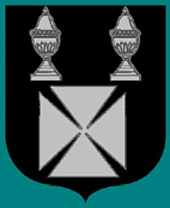
that "All Saint' Skelbrook, in the parish of South Kirkby, which we have seen good grounds for attributing to the renowned Robin Hood, and to have been the 'chapel in Barnisdale' to which, while at the royal
court..........the three cups, the arms of that priory, were till lately to be seen as a finial to the hood-moulding of the tower, a
comparatively recent addition to
the Robin Hood Church, which was
originally without a tower. They have now been shifted to the south porch of a new church built upon the site of the ancient structure, the tower alone remaining of what was standing six years* ago.
* i.e. the new church replaced the old chapel about
1872.When
Joseph
Hunter
published
his 'South
Yorkshire'
in 1823,
the church
he
describes
at
Skelbrook
had not
been burnt
down so
his
description
is closer
to the
original
church. This
church
appears to
have been
attached
to St,.
Mary
Magdalene's
priory at
Monk
Bretton.
Certainly
the priory
had some
lands in
Skelbrook
and gained
the
advowson
of the
church. In
1878
Richard
Holmes
stated
that "All Saint' Skelbrook, in the parish of South Kirkby, which we have seen good grounds for attributing to the renowned Robin Hood, and to have been the 'chapel in Barnisdale' to which, while at the royal
court..........the three cups, the arms of that priory, were till lately to be seen as a finial to the hood-moulding of the tower, a
comparatively recent addition to
the Robin Hood Church, which was
originally without a tower. They have now been shifted to the south porch of a new church built upon the site of the ancient structure, the tower alone remaining of what was standing six years* ago.
* i.e. the new church replaced the old chapel about
1872.When
Joseph
Hunter
published
his 'South
Yorkshire'
in 1823,
the church
he
describes
at
Skelbrook
had not
been burnt
down so
his
description
is closer
to the
original
church.
<
Arms of
Monk
Bretton
[Lund]
Priory,
dedicated
to St.
Mary
Magdalene.
 |
|
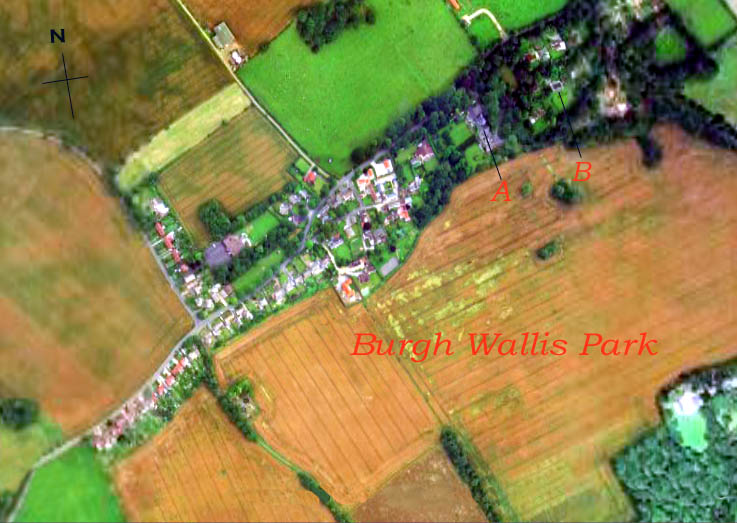
Source:
Google
Earth
Aerial
view
of
Monachorum
or
Monk
Bretton
Priory.
KEY:
A
=
Priory
Entrance.
B
=
Gatehouse.
C
=
Cellar.
D
=
Kitchen.
E
=
Refectory.
F
=
Guest
House.
G=
Infirmary.
H
=
Warming
House.
I
=
Chapter
House.
|
William,
son of Hugh Pincerna and all
his heirs were provided with
a token peppercorn rent of a pair
of white gloves for tenancy of his
lands each year [which may explain
the appearance in the Geste
of Gilbert Withondes or Gilbert
of the White hand]. The surname
'De Doncaster' is evident conjoining
with the Butler family in the
early 1200's.The disagreement and resulting
fight between Little John and the
Sheriff's butler in the
Geste is well matched and Little
John invites the butler to join the
band of outlaws, the connection with butlers
will not go amiss either.
In verse 91 of
the Geste the exclamation
'By God and Saint Richard"'
is probably St. Richard of
Chichester who was canonised
in 1262 [Dobson & Taylor],
this suggests that the
Geste was compiled after this
date. The meeting with 'Edward our Cumly
King' of the Geste
which Hunter shows is most likely
Edward II [r.1307-1327] is seen as
evidence of the earliest time that the
compiler of the Geste could
have been active although Childs
sees this as the least likely scenario
to be historically based. After abortive
attempts in Scotland, Edward II was in York by April
1323. After a progress
through North Yorkshire
King Edward moved onto Lancashire [the
only time he visited this county] to Liverpool,
a very young town then, and to Nottingham
where he stayed [9th - 23rd November,1323]
and hunted in Sherwood.
These time frames would indicate
that the Geste was compiled
between 1323 and 1377 [the latter
from the Piers Plowman reference]. As P.V. Harris
points out, Ranulf, Earl of Chester [presumably
De Blondeville] has been assumed
to be coeval with Robin Hood in Piers Plowman,
but this may not be the case. This compilation
is thus predicted to be near the end of Edward
II's reign [1327] or in the early years of Edward III's reign
[1327-1377]*. Dobson and Taylor [1976] suggest
that the compiler of the Geste
was accomplished, he fused perhaps two stories
one from Barnsdale and one from Sherwood
into the one narrative. We find the later fyttes of
the Geste are more related to Sherwood
than Barnsdale.
* Between
1327 when Edward II was
deposed and the accession of Edward
III, the kingdom was effectively
ruled by Queen Isabella, widow of
Edward II, and her paramour, Roger Mortimer
for three years 1327-1330. See Nottingham Coup.
If we consider Laurence
Minot's 1339 poem, with reference
to Edward III, during
his invasion of France, as 'oure
cumly king' [ line 1 of Poem IV] then
we must place at least one compilation
of the Geste
after 1330. We might also
consider the possibility of the
Geste being
written down in English during
this time. French was used as the language
of the judicial courts until after the great
pestilence
of 1349
during the reign
of Edward III when English was permitted.
Was the original scribe for the
Geste a cleric
associated with criminals? He was certainly well accomplished in
conveying
imagery
through
rhyming
verse and
it can be
argued in
also
creating
historically
inaccurate
metaphorical
descriptions.
We may recall
from the above pedigree that
Edmund Butler of Skelbrooke
was murdered by three assailants
and Sir John de Eland outlawed these
persons. If the compiler of
the Geste was using Sir
John's relative+, Margaret
de Savile, as a model for the prioress
of Kirklees whose tenure was perhaps
from 1350-1360 then this places the
compilation after 1350-60 and before
1377. It is worth noting that Sir John de Eland, who appears to be a bullying
tyrant for John de Warrene was living in the time
of Margaret de Savile's tenure.
+
It would appear
from Baildon's work that she
was the sister of Sir John de Savile
[d. 1405] who married Isabel de
Eland daughter of Thomas de Eland second
son of Sir John de Eland, High steward
of the Wakefield manor [d.1253], a relationship
by marriage viz :
Sir John de Eland=========1=========Alice
de Latham
High Steward of
Wakefield manor
|
Sheriff of Yorkshire
d. 1353*
|
__________________________________
|
|
Sir John de Eland
d.s.p.1353
Thomas de Eland====Joane
|
____________________
|
|
|
Isabel de Eland====<Trinity 1353===Sir John
de Savile
Margaret
de Savile
Prioress of Kirklees
tenure
prob. 1350-60
d. >1360
* Old pedigrees
give death date as 20th October
1350.
Verse 451 of the
Geste tells us that
'The pryoresse of Kyrkesly
that nye was of his kin', suggests
a filial relationship between
Robin and the prioress of Kirklees.
We do in fact find a relationship
between Robert Butler
and Margaret de Savile. The Butlers
after Hugh Pincerna's marriage
to Avice de Savile sometimes
referred to themselves, or were
referred to by their relatives in
records as 'De Savile' e.g.
Richard the son of Hugh Pincerna and Richard's
son Ralph. The connection between
Robert Butler and the prioress of Kirklees
is traced but not recognised by W.P. Baildon
[1929] this deriving from a common
ancestor in Sir Henry de Savile [d.1231?] as
follows :
The heiress
of Golcar*====1====Sir Henry de Savile
====2====?
d. 1231?
|
|
Hugh Pincerna=========Avice
de Savile
Sir John de Savile=====Agnes
b~1200 d 1250
|
|
Richard Butler [
de Sevile/Savile]====?
John de Savile===?
b 1225 d 1278
|
|
Robert I Butler====Constance
Peter de Savile*=====Maud
* 14 Ed. I
- Inq.
showed
Peter who
held
Skelbrooke
to be an
idiot.
[Hunter J.
South
Yorkshire]
b 1250 d 1308
|
|
Robert II Butler====Agnes
John de Savile===Margery
d 1299
b 1275 d1336
Rishworth
|
|
Robert III Butler of Skelbrooke
John de Savile ===Margery Wood
d. 1294
|
______________________________________
|
|
Sir John de Savile===Isabel de Eland**
Margaret de Savile
Prioress
of Kirklees
tenure prob. 1350-1360
Key:
* Golcar
is between Elland and Huddersfield,
Golcar
passed to Peter de Savile.
This removed
these lands from the Butler line
[dispossession by the male Savile
line?]
** Grand-daughter
of Sir John de Eland, chief
steward [seneschal to John de Warrene earl of Surrey Lord
of Wakefield], Sheriff of Yorkshire who outlawed
the murderers of
Edmund Butler of Skelbrooke of the De Laci
camp.
However
from the period of Margaret
de Savile's tenure and
Robert Butler's death date it would
not appear that she had any direct
effect upon his demise. The assumption
is that he did die as a result of
'pressing'. But did he? The Geste
was apparently compiled during or
after the prioress's tenure as mentioned
above. But there is a connection
between the Kirklees nunnery and Robert
Butler of Skelbrooke. This relationship
bears considered analysis.
Robert III Butler of Skelbrooke
apparently died in 1294 from
the effects of torture by the
Yorkshire ecclesiastical courts.
These courts were held in the Chapter House
which was probably built under the instruction
of John Le Romeyn, Archbishop of York.

|
The early
York Minster with its Chapter House
yellow = 1220-1260
blue = 1280-1350
The chapter house was completed
in 1286, it was and still is used as the meeting and discussion
place for the Dean and chapter of the clergy/college of canons.
New canons are also installed here and in the past ecclesiastical
courts were held to determine the fate of heretics and fallen
clerics. In 1296, Edward I even held a parliament here.
The octagonal plan unlike many other
chapter houses has no central column to support the roof,
but a very intricately designed vaulted structure. The chapter
house provides six seats on each wall, there being seven walls
for this purpose. The walls display some of the Minster's finest
carvings, mostly made between 1270-1280.
These
carvings include depictions of grimacing faces, hounds,
monkeys and other grotesque animals, a woman being attacked
by an eagle, a king with a pig on his head and green men with
leaves sprouting from their mouths. The green men represent the
pinnacle of a stonemasons skill, combining the intricacies of the
carving of the greenwood leaves and the features of the human
face. The eighth side of the octagon is taken up by the entrance doorway
leading from the vestibule and north transept. It would have been
here, in the chapter house, that Robert Butler would have been brought
in 1294, perhaps to stand in the centre whilst his inquisitors and
superiors determined his punishment and fate. This has vague correlations
with the 'Poor Knight' being arraigned in the prescence of the abbot
of St. Mary's Abbey, a short distance from the Minster, a little creative
licence by the author of the Geste.
.
|
. 

Green men in York Cathedral
Listen to the stirring
music of Charles-Marie Widor's 'Toccata from Symphonie V
opus 42,
No. 1' played in Paris. On
4th June 2011 during an
afternoon wedding ceremony this
work was played at York Minster when four major pieces of the
Robyn Hode jigsaw were
discovered at the cathedral. All
to be revealed in a forthcoming
publication. This is the real
link to the Masons, not the
often misleadingly speculated
Roslin Chapel.
Widor's opus 42 has been
played as recessional music at
the royal weddings of :
Antony Armstrong-Jones and Princess Margaret,
6 May 1960 at Westminster Abbey.
Prince Edward,* Duke of Kent and Katharine Worsley,
8 June 1961 at York Minster.
Princess Anne and Mark Phillips at Westminster Abbey,
14 November 1973.
Prince Edward and Sophie Rhys-Jones,
19 June 1999 at St. George's Chapel, Windsor Castle.
And the latest .....
Prince William and Catherine Middleton,
29 April 2011 at Westminster Abbey.
* Since
1967 Prince Edward has been
Grand Master of the United Grand
Lodge of England.
|
We should recognise
that the Archbishop of York at the time
of Robert III Butler's torture [d.1294]
was in fact John Le Romeyn [elected 29th October 1285, tenure 1286-1296]
a natural son of John Le Romeyn the elder, treasurer
of York. It was during the later1200's
that Kirklees nunnery, which was under the control
of its mother house at Rievaulx, first
came under the control of the Archbishop of
York and thence until the dissolution. At this time
there were rumours of fraternisation with the
laity and as a consequence, a concern for the spiritual
health of the nuns was raised. It is recorded
for 1287 that Le Romeyn asked the prior of St. Oswald's
of Oswaldkirk to visit Kirklees nunnery where
he was required to hear the confessions of the
nuns and ensure that they were leading worthy lives.
If Robert was tortured under John Le Romeyn's
authority then in some way the prioress in waiting,
Margaret de Savile, who by the time the
Geste was composed, was the prioress
of Kirklees, became connected by association. She was
also connected to Sir John de Eland [d. 1253],
the cruel seneschal of a dissolute master, John de Warrene earl of Surrey, Lord of the Wakefield Manor.
This man was at the forefront of the 'Elland Feud'
a running sore between two contiguous manors, Wakefield
and Pontefract. This feud may have appeared as long ago
as Hugh Pincerna's time when in 1303, it is recorded that
'Simon de Wakefeld complained about Hugh Le Butiler [Pincerna]
of Skelbroke and William de Wakefeld [Simon's relative?]
for assaulting him at York on Tuesday after the
close of Easter, 30 Edw. I [1302]. They denied it.
The jury found that Hugh did beat and wound Simon, by order
(per preceptum) of the said William, and assessed
the damages at £40 '.
October 1285, tenure 1286-1296]
a natural son of John Le Romeyn the elder, treasurer
of York. It was during the later1200's
that Kirklees nunnery, which was under the control
of its mother house at Rievaulx, first
came under the control of the Archbishop of
York and thence until the dissolution. At this time
there were rumours of fraternisation with the
laity and as a consequence, a concern for the spiritual
health of the nuns was raised. It is recorded
for 1287 that Le Romeyn asked the prior of St. Oswald's
of Oswaldkirk to visit Kirklees nunnery where
he was required to hear the confessions of the
nuns and ensure that they were leading worthy lives.
If Robert was tortured under John Le Romeyn's
authority then in some way the prioress in waiting,
Margaret de Savile, who by the time the
Geste was composed, was the prioress
of Kirklees, became connected by association. She was
also connected to Sir John de Eland [d. 1253],
the cruel seneschal of a dissolute master, John de Warrene earl of Surrey, Lord of the Wakefield Manor.
This man was at the forefront of the 'Elland Feud'
a running sore between two contiguous manors, Wakefield
and Pontefract. This feud may have appeared as long ago
as Hugh Pincerna's time when in 1303, it is recorded that
'Simon de Wakefeld complained about Hugh Le Butiler [Pincerna]
of Skelbroke and William de Wakefeld [Simon's relative?]
for assaulting him at York on Tuesday after the
close of Easter, 30 Edw. I [1302]. They denied it.
The jury found that Hugh did beat and wound Simon, by order
(per preceptum) of the said William, and assessed
the damages at £40 '.
 Above all other
similarities with the narrative
of the Geste
in Barnsdale is the case of
the above Robert III
Butler of Skelbrooke [d.1294], the
pebble in the millpond, who appears
as an alleged criminal of the
worst type. No alias here, just a
Above all other
similarities with the narrative
of the Geste
in Barnsdale is the case of
the above Robert III
Butler of Skelbrooke [d.1294], the
pebble in the millpond, who appears
as an alleged criminal of the
worst type. No alias here, just a
thief, robber, rapist and murderer,
at least those are allegations levelled.
In Robert Butler's gaol* delivery
record for 1293 we find "William
the man of William del Sayles living
in Skelbrooke...." this has undoubted
associations with Saylis of the
Geste, a place we recognise here
as Sales Wood in the valley of the Skell.
The similarity of the name Robert
with the diminutive Robin, cannot be misconstrued
by anyone who has heard the Robin Hood
tales.
* The gaol in
the "Wapentake of Osgoldcross", Liberty of
Pontefract, may have been at Pontefract Castle
where the dungeons of the castle keep can still be found.
Robert III Butler's brother, Edmund [possibly
murdered 1333-4] was the seneschal of Pontefract castle during
Henry de Laci's lifetime [d. 1311] and may well have had a hand
in the capture of his brother.
Micklegate, York,
about 1855

The base of the north tower of the
Pontefract keep
housing the windowless dungeons
[Donjon]
Baldwin describes how Pontefract Castle in 24 Edward I (~1296) had a great chamber within the castle walls, another chamber named the
‘Nichole Chamber’,* a wardrobe then being repaired, an armoury filled with artillery and a treasury where counting of money took place and records were stored.28
One of the chambers is afterwards named the Nichole* Chamber. 29
*In various other sources this word 'Nichole' translates as
'Lincoln' for Henry de Lacy was earl of Lincoln.
|

Map of Pontefract
Keep, also known as the Donjon Tower or Round Tower.
|
 This cleaned image of Pontefract
keep drawn about 1560-2 shows the final three levels
above the dungeons on each tower with intervening corbels. John of Lancaster [Gaunt] had the keep raised
in 1374 and added the corbelling which was noted by John Leland
~1530 who described the keep as 'cast into 6 roundelles,
3 bigge and 3 smaull'.17 The 1560 drawing however appears to show
a fourth or northern tower which would make the original
keep quatrefoil rather than trefoil in plan, similar to
Clifford's tower in York. We also can see the addition of Tudor
chimney pots, somewhat similar to some of those seen today at
Hampton Court which the trust is trying to preserve. At the end of August 1541
Henry
VIII did stay at Pontefract Castle on his royal progress of the
North, following the 'Pilgrimage of Grace'. He was accompanied
by Katherine Howard, a very young wife. Katherine appointed her
former lover, Francis Dereham as her personal secretary whilst at
the castle. The sheriff of Nottingham
at this time was Sir Gervase Clifton who had been visited at his
home in Hodsock by King Henry on the king's northern progress following
their mutual appearance at a Robin Hood shooting contest at Finsbury
Park. How did Robin Hood of 'Loxly'* become linked
into the ballad Robin Hood and Queen Katherine?
This cleaned image of Pontefract
keep drawn about 1560-2 shows the final three levels
above the dungeons on each tower with intervening corbels. John of Lancaster [Gaunt] had the keep raised
in 1374 and added the corbelling which was noted by John Leland
~1530 who described the keep as 'cast into 6 roundelles,
3 bigge and 3 smaull'.17 The 1560 drawing however appears to show
a fourth or northern tower which would make the original
keep quatrefoil rather than trefoil in plan, similar to
Clifford's tower in York. We also can see the addition of Tudor
chimney pots, somewhat similar to some of those seen today at
Hampton Court which the trust is trying to preserve. At the end of August 1541
Henry
VIII did stay at Pontefract Castle on his royal progress of the
North, following the 'Pilgrimage of Grace'. He was accompanied
by Katherine Howard, a very young wife. Katherine appointed her
former lover, Francis Dereham as her personal secretary whilst at
the castle. The sheriff of Nottingham
at this time was Sir Gervase Clifton who had been visited at his
home in Hodsock by King Henry on the king's northern progress following
their mutual appearance at a Robin Hood shooting contest at Finsbury
Park. How did Robin Hood of 'Loxly'* become linked
into the ballad Robin Hood and Queen Katherine?
Bellamy [1985] suggests this ballad
could have been written by Richard Darrington who from
1542 was a footman and Keeper of the Royal Mastiffs
for King Henry VIII. In the first few stanzas of Queen
Katherine, a Richard Parrin[g]ton or Patrington is mentioned
as Queen Katherines 'trusted page'.
The queen is to her chamber gon
As fast as she can wend,
She calls to her her lovely page,
His name was Patrington
Darrington
is also a place-name near Pontefract, thus
it could be speculated that Richard Darrington originated
from the village of Darrington, exactly two miles
south-east of Pontefract Castle and that he was hired
by the king on his progress north. Did
this person, Darrington, carry the place-name, 'Loxly'
to King Henry VIII’s Court in the ballad Robin
Hood and Queen Katherine? This author thinks that he did.
* The accepted wisdom is that the
first mention of Robin being connected to Locksley
(Loxley) in Yorkshire or Nottinghamshire appears
in the Sloane MS. of about 1600 which also states
that Robin haunted around Barnsdale Forest. However if we
take the ballad of Robin Hood and Queen Katherine
as being penned by Darrington, a footman of Henry
VIII's household then the Sloane likely borrows from it. The
Sloane seems to borrow from John Leyland's Collectanea
[1540] which suggested that Robyn and his followers hid out in
'Barnsdale Forest'. However, there never was a Barnsdale Forest,
suggesting that this was either creative hypothesising or
inaccurate local hearsay committed to print.
|
Alice daughter of Henry [d.1311] de Laci
of Pontefract would have been about 11 or 12 years of age
in 1296
two years after
her marriage to Thomas Earl of Lancaster, the question
which may arise is: Was Alice de Laci living in an
upper level of Pontefract keep whilst Robert Butler was incarcerated
below in the dungeons? Edmund Le Botillier, Lord of Skelbrooke,
younger brother of Robert III Butler was Henry de Laci's steward [Fr:
seneschal] and was later steward for Thomas Earl of
Lancaster at Pontefract and Alice de Laci, for Edmund did not die until 1333.
 Robert Butler
would not plead and although
he provided the court
with names of accomplices,* his lack
of plea led the court to dispense
with him by an extreme form of punishment
intended to extract such a plea,
la peine forte et dure
['strong and hard punishment'] or
basically pressing, often to death with
as much force as could be applied. This
method was introduced under Edward
I's Chancellor, who was also a churchman and was
also used during Edward I's reign upon William
Wallace, the Scots thorn in the Anglo-Norman heel.
At least Robert Butler and William Wallace had one
thing in common but William was not Robert as
some have speculated. Such a form of torture was
not abolished in Britain until 1772 following
the last case to employ such a method at the Cambridge
Assizes of 1741.
Robert Butler
would not plead and although
he provided the court
with names of accomplices,* his lack
of plea led the court to dispense
with him by an extreme form of punishment
intended to extract such a plea,
la peine forte et dure
['strong and hard punishment'] or
basically pressing, often to death with
as much force as could be applied. This
method was introduced under Edward
I's Chancellor, who was also a churchman and was
also used during Edward I's reign upon William
Wallace, the Scots thorn in the Anglo-Norman heel.
At least Robert Butler and William Wallace had one
thing in common but William was not Robert as
some have speculated. Such a form of torture was
not abolished in Britain until 1772 following
the last case to employ such a method at the Cambridge
Assizes of 1741.
"He was
stripped, laid on his back
on the bare ground, and as
much iron and weights as he could
bear, et plus, were placed on
him, so that he could not rise;
he was given to eat of the worst bread
that could be found, and to drink
of the water nearest to the gaol, except
running water; he had nothing to drink
on the day that he ate, and nothing to
eat on the day that he drank. This was kept up
until he either pleaded or died. The object
of the prisoner was to avoid forfeiture,
which followed on a conviction for felony;
by refusing to plead, he could not be tried, and
consequently could not be convicted."-W.P.
Baildon [1929]
* These 22 who indicate
a large network of criminals
as accomplices and receivers
in the Barnsdale area are provided
by Dr. David Hepworth : Alice Hotty of Skelagh
[Skellow] and her sister
Matilda, Colle of Burgh Walleys
[Burghwallis] the man of Richard
Tyes [Le Tyas probably after Farnley Tyas although
Richard is also known to have held land in Burghwallis and Skellow
in 1284 and 1319], Thomas son of Sybil of
Skelagh [Skellow], William the man of
William del Sayles living in Skelbrook,
John son of Sen' of Doncaster, Thomas
chaplain of Skelagh [Skellow] formerly
living at Doncaster, William Luggeto sergeant
of Armethorp [this is one of the Butler
families earliest estates, east of Doncaster],
Adam le Waleys [Wallace] of Skelagh
[Skellow], Geoffrey le Mouner [Miller]
of Skelbrook, Adam Alman, Benedict son
of Thomas of Slepyl [Sleephill] living
at Kekelton [?Kirkheaton], William son
of Stephen of Burgh Waleys [this may be an unknown
son of Sir Stephen Le Waleys], Robin son of Walter
Walschef of Elmsale [Elmshall], William Smith
of Leicester and his wife, John Skyllare of Lancaster,
William Curry of Tickhill, John the Goldsmith
of Doncaster, Robert le Mouner [Miller] of
Paynel Hoton [Hooton Pagnell] and William Maureward.
It is noteworthy that a cleric,
the chaplain of Skellow
is included, perhaps a prelude
to the introduction of 'Friar
Tuck' in much later ballads.
The name Robin makes
its appearance at this time and place in
Robin 'Walschef' probably of
Elmshall [Robin was a
diminutive of Robert more common in the
1200's, according to Dobson and Taylor
than Robert]. The reference to a goldsmith indicates
the direction any contraband gold would
have travelled and this destination appears
to be Doncaster rather than Pontefract. The
place-names provide us with the geographical
distribution of the persons involved.
'Walter Walschef
of Elshale' would have been 'a man of' John de Wentworth of Elmshall who married Joan daughter
of Richard Le Tyas of
Burghwallis who is mentioned above
in relation to 'Colle of Burgh
Walleys the man of Richard Tyas'.
Richard Tyas married
one of two heiresses of Tankersley,
Alice de Tankersley and thereby
gained part of the Tankersley estates along
with Hugh de Eland who married
the other heiress Joan. Joan Tankersley's
marriage to the High Steward of Wakefield
the manor and High Sheriff of Yorkshire, Sir
John de Eland made him the nephew of Alice de Tankersley. This Alice
de Tankersley who
married Richard Tyas of Burgh Wallis had
a daughter Joan who married John de Wentworth
of Elmshall, this appears to be a close network of
local landowners and their criminal subculture.
Is this the band of outlaws
which provided the compiler of the Geste
with further inspiration for the original ballad,
at least the earlier fyttes, of Robin Hood?
Robert III Butler
claimed some immunity from
the king's civil courts as
a clerk of the Church. According
to court records Robert possessed no
chattels, he admitted his guilt,
ostensibly outside the court, and
allegedly under torture whilst
in custody. However, the custodian denied,
under oath, that any torture had occurred.
Robert Butler would have succeed to his father's
lands at Skelbrooke if he had not been convicted,
but if he were to plead, be tried and
convicted then he and his heirs would
lose the claim to his father's lands [dispossession].
The justices ordered the sheriff
of the time to take Robert back to prison.
A priest pleaded for Robert as a member
of the clergy, the justices handed Robert
to the Archbishop of York for trial by
ordeal [pressing]. Again similarities arise,
for the court that dispensed
the punishment was an ecclesiastical
court at York. This may remind us of
the abbot of St. Mary's court at York who was visited by Sir Richard at the Lee and
perhaps the York county assizes where historically
a Rob. Hode was declared
a fugitive in 1230.3
Ostensibly, Robert Butler
was killed in 1294 by the method of
'pressing', but his trial is exactly
100 years after John Major claimed
that Robin Hood had been outlawed [1193-4].
Hunter gave Robin Hood's age at his
death as 77 years, subtraction from
the oft quoted death date of 1347 that provides
a birth year of about 1270, approximating to
that of Robert Le Botiller of ~1275 [according
to Baildon] whose parents married ~ 1269.
If there were folk tales about shortly after
the death of Robert III Butler then there would
have been 25 years or less in which to name
Robin Crosse* in Derbyshire
and 150 years or less,
plenty of time, to name Robin Hood's Stone
in the
Skell valley, first recorded 1422. Local folklore today tells us that
Robyn and
his men
watered
their
horses in
the Skell
and grazed
their
horses in
a field
above
Wrangbrook
House
located in
the 'Lynges
of Slepil'.27
Wrangbrook
and the
area of
Slephill
('Stephill'
in
Burton's
Monasticon
Eboracense,
1758, p.
305.) is
where the
monks of
Monk
Bretton
(dedicated
to St.
Mary
Magdalene)
worked the
land.*Three miles S.W.
of Hathersage, a medieval wayside
cross on the moors, one mile east
of Bradwell in Hazlebadge parish. The
base of the cross was still extant
in the 1970's and recorded as 'Robin
Crosse' in 1399. Later this became known as
'Robin
Hood's
Cross'.
How could
Robert Butler become known as 'Robyn
Hode'? There had already been
a number of miscreants with a similar
name. Robert Hode of the York Assizes of 1225 for example.
Between 30 Edward I [1302] and 10 Edward
III [1336] a period of less than forty years,
there were no less than six 'Robyn Hodes' identified
by Childs such as Robert Hood of Bitchill,
Wakefield [1316], originally noted by Hunter,
Robert Robyn Houd of Hastings, Sussex [1332],
Robyn Hode, one of Edward II's valets de chambre*
[1324], also noted by Hunter and Robert Hod a common
councillor for Vintry Ward, London [1325]. These
may all have been legitimate names rather than
epithets. By 1400 a manuscript from Lincoln Cathedral
had wriiten on it 'Robyn hod in Scherewod, stode'
which mimics the Geste ['Robyn stode in Bernesdale']
which in turn seems mimiced by a legal maxim which appeared
in the English court of 1429 'Robin Hode en Barnsdale
stode'. His name seems to come entirely from the Geste
so popular was its movement through the halls and fairs
of England and Scotland.*Hunter's account [1852] of a
Robyn Hode as one of the King Edward II's hirelings
centred upon a correlation with Robert Hood,
who lived in Wakefield, with the person 'Robyn Hode' mentioned
in the king's accounts. Hunter's researches indicated
that this person was in the King's service from March
1324 to November 1324. However subsequent ultraviolet
analysis of the account documents showed that Robyn
Hode was in the King's service in July 1323 which is before
the King travelled North.16
The
Sheriff of Yorkshire was
John de Meux in 1292 and 1293 but
just prior to Meux the sheriff
of Yorkshire for six years had
been Gervase de Clifton [tenure
1286-1292] . We also find
that a Sir Gervase Clifton was
a Sheriff of Nottinghamshire and Derbyshire
in 1279 and 1290, this would obviate the
removal of any barrier to the sheriff
of Nottingham and Derbyshires operating
in Yorkshire. Is this the sheriff
that Robyn [actuality the compiler] reminds his
band of men to keep high in their minds? The compiler
of the Geste could
have been writing about a Sir Gervase de Clifton
[d.1377] who was the sheriff of Nottingham
in 1345, the similarity of name and descendancy
would not have gone amiss. A Sheriff of Nottinghamshire
who followed the tenure of Gervase [d.1377]
was John Walleys [1350] who may have
been a descendant of the Le Waleys of Burghwallis.
Much later
a Gervase Clifton 1st baronet
of Hodsock [b.1581]
is recognised here as being a great
influence in popularising the
Robin Hood-Nottingham connection.
Hodsock is just over the county boundary
in Nottinghamshire and was visited
by Henry VIII with his wife Queen
Katherine [Howard]. Katherine had
a short tenure as queen as a result of her
dalliances whilst on Henry's perambulation
of the North. This royal progress
evolved after the 'Pilgrimage of
Grace' when Catholics in the north revolted
but were crushed after Henry broke
his vow. Hodsock was granted originally
by Roger de Busli to his kinsman Torald de Lizours whilst Torald's likely brother, Fulk
de Lizours was granted Sprotborough. Sprotborough then
descended to the FitzWilliams when Sir William
FitzWilliam de Clairfait,
Lord of Emley and Hampole advantageously married
Albreda [Aubrey] de Lizours.
We also find
that the Butlers held lands at
Scawsby adjacent to Sprotbrough
lands [FitzWilliam country] where
Scawsby Lees, like the Butler's Skelbrooke
lands, straddled the old Roman Ridge,
and which further north becomes 'Watling
Strete' through 'Barnsdale'. To the
N.E. probably still in the Butler lands stands
a motte and bailey , 'Castle Hills' which could conceivably
have been a residence of the Butler family.
.
Key :
..... Lands belonging to the Butlers
..... Lands
belonging to the FitzWilliams
Upon these
lands at Scawsby Lees on the 26th October
1536 Robert Aske with 30,000
troops camped during the rebellion
against Henry VIII's repressive regime
led by the Duke of Norfolk. Were
the troops, 'the flower of the North'
aware of the significance of this site as they
faced Henry's troops across the rapidly
flooding River Don.? If so, how much would
tales of Robin Hood be regaled around the troop's
camp fires.
It is also interesting to note
that Katherine Howard prior
to Henry's travels north instigated
an archery match at Finsbury
Circus outside the London
city walls.7 Sir Gervase
of Hodsock ['Gentle Sir Gervase'
b.1516, grandfather of the 1st
baronet] played the part of the Sheriff
of Nottingham. Was it here a member
of the Stanhopes played 'Little John'
which gave rise to the story attached
to 'Little John's bow' which used to hang
at Hathersage and then Cawthorne Hall,
South Yorkshire?
Gervase Clifton
1st baronet was somewhat
of a serial groom for he married
seven times. The first was
to Penelope Rich of the Wakefield
Manor [wherein lies Kirklees
priory] the seventh and last was to
Alice Hastings, daughter of the 5th
earl of Huntingdon which honour
Henry VIII had revived in George
Hastings. Both these marriages provide
strings with which to draw some of the
other stories together.
We find similarities
between the Butlers of Skelbrooke
and the Paston's of Norfolk.
Sir John Paston's letter to his
brother William Paston dated 16th
April 1473 states that John's servant had
deserted him 'to pleye Seynt Jorge and Robyn
Hode and the Shryff of Nottingham' and
had 'goon to Bernysdale'.15 The Paston's
were patrons of minstrels and balladeers,
albeit the letter was written about one hundred
and eighty years after Robert Butler's death.
Recent findings indicate that the copy of
Robin Hood and the Potter in
Cambridge University Library, another early ballad,
belonged to John Paston's bailliff, Richard Calle.
A complex set of circumstances surrounds the
family and its involvement as patrons to the
art of minstrelsy and balladry.
What could
a ballad-muse/minstrel in Skelbrooke/Burghwallis
not do with this story
of Robert Butler! A story of
a man perhaps nineteen to twenty-one
years old, ostensibly from
a well connected family in Barnsdale,
who at the end of the 1200's was made
to look a criminal to all and sundry.
He certainly appears from the list of his
accomplices names to be of a higher social status
and thus may have been respected as a leader.
Would
it not be a literary
incongruity to
paint a robber from a landed
family as a friend to all yeomen
and knights but an enemy of the clerics
and sheriff. A man who would be hero, a
man who would be moulded in the image of
a local robber who had perhaps lived a hundred years
before in the same geographic location.
This sounds like cunning literature, for
which the English have become well known.
A tongue in cheek approach, irony and paradox
rollicking together, some elements
of truth, some of fiction, but above all a
roaring good tale told by the fireside in
a lord's hall with a pint of ale; the primeval
beginnings of the Geste.
Robbery seems
to have been a favourite
occupation in Barnsdale for
a long time, even after the example
the judiciary made of Robert Butler.
Joseph Hunter showed that Barnsdale
was rife with robbers in 1306.26 The
Bishop's of St. Andrews [William de Lamberton] and Glasgow
[Robert
Wishart] and the
Henry the
abbot of Scone journeyed
from Scotland to Winchester where
on some sections of the journey [in
southern England] they had no guard of archers;
at others they had a guard of eight
or twelve men but from Pontefract to Tickhill
the guard was increased to twenty, the reason
given was propter Barnsdale
[because
or on
account of
of
Barnsdale]. Twenty-two years later
the situation was palpably unchanged when it was recorded in the C.P.R.24
for 23rd June 1329 at a parliament at Rochester -
'Commission of oyer and terminer to John Travers, Thomas Deyvill*,
and Adam de Hoperton on complaint by William de Felton
that William Frere of Doncaster, William le Taverner of
Doncaster,
Thomas
Frere, John Frere, Nicholas de Tykhull, Matilda de
Clayton, John le Carter and others assaulted him at Skelbrook, co.
York,
and carried away his goods. By p.s.' *keeper of the contrariants property at Sandal
etc.1322.
In the Geste Little
John notified Robin that the monk[s] waylaid
in Barnsdale had fifty two men with them
whereas Robin's band is described as numbering
'seven score [140]
of whyte young men'. Was the
instruction given by Robin to 'bete
and bynde ... these bisshoppes and these
archebishoppes' a salvo at the ecclesiastics,
particularly of York after Robert III
Butler's cruel death?
If the monetary value of £ 800, given
in the Geste is any guide to the
amount of money taken from the monks on the road
North, then this equates today to an amount of over £
4 million, a not insubstantial sum13.
If Robert Butler had been involved in the robbery of
such wealth from the monks of St. Mary's, York then
the Chuch and archbishop would have approached Robert's
sentencing most severely.
By 1333 Robert's
brother, Edmund Butler,
Lord of Skelbrooke had been
murdered. The third brother,
the last of the Butler male
line,died in 1336. All that was left of
this family in this year was Agnes Butler
who appears to have had a chantry
built into the chapel on the north
side of the church in 1336. In this building
is a window approximately dated to the
mid 1300's, The window is a simple
glass affair with the representation
of a young man's face that stares dolefully
out of a foliate background. Is
this the face of the forest 'greenman' or the
first representation of a Barnsdale
robber imitating Robin Hood?
The Wallaces of Burghwallis
If we now
turn our attention to the
Wallaces [Le Waleys] of
Burghwallis, the next village
to Skelbrooke, in the honour of
Pontefract, they seem related
to the Wallaces of Ayrshire,
one, Robert Le Waleys [Wallensis],
as we have seen was a tandem sheriff
of Yorkshire with Roger de Laci
in King John's reign, so the
links to Carrick/Galloway
seem strong at this time within Barnsdale.
Walter
W. Skeat in his edition
of English Dialects
From the Eighth Century to the
Present Day [e-book May
2005] gives as a heading in Chapter
IV "Lowland Scotch
[sic] identical with
the Yorkshire dialect of Hampole."
Here Skeat rediscovers the works
of earlier writers relating to the
dialects of Northumbria A.D. 1300-1400.
Specifically Skeat is exhuming
the works of the hermit Richard
Rolle of Hampole, Barnsdale. Rolle wrote a
poem about the year 1340 called The
Pricke of Conscience.5
The language of this poem is very
unlike the Geste
although some have suggested, with little
evidence that Rolle wrote the primal
Geste. More than likely A Lyttel Geste of
Robyn Hode and The Pricke of Conscience were later provided
to the printer 'Wynken de Worde' in the same bundle of manuscripts from
a source in Barnsdale, either Skelbrooke or Burghwallis Hall. In the1863
edition of a work by a Dr. Morris
for the Philological Society there
is an analysis made of the grammar
:
"I have
now mentioned the chief
authorities for the study
of the Northern dialect from early times
down to 1400. Examination
of them leads directly to a result
but little known, and one that
is in direct contradiction to
general uninstructed opinion;
namely that, down to this date, the
varieties of Northumbrian are
much fewer and slighter than they afterwards
became, and that the written
documents are practically all in one and
the same dialect, or very nearly
so, from the Humber as far north as Aberdeen.
The irrefragable results noted
by Dr Murray will probably come
as a surprise to many, though they have now
been before the public for more than forty
years. The Durham dialect of the Cursor
Mundi and the Aberdeen Scotch [sic] of
Barbour are hardly distinguishable
by grammatical or orthographical
tests; and both bear a remarkable resemblance
to the Yorkshire dialect as found in
Hampole. What is now called Lowland
Scotch [sic] is so nearly descended from
the Old Northumbrian that the latter was
invariably called “Ingliss” by the writers
who employed it; and they reserved the name of
“Scottish” to designate Gaelic or Erse, the
tongue of the original “Scots,” who gave
their name to the country.
"We should
particularly notice Dr Murray’s
statement, in his essay
on The Dialect of the Southern
Counties of Scotland, at p.
29, that “Barbour at Aberdeen,
and Richard Rolle de Hampole near
Doncaster, wrote for their several countrymen
in the same identical dialect.”
The division between the English
of the Scottish Lowlands and the English
of Yorkshire was purely political,
having no reference to race or speech,
but solely to locality; and yet,
as Dr Murray remarks, the struggle
for supremacy “made every one either
an Englishman or a Scotchman [sic], and
made English and Scotch [sic] names of
division and bitter enmity.” So strong, indeed,
was the division thus created that it
has continued to the present day; and it would
be very difficult even now to convince
a native of the Scottish Lowlands—unless he
is a philologist—that he is likely to
be of Anglian descent, and to have a better
title to be called an “Englishman” than
a native of Hampshire or Devon, who, after
all, may be only a Saxon. And of course
it is easy enough to show how widely the old “Northern”
dialect varies from the difficult
Southern English found in the Kentish Ayenbite
of Inwyt, or even from the Midland of
Chaucer’s poems.""To quote from Dr Murray once
more (p. 41): “the facts are still far from
being generally known, and I have repeatedly
been amused, on reading passages from Cursor Mundi
and Hampole to men of education, both English and
Scotch [sic], to hear them all pronounce the dialect
‘Old Scotch.’ Great has been the surprise of the latter
especially on being told that Richard the Hermit
[i.e. of Hampole] wrote in the extreme south of
Yorkshire, within a few miles of a locality so
thoroughly English as Sherwood Forest, with its memories
of Robin Hood. Such is the difficulty which
people have in separating the natural and ethnological
relations in which national names originate
from the accidental values which they acquire
through political complications and the fortunes
of crowns and dynasties, that oftener than once
the protest has been made—‘Then he must have been a
Scotchman settled there!’” The retort is obvious
enough, that Barbour and Henry the Minstrel
and Dunbar and Lyndesay have all recorded that their
native language was “Inglis” or “Inglisch”;
and it is interesting to note that, having
regard to the pronunciation, they seem to have
known, better than we do, how that name ought to
be spelt ."
|
The conclusions
to this linguistic study
clearly indicates that
even by the 1300's the dialect
used in the Barnsdale area was
little different from that used
in Northumberland and lowland Scotland.
Dobson and Taylor ponder 'why
the Robin Hood legend should have struck
such deep roots north of the border' and
add 'this has never been satisfactorily
explained'. Was it that the title 'Earl of Huntington',
included later in Munday's plays, was held
as the earldom of Huntingdon by various Scottish
kings or was it that there were links with Barnsdale
and Ayrshire? Both seem plausible.
Genealogy of the Le
Waleys of Burghwallis
and their Galwegian
association
Henry I le
Waleys============Agnes*
b~1133 Skellow
|
b~1135
|
Robert le Waleys**=========Dionysia
Poitevin
[Wallensis]
heiress of Burgh
[Wallis], Skellow, Frickley &
Hooten Pagnell
b~1158 d.1218
|
1206-1211
Sheriff of Yorkshire
|
_________________________________________________________________
|
|
|
Henry II ======Elizabeth
Robert===?
Elizabeth=====?
dsp 1210
|
de St. Mary µ
succ.
1210 d.1247
neice of
the abbot
| of Kirkstall later
abbot for Fountains
| Abbey
|
Sir Richard I
le Waleys+======Albreda
FitzWilliam§
sister to Agnes FitzWilliam
b. <1226 d.1272
|
d.of Sir Thomas FitzWilliam
of Elmley & Sprotbrough
probable
uncle to Robert III Butler
descendant illegitimate line
from
|
Henri
Curtmantle's father Geoffrey of Anjou
Sir Stephen I¤======Alice? Contemporaries
of Robert III Butler of
Skelbrooke.
b~1245
|
probable cousins to Robert
III Butler
|
__________________________________
|
|
|
Nicole
Elizabeth====Sir
William
Sir Richard
II ====<2===Eleanor===<1===Robert
VI Bruce==2>==Marjorie
of
Nevile of Raby Wallace
of
b~
1240 d1304
Carrick
Burgh
Wallace#
|
descendant of
d 1301
|
Duncan of
Galloway
|
|
Stephen II Le Waleys
King Robert
The Bruce
b 1305 d 1347 Healaugh Priory.
Key :
*
The name Agnes is French
and is particularly popular
in Ayrshire [originally
part of Galloway]
** Gained
Sibthorpe near Nottingham
in the time of King John.
µ Richard I Le Waleys' mother was Elizabeth de St.
Mary, i.e. of St. Mary's, York. .She was the daughter
of Jordan de St. Mary, who married Alice Haget sister
to Ralph Haget Abbott of Fountains Abbey[1170-1190].
 + 1253
Sir Richard I Le Waleys was
appointed as the first rector
of Burghwallis Church [St. Helen's]
when Burgh was first recorded
as 'Burgh Wallis'. If we are looking
for an early compiler[s] of the
Geste then a
member of the Le Waleys family could be the
originator [s]. Stephen I Le Waleys[d
<1301] appears to be a first cousin of
Robert III Butler, a son of a knight &
rector who held Burghwallis manor, just as Robert III
Butler was a son of the owner of Skelbrooke
manor. We might reasonably speculate that Robert and
Stephen played together as children, in Skelbrooke and
Burghwallis as well as their grandparents lands at
Emley, Hampole and Sprotbrough. Sir Richard as a rector
of Burghwallis and probably his son, were learned men,
able to read and write in English and Latin. That Burghwallis
Church [St. Helen's] may always have had a minstrel
gallery also points in the direction of patronage
of minstrels. The compiler of the
Geste makes our hero a devout follower
of the church as we assume the family of a rector might
be. By his marriage, Sir Richard I was connected
to the FitzWilliams[an illegitimate descendancy
from Henry II's father, Geoffrey of Anjou] and from our
speculation here his wife Albreda was sister
of Agnes FitzWilliam who may be the Agnes who married
Robert II Butler of Skelbrooke. If this
is the case then Robert III Butler's grandparents
were the high profile FitzWilliam family residing
at Emley, near Midgley and
Sprotbrough castle whose woodlands,
Robert Butler would have known as a child
whilst visiting his grandparents, perhaps in companionship
with his cousin Stephen. If this filiation
and speculation holds true then Sir Richard I
Le Waleys would also have visited his parent in law's
manor at Emley, perhaps with his son and young nephew,
Robert at his side.
+ 1253
Sir Richard I Le Waleys was
appointed as the first rector
of Burghwallis Church [St. Helen's]
when Burgh was first recorded
as 'Burgh Wallis'. If we are looking
for an early compiler[s] of the
Geste then a
member of the Le Waleys family could be the
originator [s]. Stephen I Le Waleys[d
<1301] appears to be a first cousin of
Robert III Butler, a son of a knight &
rector who held Burghwallis manor, just as Robert III
Butler was a son of the owner of Skelbrooke
manor. We might reasonably speculate that Robert and
Stephen played together as children, in Skelbrooke and
Burghwallis as well as their grandparents lands at
Emley, Hampole and Sprotbrough. Sir Richard as a rector
of Burghwallis and probably his son, were learned men,
able to read and write in English and Latin. That Burghwallis
Church [St. Helen's] may always have had a minstrel
gallery also points in the direction of patronage
of minstrels. The compiler of the
Geste makes our hero a devout follower
of the church as we assume the family of a rector might
be. By his marriage, Sir Richard I was connected
to the FitzWilliams[an illegitimate descendancy
from Henry II's father, Geoffrey of Anjou] and from our
speculation here his wife Albreda was sister
of Agnes FitzWilliam who may be the Agnes who married
Robert II Butler of Skelbrooke. If this
is the case then Robert III Butler's grandparents
were the high profile FitzWilliam family residing
at Emley, near Midgley and
Sprotbrough castle whose woodlands,
Robert Butler would have known as a child
whilst visiting his grandparents, perhaps in companionship
with his cousin Stephen. If this filiation
and speculation holds true then Sir Richard I
Le Waleys would also have visited his parent in law's
manor at Emley, perhaps with his son and young nephew,
Robert at his side.
§ Sir Richard Le Waley's
wife Albreda FitzWilliam had
a marriage settlement dated 1250-1260.
Albreda's great great grandmother
was Albreda de Laci, ancestor
of the Pontefract de Lacis. Her grandmother
was Adela Plantagenet, daughter of Hamelyn
Plantagenet, illegitimate half brother
of Henry [II] Curtmantle,
King of England.
¤
Sir Stephen I Le Waleys,
it is speculated, was a cousin of Robert
III Butler of Skelbrooke. We know that Sir Stephen was familiar with an Abbot
of St. Mary's, York [Simon de Warwick in 1276]
for their names appear along with Roger
FitzThomas [of Woodhall], and William FitzThomas both Robert
III Butler's uncles:
''Sir
Roger fitzThomas [of Woodhall], witness (together
with his brother Sir
William)
to grant of the manor of Langthwaite for life, dated
at
Langthwaite, 2 Ides of Mar 1276:
Hugh de Langthewait, son and heir of Sir William de
Langthewait,
to
Sir Robert de Eueringham,[Everingham] then rector of
the church of Berkyn.[Birkin, E. Yorks.]
The
manor of Langthwaite with all appurtenances; all his
land in
Adwick
le Street; all his land and rent in Doncaster between
Chesewold
Bridge and the mills bridge; all his land and rent
in
Wheatley; ½ mark annual rent in Sprotborough
which is owed by Sir
William fitzThomas. For term of life. Annual rent
of 19s. 8d., of
which 5s. 4d. to the chief lord of the fee, Peter de
Mallo Lacu,
13s. 4d. to the Abbot of St. Mary's,
York, 1s.[Simon de Warwick in 1276] to Sir Stephen
le
Waleis,[Stephen I Le Waleys] lord of Bourk[Burgh
(Wallis)]; and suit of court to the Court of Sir Peter
de Mallo Lacu at Doncaster.
Witnesses:
Sir William fitzThomas [aka FitzWilliam
d. 1295], Sir John de Romundby, Sir
Roger fitzThomas,[of Woodhall] Sir
Richard de Romundby, kts., Sir William de
Veyley, rector of Owston, Sir Henry de Normanton,
Henry chaplain of
Adwick le Street, Ralph de Langthewait, Thomas de Scauceby
[Scawsby], William
de Newesum, Henry de Rockeleye, Adam de Langthewait,
Adam Maldut
and many others. " - PRO, Sheffield Archives: Cooke
of Wheatley Muniments, CWM/131[12]
# Sir Richard married
Robert VI Bruce's widow, Robert had stong
links to the Wallaces of Ayrshire and secondly
married the Countess of Carrick.
Sir Richard II Le Waleys [Wallace] originally
supported Thomas Earl of Lancaster against Edward II for in 1315 he was
a member of an insurgent group who struck at supporters of
the king in Lancashire, this was led by Adam Banastre and became
known as the Banastre Rebellion. The Lane through Skelbrooke is
called Bannister [Banastre] Lane . Later Sir Richard
II Le Waleys also supported Thomas Earl of Lancaster in his
attempt to overthrow Edward II. As a result of the earl's
loss at the Battle of Boroughbridge, Sir Richard
forfeited Burghwallis after 1322 for a while.
Earl Thomas's lands were held from 1322 until 1327,
this may give us some indication of the time that elapsed during which
Richard had his lands confiscated.22 1322 was the
year that Roi de Bruant, John Butler [Botiller], lost his
holdings in Pontefract for also supporting Thomas.
Both Robert
le Waleys and
Hugh Pincerna were contemporaries
living on adjacent manors
and held offices as consecutive seneschals
of Pontefract. Their lands
straddled 'Watling Street' in Barnsdale.
In addition a decendant of Robert
le Waleys, the sheriff in King John's
reign, was the first marriage of
Robert VI Bruce who later married Marjorie of
Carrick [northern Galloway] who was the
mother of King Robert The
Bruce.
There is no evidence
as yet that Robert Butler took
from the rich and gave to the poor.
What sets Robyn aside from other outlaws
in the Geste
is his 'curtesye' but this appears to be
a construct of the compiler later taken up by John
Major [Mair] who added flesh to this solitary
word from the ballad.:
'He
would allow no woman to suffer
injustice, nor would he spoil the
poor, but rather enriched them from
the plunder taken from the abbots'
-Historia Majoris
Britannia.
|
'Equally unlikely,
from the relationships provided
here, is the period of
our hero occurring in the reign of King
John as suggested by Major 'Robertyus
Hudus Anglus et Parvus Johannes'.
This denial flies in the face of widely
and commonly held beliefs which may need
to be rectified. Dobson and Taylor [1972]
remind us that Major derived his positive
belief in Robyn Hode from 'songs which were
told all over Britain'.
Did Robert Butler
plunder the abbots wealth as John
Major suggested? One in particular,
the bishop of Hereford? Here again
we enter the grey area. There is little
support for this other than a later ballad
and folk tales. But the fact that Robert
Butler was passed over to the ecclesiastical
court at York indicates that, apart
from being a clerk of the church perhaps under
Richard Le Waleys, first rector of Burghwallis
church, there was a serious score to settle.
Certainly the church tortured Robert using a very recently
devised method and for him there seems to have
been little mercy. In reality what part, if any,
did the prioress play in Robert's capture and why
does she take such a defining part in the
Geste? The speculation may revolve about
the prioress representing the Church at York or
just as plausibly this part of the Geste
was added later, along with Robyn's exploits in Nottingham.
There is little doubt that the pervading tenor of the Geste
is anti-monasterial.
There are two
possible reasons why the
Geste and
later ballads were so popular,
why the pebble in the millpond created
such a huge wave. One is that the
person they were based upon was a larger than
life character as is often displayed in modern
entertainment, or alternatively, and
probably more realistically, he was an ordinary
man-boy of whom larger than life things were
written. There is little doubt that the Geste
and later ballads gave ridiculously exaggerated abilities
to both Robyn and his followers, such as jumping huge
distances etc.
Is this the nucleus upon which was
grown a crystal so
large and brilliantly coloured
that we have lost the original seed, that
literary inspiration? Is Robert III Butler
of Skelbrooke that seed? He was living
at the epicentre for the setting of the earliest
ballad and was associated with a large network
of criminal accomplices who may have been but the
tip of the iceberg. It would be interesting to hear
the views of a criminologist on this one.
Roger de Laci - the
Patron of Minstrels - a Conduit
for Minstrelsy.
We now
turn to what at first seems
unrelated but bears direct
relationships to Barnsdale and
minstrelsy at the time of Roger de
Laci. Ranulf de Blundeville, the
earl of Chester took a force of men
from the town of Chester and entered
Wales. However, during their tour
they found themselves outnumbered
by the Welsh and decided to make haste
to the safety of their nearest castle at Rhuddlan
or 'Rothelan' [Rhuddlan-
4km S. of Rhyl, North Wales 40 km west of Chester].
Whilst under siege, Ranulf sent
word to his constable at Chester,
Roger de Laci, Lord of Pontefract to come
to their assistance. Roger had recently
[1205] been released from King Philip
of France for a ransom of 1000 marks
after his defiant, almost year long stand
against overwhelming forces at Castle
Galliard.
Roger set
forth across the River
Dee with mostly minstrels,
thieves and vagabonds who were
attending the Chester Fair that
had originally given priviledges
to these people "That they should not
be apprehended for theft, or any other
offence during the time of the fair,
unless the crime was committed therein."
Roger raised
the seige more by bluff
than substance, for when the
besiegers perceived the
large host descending upon
them with Roger's purple lion
rampant banner at their head,
they dispersed, thinking it was
a large trained army approaching. As
a reward Ranulf earl of Chester [he who
is probably mentioned in Piers Plowman]
conferred upon Roger and all his heirs
the control and patronage of all the
minstrels [as well as fiddlers,
shoemakers and vagrants] in the county
of Cheshire. This ostensibly gave rise
to the exclamation "Roger, and by all
the fiddlers of Chester!".
Roger then
transferred this patronageof the
minstrels to Hugh Dutton,
his seneschal [chief steward]
of Halton Castle [Dutton
lies 5 km S.E, of Halton Castle].
This eventually led to the Dutton
family taxing by licence, the musicians
in the county which was carried out
in the Dutton Court at Chester on
the feast day of Saint John the
Baptist, this jurisdiction continuing
in the Dutton family until 1756 :
The Patronage bestowed
upon Roger de Laci's Steward
"That,
at the midsummer fair held
at Chester, all the minstrels
of that country, resorting
to Chester, do attend the heir
of Dutton, from his lodging to St.
John's Church* (he being then accompanied
by many gentlemen of the country,
one of them walking before him in a surcoat
of his arms depicted on taffeta,
the rest of his fellows proceeding
two and two, and playing on their several
sorts of musical instruments."]
When divine service terminates, the like
attendance upon Dutton to his lodging,
where a court being kept by his steward,
and all the minstrels formally called, certain
orders and laws are made for the government
of the society of minstrels."
*Near the now half excavated
Roman Amphitheatre at Chester.
|
If
we now move this scenario
to the other side of England, to the
De Laci lands in the honour
of Pontefract, we can envisage
Roger de Laci's seneschals
at Pontefract and perhaps Roger himself,
patronising minstrels and
fiddlers in order that they entertain
them. Not only was the chief steward
responsible for the food and wine, but
also, with the supervision of Lady de Laci, the organisation of
periodic entertainment, a social
secretary of sorts.9
There can be little difficulty
in visuallising Lady Matilda de
Laci, [a lady of the great House of Clare formerly
living at Tonbridge Castle, Kent],
bringing the enjoyment of the minstrels
to Pontefract Castle from Halton Castle
where she would have often resided.. We
should not be surprised if this cultural
cross-pollination occurred between
Cheshire and Yorkshire.
It would
not be drawing a long bow
to expect that this influence
of minstrelsy, through direct
contact of Roger with the
minstrels of Chester Fair, would
find its way to Burghwallis and Skelbrooke
after 1205 where both manor houses
were held by two consecutive seneschals
of Pontefract. The minstrels would
also have been brought to Burghwallis
and Skelbrooke manors in Barnsdale
where at least one of them seemingly
absorbed the local stories of the
1180's and 1190's. This tradition
would have been passed down the
Le Waleys* and Butler lines for a number
of generations, for contacts with fiddlers
and minstrel bands, once made, would
be maintained by demand, regular patronage
and word of mouth.
*St.
Helen's Church, Burghwallis,
may always have had a minstrel
gallery.
Like Ranulf de Blundeville, Roger's
de Laci's overlord, Roger
had a major change of policy
towards Prince John following
his accession
in 1199. From being his
unrivalled enemy, and probably
therefore an enemy of Ralph
III Murdac, sheriff of the
adjoining
county, Nottinghamshire, he became
after 1199, not quite a supplicant
but a strong supporter of King John
par excellence. He was
the only baron in practice, to totally
support John in his desire to retake his
French possessions, evidenced by Roger's heroic but
unsuccessful stand at Castle Galliard.
This would
suggest that Roger's liegemen
would have had to follow
suite even though their lands
had likely been ransacked
along with De Laci's lands at Donnington
near Nottingham about 1193 under Prince
John's orders, the year before
Roger came of age. If an earlier hero had
been sheltered up to now by either
Roger or his liegemen, Robert Le Waleys
of Burghwallis, and/or the Butler family
of Skelbrooke, he would now have to depart
for Sherwood. Richard's general pardon of
1189 for all felons in England had long
since expired, good will had run out.
Hugh Pincerna
of Skelbrooke operated under
the aegis of John II de Laci from 1211 to 1216. It
is easy to see that Robyn
could have been sheltered or at
least tolerated, particularly if the Butlers
and Le Waleys were operating
collusively with cutthroats
and robbers. We can envisage perhaps
Robin being employed as a huntsman
in Burgh [Wallis] or Skelbrooke
Park for the respective families with or
without Roger or his son's knowledge
or agreement*. Indeed verse 115 of
the Geste mentions that Robin
is residing in a [hunting] lodge when
he sends Little John and Much [later, Midge]
the Miller's son up to Saylis [Sales
Wood, above the Skell valley and Skelbrooke].
*Roger seems to have been
extremely confined to matters
in Halton, Chester, Donnington, Nottingham,
Wales, Normandy and Ireland, it must
have left little time for his Pontefract concerns
which he probably left in the hands
of his seneschals.
They brought
hym to the lodge door,
Whan Robyn hym
gan see,
Full curtesly
dyd of his hode
And sette hym
on his knee.
It
is difficult to imagine that
Robert could have worked his 'trade'
in such close quarters to the
two manors of Skelbrooke and Burgh
[Wallis] without some
connivance of the local landowners,
even as heirs of the landowners. Indeed,
Professor J.C. Holt notes,
'Extremely common for example,
was the use of armed ambush as an instrument
in local vendettas and disputes between
landlords and their other tenants'.8
We might add no less between
these landlords and the wealthy
travellers, particularly the clergy.
Landlords could endow themselves with some
of the spoils of the highway robber, which
would have supplemented their incomes
and would have been particularly tempting
stradddled as their lands were, across this part
of the richly travelled great road north,
their behaviour little different to the Cornish
ship-wreckers. Indeed after Roger's de Laci's death
in 1211, Robert Le Waleys had to produce a large
sum of money which had apparently been detained from
the sheriff's county profits.6 He and Roger de Laci had only declared half the profits
made, Robert was obviously not averse to plundering
even King John's income stream.
The original
composer of the
Geste narrative
knew the locality of the
Burgh [Wallis] and Skelbrooke
environs well enough to include
salient topographic features
and human settlement patterns, but
nowhere are Skelbrooke and Burgh
mentioned, just the generalisation
'Barnsdale' which seems vague
enough to deflect any identification and
targeting of local families involved.
The question which arises here is was
Robert Butler of Skelbrooke the inspiration, rather
than the candidate for a medieval narrative
based upon some associations with this family?
The
seal of
St. Mary
Magdalena
of
Lund, Monk
Bretton
Priory
commonly
called
Burton
Abbey >
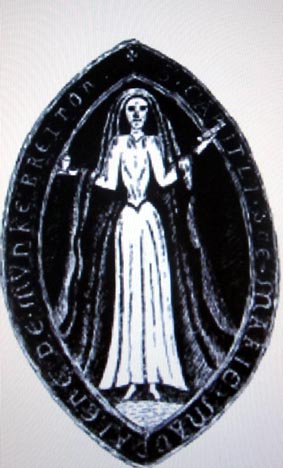 The chapel at Skelbrooke,
originally built in the 1100's
was undoubtedly patronised
by the Butlers of Skelbrooke,
is this the chapel in the Geste dedicated to Mary
Magdalene which Robin said he wanted
to [help] build, an excuse to leave
the king's household? If so then
the compiler of the Geste
was almost certainly residing
in the area at the time this piece was written. The
probable
truth is
that the
author of
the Geste
used the
name of
the nearby
Monk
Bretton
Priory. Unlike Hunter, perhaps we should not
try to equate occurrences in the
Geste with literal historical
figures here, remembering that the
primary purpose of a minstrel's verse sung
was for the that of entertainment in
order to make a living. Show business with the
emphasis on 'business'. Ask any English folk
balladeers
today, who essentially
sing about situations extremely
close to themselves, we
should not expect the literal truth
but some entertaining version of it.
No one would suggest that 'the
Scottish play' of Shakespeare was historically
accurate yet there are elements
of history within the play.
The chapel at Skelbrooke,
originally built in the 1100's
was undoubtedly patronised
by the Butlers of Skelbrooke,
is this the chapel in the Geste dedicated to Mary
Magdalene which Robin said he wanted
to [help] build, an excuse to leave
the king's household? If so then
the compiler of the Geste
was almost certainly residing
in the area at the time this piece was written. The
probable
truth is
that the
author of
the Geste
used the
name of
the nearby
Monk
Bretton
Priory. Unlike Hunter, perhaps we should not
try to equate occurrences in the
Geste with literal historical
figures here, remembering that the
primary purpose of a minstrel's verse sung
was for the that of entertainment in
order to make a living. Show business with the
emphasis on 'business'. Ask any English folk
balladeers
today, who essentially
sing about situations extremely
close to themselves, we
should not expect the literal truth
but some entertaining version of it.
No one would suggest that 'the
Scottish play' of Shakespeare was historically
accurate yet there are elements
of history within the play.
A vector for the narrative, 'A
Lytell Geste of Robyn Hode'
One other interesting
connection occurs between a Gilbert
Robynhod of Fletching,
Sussex and Pontefract. This person
was first noted by E. K. Chambers12
and later followed by Dobson & Taylor [1976].
J.C. Holt noted that this surname must have derived
from the outlaw. Bellamy [p.32] states, "Gilbert
Robynhod may have served in the household of Alice de Lacy [and Earl Thomas
Plantagenet]
and aquired the name by playing or reciting the tales
which came from the northern Lacy estates". As
J.C. Holt states [p.59] this is the first recording of the
surname Robynhod. Gilbert appears as a
tenant of the Liberty of Leicester, Sussex in a tax roll
of 1296. In 1294, the year Robert III Butler presumably
died, Alice de Laci, heiress to much of the De Laci
estates, married the Earl of Lancaster, Thomas Plantagenet.
Until his death in 1311,
Alice's father, Henry de Laci held the honours
of Pontefract and Clitheroe. Thomas and Alice
held the Liberty of Leicester in Sussex wherein
lay the manor of Hungry Hatch in Fletching as well
as the De Laci lands of Alice's father. This
supports both Bellamy and Holt's suggestions that
the ballad was known within the De Laci family into the
time of Thomas Plantagenet a powerful man who held
five earldoms.
One fact which Bellamy
felt worked against Gilbert [introduced
Withondes?] is that the period 1294 - 1296
is a very short time for Gilbert's new patronymic, 'Robynhod' [which it is suggested here is the result
of telling the story of the Geste] to become
commonly accepted. Holt details other people* in Sussex
who appear later in records with the same surname,
who were possibly descendants of Gilbert Robynhod.
* Robert
Robynhoud at West Harting, Sussex, 1332,
and Winchelsea, Sussex, 1381.
But we might now ask how
quickly could a new, popular, ballad travel,
carried by one person from the De Laci lands
in South Yorkshire to Sussex? Very quickly,
and the bearer, perhaps from Yorkshire, would equally
have quickly aquired the surname, enough to
be recorded in an official court document in 1296
at Fletching Sussex. If this is the case then Gilbert
Robynhod gained his name from the telling of the
Geste which was written and dispersed very quickly.
De Laci Pedigree:
Roger 'Helle' de Laci========
Patron of
Minstrels
|
Roger's seneschal : Robert
Wallensis [Le Waleys] 1206-1211
|
John II de Laci=========
b 1192 d 1240
|
John's seneschals/stewards
: Hugh Buticularius [i.e. Butler] before 1211, Hugh
Pincerna [Butler] 1211-1216,
Sir Henry Le Waleys
1216-1218+
|
Edmund de Laci=======Alice de Saluces [Saluzzo, NW Italy]
b 1230 d 1258
d
by 1311-1312
Const. of Chester
|
1234+ Lord
of Stanbury Manor
Edmund's seneschal : Walter de Ludham
1240-1246 |
|
Henry de Laci======Margaret Longespee
3rd Earl
of Lincoln b 1250 d 1311
| Plantagenet
b 1250 d 1306-1310
Sir John de Hoderode [ d 1269-1272] is recorded
as the seneschal/steward
of Pontefract in 1252
during Henry III's and also Edward
I's reigns.
|
1275 the steward was Peter de Santon
Henry's
seneschal : Oliver de Stansfield*
|
Thomas
Plantagenet==============1294
==========Alice de Laci+
Earl of
Lancaster
Countess of Lincoln & Salisbury
executed 1322 Pontefract Castle
d 1348 died without issue.
Held Fletching, Sussex. Stewards:
1314 -1315 - John Traves [Travers?]; August
1317 -
William de
Malghum;
1320 -
John de
Bucton; March 1322 - Geoffrey
de Byngham.
Notes:
The male line of de
Laci ended with Henry and after the execution
of Thomas Plantagenet, earl of Lancaster,
the estates passed to the crown of Edward II.
* Oliver de Stansfield or 'Stansfeud' of
Heasandford or 'Heasanforth', 'Heysandforth' House now in Burnley, Lancashire,
son of Jordan de Stansfield of Stansfield, Yorkshire,
a descendant of Wyan Marmions who
probably accompanied William the Conqueror in 1066.
Oliver was widowed by 1292 when he was granted
Worsthorne manor by Henry de Laci and subsequently Oliver became the founder of
the Stansfields of Burnley. This grant was
for a peppercorn rent of 1 penny per annum,
presumably for his efforts as constable
and
receiver of Pontefract Castle. In 1311
he was called to parliament [ M.P.] as a knight.
Oliver granted land
to John, son of Gilbert de la Legh in 1306. Bellamy
tells us that the family named Legh 'was involved in
administration of the Lancashire forests' but none of
them were named Richard. Gilbert about 1322 was the stock
manager for Ightenhill [now Gawthorpe], north of
Burnley, eventually the de la Legh's became the Townleys
of Townley manor south of Burnley. Oliver survived until about 1350 [23 Ed. III] when he was buried
in the
Stansfield
Chapel,
St.
Peter's
Church,
Burnley,
where his
effigy
resides.
+ Alice de Laci entered a marriage
contract with Thomas of Lancaster when
she was 9 or 10 years old in 1294. [this
would make her born ~1285 but some genealogists have
her birth year as 1281 which would make her ~ 13 years
old at the time of the marriage contract]. It seems
some did not approve of the marriage for one description
has 'a wretched and disgraceful marriage attended
with all kinds of scandals'.
Thomas argued with
his cousin, Edward II that the population
were being over-taxed and had suffered a number of
famines, antipathy grew between the two.
By 1317 Alice seems to have been estranged
from her husband and was allegedly abducted [others
say she ran away of her own free will] from her castle at
Canford, Dorset, which she had gained through her mother Margaret
Longespee. The men who 'abducted' Alice included Richard
de St. Martin, a retainer of John de Warrene, 8th earl
Warrene, baron of Conisbrough and Sandal Magna castles.
Eubolo Le Strange was earl Warrene's squire and it seems that
Alice and Eubolo were adulterous before their marriage in 1324.
This scenario was most probably encouraged with the connivance
of Edward II. As a consequence, Thomas Earl of Lancaster laid
siege and took Sandal and Conisbrough Castles, burning
Sandal to the ground. After his defeat at Boroughbridge in
1322 and his subsequent trial in the Great Hall at Pontefract
Castle, Thomas was made to face Scotland before being beheaded
under the orders of King Edward II.
See Elland Feud and
The honour
of Pontefract
The Honour of Clitheroe
as part of the Duchy of Lancaster
possessed six manors :
 * Ightenhill Manor [now
Gawthorpe Hall and Park]. Here a manor
house was built in the 1100's-1200's which today
exists only as a mound to the rear of Hill Farm
[Manor House or Smith's Cottages]. In 1200 Geoffrey
Towneley married a daughter of Roger 'Helle' de Laci,
when Geoffrey was granted land at Burnley by Roger.
Later the Towneley family of nearby Towneley Hall held
Ightenhill Park lands until about 1580 when Richard
Shuttleworth was granted a lease here. In 1290 Ightenhill
had a corn mill constructed and by 1294 Henry de Laci
[12th Lord of Clitheroe] had been granted, by his great
personal friend, Edward I, a charter for a weekly Tuesday
market and a three day annual fair both of which continue
today. By 1296 a fulling mill, using local fuller's earth
had been established on the banks of the river Brun, this
saw the beginning of cloth making in Lancashire. Henri de Laci's two sons died prematurely, one is reported to have
fallen down the main well of Denbigh Castle and the second
son to have fallen either from the parapet of Pontefract
Castle or from a window at Ightenhill manor house. Henri's
only surviving child and heiress, Alice de Laci married
Thomas Plantagenet, Earl of Lancaster in 1294. Thomas
gained Ightenhill manor upon the death of Henri in 1311.
But by 1322 Thomas had been executed for his open rebellion
against Edward II. In October 1323 Edward II visited the
manor and spent a number of days here where he busied himself
with hearing pleas after the rebellion of Thomas of Lancaster. In
1333 Richard de Norton, one of King Edward III's archers was
the keeper of Ightenhill Park. Ightenhill Manor was bounded
by Colne and Accrington manors whose limits were marked with unusually
shaped stone boundary markers, ditches and dykes.
* Ightenhill Manor [now
Gawthorpe Hall and Park]. Here a manor
house was built in the 1100's-1200's which today
exists only as a mound to the rear of Hill Farm
[Manor House or Smith's Cottages]. In 1200 Geoffrey
Towneley married a daughter of Roger 'Helle' de Laci,
when Geoffrey was granted land at Burnley by Roger.
Later the Towneley family of nearby Towneley Hall held
Ightenhill Park lands until about 1580 when Richard
Shuttleworth was granted a lease here. In 1290 Ightenhill
had a corn mill constructed and by 1294 Henry de Laci
[12th Lord of Clitheroe] had been granted, by his great
personal friend, Edward I, a charter for a weekly Tuesday
market and a three day annual fair both of which continue
today. By 1296 a fulling mill, using local fuller's earth
had been established on the banks of the river Brun, this
saw the beginning of cloth making in Lancashire. Henri de Laci's two sons died prematurely, one is reported to have
fallen down the main well of Denbigh Castle and the second
son to have fallen either from the parapet of Pontefract
Castle or from a window at Ightenhill manor house. Henri's
only surviving child and heiress, Alice de Laci married
Thomas Plantagenet, Earl of Lancaster in 1294. Thomas
gained Ightenhill manor upon the death of Henri in 1311.
But by 1322 Thomas had been executed for his open rebellion
against Edward II. In October 1323 Edward II visited the
manor and spent a number of days here where he busied himself
with hearing pleas after the rebellion of Thomas of Lancaster. In
1333 Richard de Norton, one of King Edward III's archers was
the keeper of Ightenhill Park. Ightenhill Manor was bounded
by Colne and Accrington manors whose limits were marked with unusually
shaped stone boundary markers, ditches and dykes.
* Accrington
* Colne
* Pendleton
* Tottington
* Chatburn
* Worston
Ightenhill was perhaps
the most pre-eminent manor containing
eight vills :
Padiham
Briercliffe
Worsthorne - granted
to Oliver de Stansfield by Henry de Laci
for his services rendered as constable of Pontefract
Castle. Henry de Laci looked after Ightenhill
in King Edward's name.
Burnley [Bruneley]
Extwistle
Haberingham
Little Marsden.
Bellamy discussing Holt's
comments states 'Three names
and incidents "seeped into a legend centred
on South Yorkshire" through the Lacy families
possession of the honour of Clitheroe, the
Park of Ightenhill and various chases in Blackburnshire....there
were long established links between the
Lacy holdings in Lancashire and those in Yorkshire'
and as Holt puts it, the two county
holdings were connected by ' the road that never left the
Lacy territory'.
An author for the
Geste
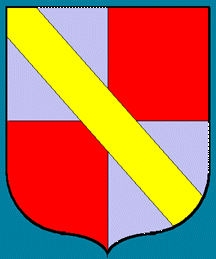 There is a reasonable speculation
that one of the Waleys of Burghwallis
and Newton Wallis was the author of the
Geste. It is proposed that [Sir]
Richard II Le Waleys of Burghwallis [first
baron Waleys d. >1336 who married
Eleanor, Robert Bruce's* widow i.e. King Robert
Bruce's step mother] wrote at least the some of the
fyttes of the Geste Later, Richard II Le Waleys son,
Stephen II Le Waleys is considered to have added or compiled the Geste
with the later fyttes concerning the prioress and Sir Roger de Doncastre
being added by his son-in-law, Sir Robert de Swillington, steward to John
of Gaunt at Pontefract Castle. The undying belief in
the goodness of 'Robyn Hode' and his fidelity
can really only be borne out of a personal knowledge
of a person who modelled for the ballad hero. The first
fytte is at great pains to repeat that Robyn was 'a good
outlaw'. That Robert Butler was a church clerk would
also offer some support for the Geste's
insistence that Robyn was dedicated to Mary Magdalene.
The Magdalene name appears as the dedication in Campsall
Church and the priory at Monk Bretton near Barnsley.
The author seems to have borrowed the name from one
or the other location. Thus what is proposed here is that the
Geste in its early stages underwent
an evolutionary process as the 'Robin Hood' tales still
undergo today. As prof. J.C. Holt has noted, later fyttes seem
to be grafted on. Evolution allows for survival. As with
the living world, organisms that do not evolve or change
to suit their surroundings become extinct. The stories
of Robin Hood survived because they constantly changed
or were added to, new adaptations produced an entirely
different beast to the original concept.
There is a reasonable speculation
that one of the Waleys of Burghwallis
and Newton Wallis was the author of the
Geste. It is proposed that [Sir]
Richard II Le Waleys of Burghwallis [first
baron Waleys d. >1336 who married
Eleanor, Robert Bruce's* widow i.e. King Robert
Bruce's step mother] wrote at least the some of the
fyttes of the Geste Later, Richard II Le Waleys son,
Stephen II Le Waleys is considered to have added or compiled the Geste
with the later fyttes concerning the prioress and Sir Roger de Doncastre
being added by his son-in-law, Sir Robert de Swillington, steward to John
of Gaunt at Pontefract Castle. The undying belief in
the goodness of 'Robyn Hode' and his fidelity
can really only be borne out of a personal knowledge
of a person who modelled for the ballad hero. The first
fytte is at great pains to repeat that Robyn was 'a good
outlaw'. That Robert Butler was a church clerk would
also offer some support for the Geste's
insistence that Robyn was dedicated to Mary Magdalene.
The Magdalene name appears as the dedication in Campsall
Church and the priory at Monk Bretton near Barnsley.
The author seems to have borrowed the name from one
or the other location. Thus what is proposed here is that the
Geste in its early stages underwent
an evolutionary process as the 'Robin Hood' tales still
undergo today. As prof. J.C. Holt has noted, later fyttes seem
to be grafted on. Evolution allows for survival. As with
the living world, organisms that do not evolve or change
to suit their surroundings become extinct. The stories
of Robin Hood survived because they constantly changed
or were added to, new adaptations produced an entirely
different beast to the original concept.
The Waleys family
also held Newton Wallis [Waleis] from 1159, a property
with a moated manor house lying beside the water meadows
of the left bank of the River Calder downstream from Castleford.
The Waleys family had to travel between their two estates
and to do this they passed from Newton Wallis by either of two
routes :
1. Along Newton
Lane towards where it connected with the Roman road,
sometimes called Roman Ridge, between York and Doncaster.
This Roman road has been given various names along its
length. From Doncaster it was Roman Ridge, today, York Road,
towards Barnsdale Bar, the Great North Road, from Barnsdale
Bar it has been called Watling Street, today, Doncaster Road.
From East Hardwick to the Aire meander it is Pontefract Road and
then Lock Lane, a more modern name following the canalisation
of the Aire. North beyond this point it becomes, anomalously,
Barnsdale Road and continues with this name today as far north
as the Allerton Bywater turnoff, beyond which it becomes Ridge Road.
What is significant here is that it appears that the Waleys family
were naming the road to their southern estate after the location of
their Newton Wallis estate. This indicates that the family referred
to their second estate in Burghwallis as 'Barnsdale', the very
name which appears in the Geste.
2. A later route
developed as a substantial highway after the late
1200's or early 1300's through Fairburn and Ferrybridge.
As its name implies, Ferrybridge had been an early ferrying
point downstream from the lowest fording point at Castleford.
About the turn of the 13th century , the Waleys family could
have taken the shorter and faster route by bridge across the
Aire at Ferrybridge. The route would then follow this newly
improved road through what is now Wentbridge, and which was
probably only just developing as a hostelry/staging point,
then on to Burghwallis in Barnsdale. The successor to the Waleys
estates at the turn of the thirteenth century was none other
than Sir Stephen I Le Waleys, cousin to Robert III Butler.
Ritson, in his Robin Hood makes a note
regarding Leland's mention of Barnsdale [Itinerary, V.101]
" Along on the left honde,
III miles of betwixt Milburne and Feribridge, i saw the woodd
and most famous forest of Barnsdale, wher thay say that Robyn Hudde lyvid
like an outlaw."
Now there is no place known by the name of Milburne
but looking on John Speed's map of 1612 we see Milforth which
today is the same place as [South] Milford. It is possible that
Leland travelling from Milforth to Fairburn has conflated the two
names as Milburne. This then would make the wood referred to as "Barnsdale"
an area on both sides of the A162 just north of Brotherton. Here,
today, there is a place called "The Dales" and the area is still well
wooded. This was where Newton Lane from Newton Wallis met the road
to Ferrybridge and would have been one of the routes for the Le Waleys
to take south.. By the mid 1800's the area north of Brotherton had
been extensively quarried for limestone, changing its sylvan character.
Thus, hearsay was providing more 'factoids' with which the Elizabethans
were muddying the waters.
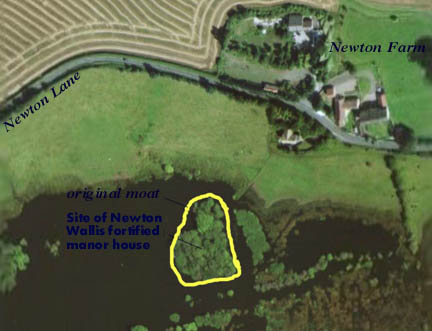 |
Site of Newton Wallis
'Abbey'[Fr:
ab-bé, a house surrounded by
water]. It became known as such because
it was a fortified manor house lying within the backwaters of the river
Calder. |
Sir Stephen
I was born ~1245 and died at Newton Wallis [Waleis]
sometime before 1301. He was thus familiar with route1.
to 'Barnsdale' and was just becoming familiar with the
new route 2. when his life was cut short. Sir Stephen's son
Richard II Le Waleys would have been far more familiar with
route 2. than his father for he died about thirty years
after his father. If Sir Richard II did amplify and add to the
Geste then he could well have added references
to Wentbridge. Sir Richard II Le Waleys had shown his alliance
to Thomas earl of Lancaster by his involvement in the Banastre
Rebellion in 1315, and later fell foul of Edward when in
1320 he supported Thomas Earl of Lancaster against the King.
John Bellamy suggests that King Edward II may have visited
the nearby Campsall manor from the 5th to the 6th of November 1322
when Campsall was forfeited to the crown by Thomas earl of Lancaster.7,
p80 If this is so then Edward may have also called in at
Burghwallis, passing along the Great North Road, turning off at Skelbrooke
for Burghwallis and Campsall. It was here at this turning that fairs
with troubadours would gather for local festivities. We could perhaps
envision the local populace merry-making at this junction with the procession
of the king along the highway and local by-ways.
Thus for a while, Richard II Waleys lost Burghwallis,
his precious 'Barnsdale' from 1322. But at the accession
of Edward III [1327] under Isabella and Mortimer he had the 2000
mark fine imposed by Edward II cancelled. Certainly as a possible
compiler of the Geste he could have added the veneration
of King Edward [his regal reality being King Edward III] as
the 'comely king' at this point. Was it here that Richard II Waleys
eventually regained his 'Barnsdale'- Burghwallis from the King, a
pardon in 'Barnsdale', not Sherwood, written into the
Geste as Robyn Hode?
It has been
noted by others that the latter part
of the Geste seems
to be a later addition. Stephen II Le
Waleys' son-in-law, Sir Robert de Swillington, steward to John
of Gaunt at Pontefract Castle is the man with local knowledge
at the right time to complete this. Robin's
visits to Nottingham, Little John's
stouch with the sheriff's butler and the death
of Robin at the hands of the prioress of
Kirklees are fyttes more concerned with places
other than Barnsdale. The connection of the Waleys
[Wallaces] to the Scots may explain why the Scottish also
widely celebrated the ballads of Robyn
Hode.
Stephen II was probably born
about 1305 at Burghwallis and died 1347.
This date will be familiar with Robin
Hood researchers as the date given by
Hunter and others for the death of Robin Hood.
But was it the death year of the author/compiler
of the Geste? Did Sir Stephen II
Le Waleys [highly speculative], the suspected author/compiler
of the Geste, not Robyn Hode, die in 1347? As we will
see Stephen II had the opportunity to gain considerable
material for the Geste from his wife's family as well
as his own.It might also be noted here that Richard I Le Waleys
father, Robert is recorded as dying in 1247, this too will
be recognised as an alternative death date for 'Robin hood'
as offered by the Scottish chronicler, John Major but is likely
to be nothing more than a coincidence.
As mentioned above, Richard Le
Tyas was known to have held lands in Burghwallis and Skellow
in 1284 and 1319. His caput however was at Lede [Lead] near
Saxton only 6 miles north of Newton Wallis, the Waleys and Tyas
families would have undoubtably been well known to each other.
As touched on above, in 1327 Edward III as a king in
his nonage, under the influence
of Isabella and Mortimer, had a fine of
2000 marks cancelled against Stephen II's
father, Sir Richard II, which had been imposed
by Edward II for Sir Richard's involvement with
Thomas the earl of Lancaster. Does this too explain
the lauding of 'Edward our comly king' in
the Geste ? Certainly Edward III was
much more popular than his father.
In July 1306 Edward I granted a third of the manor at farm in Hatfield Broad
Oak priory to Eleanor le Waleys* but in 1307, the year of his accession,
Edward II granted the manor to Humphrey de Bohun, earl of Hereford and Essex.
[Calendar Close Rolls, 1307–13, pp. 386-387.]
However, Humphrey was one of the baronial leaders who fought against Edward
II and lost his life at Boroughbridge in 1322. After this his lands were
forfeited and not regained by his son John until 1326.
In the next reign, according to a writ issued at Wells on the 25th December 1331, the dower lands of Eleanor, Sir Richard's wife at Writtle
and Hatfield Regis, Essex were given to John de Bohun son
of Humprey the earl of Hereford who had died at Boroughbridge. [Calendar Fine Rolls, 1327-1337, p.292.]
This writ of 1331 indicates that Sir Richard and Eleanor were possibly out of
favour
with the
king and that Edward III now saw fit for these lands
to pass back into into the de Bohun family. * Eleanor had previously
been the wife of Robert Bruce, father of King Robert Bruce, she was
thus King Robert Bruce's stepmother..
In the time of
Stephen I Waleys,1288, it was recorded
that "his ancestors were seised from
the time of King John of lands at Sibthorpe
in Nottinghamshire". This would be lands
granted to Robert Walensis, the seneschal of
Pontefract and one time tandem sheriff of Yorkshire
with Roger 'Helle' de Laci. The position of these
lands to the east of Nottingham,
the Fosse Way and Sherwood may explain
why Nottingham was introduced into
the Geste. Sir Stephen
was, it seems, also familiar with this part
of the medieval world. We find some eight
miles SSW of Sibthorpe a village
called Cropwell Butler. This manorial
affix suggests that the Butler's of Skelbrooke
also held lands east of Nottingham in the same
area as the Waleys family. Six miles to the SE of
Cropwell Butler lies Clipston where
the king's of England had a hunting lodge within the forest of Sherwwod
from at least the reign of King John *Clipston lies
near the Fosse Way sometimes also
called 'Watling Strete' between Leicester and Lincoln
six miles to the south-east of Nottingham.
In 1330 Edward [later III] attacked his mother, Isabella and her
lover, Roger de Mortimer whilst in their chambers at Nottingham Castle,
when Edward seized power and took the throne for himself. Following
this coup, Edward met with his supporters in the castle .We do know
that later, in December 1345, Edward
III did hunt at Clipston, his
favourite residence in Nottinghamshire
and that he took Sibthorpe Chapel under
his special protection. If the compiler for
the seventh fytte which mentions the meeting
of Robyn with our 'comly king' was aware of this
he may have replaced King Richard with Edward III.
Local east Nottinghamshire folk tales would
have circulated about meeting King Richard
in Sherwood and thus this scene made an
appearance in the Geste,
but with King Edward III taking the place
of King Richard. Edward III [r.1327-1377]
was the king reigning in the latter half of Sir Stephen's
life when we have suggested, from other relationships,
that the Geste was first compiled.
We are left with the thought that the Geste
may have been substantially written by Sir Stephen
II Le Waleys in memory of his predecessors
childhood friend and cousin, Robert Butler of Skelbrooke
and as we will see at least three other persons being an inspiration
for the ballad.
The sceptic's evidence would
lead us to think that the meeting
of Robin Hood in Sherwood Forest never
occurred and was but a romanticised folkloric
invention which later came to be associated
with the title of earl of Huntingdon through
associations of the tale with persons who
held that title.
Cropwell Butler,
meaning 'Rounded hill', between the
Vale of Belvoir and Nottingham, is named
after a peaked or copped hill south
of the village. In the Domesday Book it
is recorded as Crophille [1086]
and by 1265 Croppill Boteiller, the
manorial addition is from the possession by the
Butler family from the 1100's [A.D. Mills.]. A
mile south of Cropwell Butler is strangely,
Cropwell Bishop or Bishopcroppehill
mentioned in 1280, the manorial affix is
from the possession by the Archbishop of
York! [A.D. Mills].Crophill Bishop being
amongst the manors of the Archbishop
of York, later given to Southwell
Church and Lenton priory, raises the the
possibility of a seed of antipathy
between the two manors that would have developed
from the 'pressing' of Robert Butler under
orders from the Archbishop of York. It is
possible that the Archbishop gained the manor from
the Butlers as compensation for church losses
after Robert Butler's death.
Sir Richard at the Lee
The first
and second fyttes of the Lytell
Geste of Robyn Hode concern
the knight who, we are later told, is Sir Richard
at the Lee.Various authors have tried to identify
this ballad character with a real person. If
we follow J.C. Holt's assurance that the
Geste was essentially based upon intense
geographic localisation, then we should not
cast too far afield for a candidate or an inspiration.
There are eight fyttes in the Geste,
the fifth fytte reintroduces Sir Richard who
provides shelter for Robyn and his men at his castle 'doubleditched about'. This is mirrored in a parrallel
and real local occurence which occurred in 1272. Sir
Richard Foliot at this time held Fenwick manor, which
is a little to the east of 'Barnsdale'. Here a number
of roguish rebels, namely Roger Godberd, Walter Ewyas and
John D'Eyvile were pursued by the sheriff of Yorkshire's
men to Sir Richard's castle at Fenwick. Foliot gave them
shelter but was forced to surrender and gave his son [probably
Jordan II Foliot] with assurances, that he would 'give himself
up as a prisoner at York on an agreed date' [Bellamy p.33]. This,
J.C. Holt notes, is similar to the goings on in fyttes five and
six. But there is little to recommend this correlation until we
realise that in real life Richard Foliot had a second residence,
Jordan Castle near Grimston and Wellow, Nottinghamshire which
Henry III permitted to be crenellated in 1264. Today, Grimston
is marked on maps only as "Grimston Hill", east of Wellow. In Nottinghamshire
Sir Richard was known as 'Lord of Grimston and Wellow' J.C.
Holt sees it as significant that the Foliots who held Fenwick,
[Walden] Stubbs and Norton [Went Valley], before the Hastings
family, had these other holdings on the eastern margin of
Sherwood Forest thus linking Sherwood with Barnsdale.
By about 1320 the heiress of Fenwick, Margery Foliot,
had married Sir Hugh Hastings, son of the Scottish Competitor.
Thus if the author for this part of the Geste
were writing in or after this time he would be intimating the
Foliot residence at Grimston.
Thus the
Foliots married into the Hastings and
thereby Fenwick came into the hands of Sir
Hugh Hastings d.1347. Sir Hugh was the son of
one of the thirteen Competitors for the
Scottish Crown, John I Hastings, who the great-great grandson
of Ada Ceann mhor de Huntingdon, third and youngest
daughter of Earl David de Huntingdon.
In the
Geste it seems that the author
here has transposed the activities
at Fenwick to somewhere nearer Nottingham, perhaps
Jordan Castle. Jordan Castle was rebuilt in
stone in the 1200's and it is likely that
an earlier wooden castle was sited here with a motte
and bailey. The manor castle is now ploughed
under and little remains but there is likely to have been
this small motte and bailey castle on the hill above
Wellow. What we find at Wellow is another 'ditch' which
was erected by the residents around the village.
A very unusual structure for a civil settlement in the
Middle Ages. This may suggest a double ditched arrangement
if Jordan Castle also possessed a moat. An embankment
and ditch running through the present day village
called George Dyke was erected by
the villagers for protection. The bank and dyke at Wellow
were built sometime after 1145-7 when the monks of
the Cistercian Rievaulx Abbey in Yorkshire purchased
the land for Rufforth Abbey nearby, whereafter the people so
displaced established Wellow. For this reason Wellow does
not appear in the Domesday Book. As a result of the land aquisitions
the monks of Rufforth Abbey became unpopular with the villagers,
somewhat reminiscent of the Geste's
"These bisshoppes and these archebishoppes, Ye shall
them bete and bynde". The likelihood remains that the two
dykes or ditches, one at the castle and one at the village
represent the 'double ditch' of Sir Richard's castle
in the Geste.
There
is a large difference between the two
scenarios in terms of outcome. The
Geste version has Robyn, and
Sir Richard seeing off the Sheriff of Nottingham
whilst the Fenwick conflict has Sir Richard
Foliot and his 'guests' having to surrender to the
Sheriff of Yorkshire [Roger de Estraneus]. In terms
of literary borrowing there is no difference.
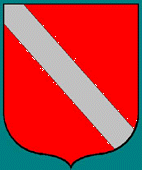 In reality
Sir Richard II Foliot held lands at
Cowesby [N. Yorks.] and as a tenant of the
Delaci family, Fenwick, Yorkshire [Holt p.98]
and Grimston, Nottinghamshire. In 1252
a Robert Foliot [a relative] et. al. was a witness
to a charter for John de Savile in Kirk Smeaton
and for rent at Skelbrooke. In 1268 Henry III granted
him a charter to hold a fair at Wellow [Wellhaugh].
Henry III also granted him a coat of arms: "de goulz ung
bend d'argent" [Roll of Arms Henry III] i.e. Gules a bend
argent. Sir Richard was a patron to St. Peter's Church,
Kirk Smeaton 1238-9, 1270-71 and 1289.
In reality
Sir Richard II Foliot held lands at
Cowesby [N. Yorks.] and as a tenant of the
Delaci family, Fenwick, Yorkshire [Holt p.98]
and Grimston, Nottinghamshire. In 1252
a Robert Foliot [a relative] et. al. was a witness
to a charter for John de Savile in Kirk Smeaton
and for rent at Skelbrooke. In 1268 Henry III granted
him a charter to hold a fair at Wellow [Wellhaugh].
Henry III also granted him a coat of arms: "de goulz ung
bend d'argent" [Roll of Arms Henry III] i.e. Gules a bend
argent. Sir Richard was a patron to St. Peter's Church,
Kirk Smeaton 1238-9, 1270-71 and 1289.
By 1272
it was obvious that by sheltering Godberd,
Ewyas and D'eyvile, supporters of the
rebel Earl of Leicester, Simon de Montfort, that
Sir Richard had changed his allegiance.
One other
challenge the Geste has
provided is that of the whereabouts of Sir
Richard's lands, described as 'Verysdale'.
If we can accept that Jordan castle near Wellow,
was the scene for Sir Richard's Castle and the
repulsion of the sheriff, then it might well be the
phonetic, Wellhaughsdale [Wellowsdale] a name that
would be used by the monks of nearby Rufford Abbey,
as the nuns of Hampole called Barnsdale or the
monks of Fountains Abbey called Fountainsdale. Independently,
Jeffrey Stafford in an unpublished work has found a reference
to a 'Ferresdale' in the Rufford Charters vol. 3 which he
suggests is a phonetic variant of the 'Verysdale' in the
Geste. Jeffrey includes the statement that this is found
on the western bounds of Boughton, on the main road from Blyth
to Nottingham and about a mile to the N.W. of Jordan's Castle.
see Jeff Stafford's notes at : https://www.midgleywebpages.com/jeff_staff.pdf
 In 1535, just
before the reformation,
the religious building at
Skelbrooke was listed as a 'chapel'.
In 1336 Skelbrooke Chapel
on the north side of the church, then possibly dedicated to St. John the Evangelist,
had a chantry added. A window
on the south side portrays a man's face
from the mid 1300's perhaps constructed
well after the death of Robert Butler
and shortly after the murder, in 1333,
of Edmund Butler*. The window thus appears
in the time of Edmund's widow Agnes of Skelbrooke manor who is
recorded as founding the chantry. Is this a
representation of the 'Green man' or the earliest
representation of Robin Hood's face,
set within a circlet surrounded by a swathe
of greenwood leaves imitating St. John the
Evangelist? *court case presided
over by by Henry de Percy and John de Eland.
Sir John de Eland was sheriff of Yorkshire in
1341 and steward of the Warenne estates
in the manor of Wakefield but was himself
murdered during the 'Elland Feud'
at
Brookfoot.
In 1535, just
before the reformation,
the religious building at
Skelbrooke was listed as a 'chapel'.
In 1336 Skelbrooke Chapel
on the north side of the church, then possibly dedicated to St. John the Evangelist,
had a chantry added. A window
on the south side portrays a man's face
from the mid 1300's perhaps constructed
well after the death of Robert Butler
and shortly after the murder, in 1333,
of Edmund Butler*. The window thus appears
in the time of Edmund's widow Agnes of Skelbrooke manor who is
recorded as founding the chantry. Is this a
representation of the 'Green man' or the earliest
representation of Robin Hood's face,
set within a circlet surrounded by a swathe
of greenwood leaves imitating St. John the
Evangelist? *court case presided
over by by Henry de Percy and John de Eland.
Sir John de Eland was sheriff of Yorkshire in
1341 and steward of the Warenne estates
in the manor of Wakefield but was himself
murdered during the 'Elland Feud'
at
Brookfoot.
In 1332 social
glue was stretched and smeared
in this part of the world when 'contrariants'
escaped from Edward II's forces
at Boroughbridge and entered the Barnsdale
area. Prior to the 'pestilence' in
1346 the 'Battle of Neville's Cross
had been fought and won by he English army under
the control of Henry III's wife Phillipa
of Hainault, lives were lost no doubt many
from the North leading to disruption in society.
Between 1347 and 1352 and particularly
in England in 1348 and 1349, there was
a serious loss of life from the bubonic
plague, no less in the Barnsdale area.
The original real person behind the Geste
was lost, links were broken, families
and society in general were disrupted,
at least one local plague pit has
been found. This lies in an area near the church
of Mary Magdalene, Campsall. Local tradition
says Robin married 'Maid Marion' in this
church at Campsall. Of course no such person
as Marion appears in the Geste,
she appears to be a much later graft to the
tales of Robin Hood, but we note that
Robert III Butler [Robert Le Botiller]
was married to Constance and that their likely
place of marriage would have been at the family
chapel of Skelbrooke or the larger Campsall
Church.
If we can
envisage the Geste
being read in the household
of the Wallaces of Burgh
[Wallis] and the Butlers
of Skelbrooke Hall during the
1300's [by which time Wentbridge
and Edward II could be rolled
into the narrative] then we are probably
on the route to understanding the
origins of the tales of Robin Hood which
appeared in print by the middle of the
1400's.
Sources/References:
1. Baildon, W. P.
Notes on the Early
Saville Pedigree and the
Butlers of Skellbrook
and Kirk Sandal. Yorks.
Arch. J. vol. 29, (1929).
HTML
version
by Chris Phillips additional
notes by Dr. David Hepworth
2. Ellis A.S. Domesday
Tenants
Yorks. Arch. Journal, vol.
v, (1879), p. 309; Pontefract Chartulary
(Record Series, vol.
25).
3. Dobson R.B. &
Taylor J. Rhymes
of Robin Hood.
University Pittsburgh Press.1976.
4. Harris P.V.
The Truth About Robin
Hood. Linneys. Mansfield.1952.
5.
Rolle, Richard. The
Pricke of
Conscience
(Stimulus
Conscientiae),
A. Asher
& Co., Berlin.1863.
6. Gladwin, Irene.
The Sheriff. Gollancz,
London, 1974.p.108
7. Bellamy, John.
Robin Hood an Historical Enquiry.
Indiana Press, Bloomington.1985.
8. Holt J.C.
Robin Hood. Thames
& Hudson, London.1982.
9. Ibid. p.108
10. Listen
to a modern English folk balladeer-supremo-Richard Thompson.
11. Whiting C.E. Rev. Prof., Excavations
at Hampole Priory,
1937,Vol XXXIV part 2, Part 134
Yorkshire Arch. Journ. MCMXXIV, pp. 204-212.
12. Chambers, E.K. English
Literature at the close of the Middle
Ages. O.U.P. 1945.
13. The National Archives Currency Converter.
15. https://home.infionline.net/~ddisse/pastons.html
16. Hobsbawm, E.J. Bandits.Weidenfeld
and Nicolson, 1969, ch III.
17. Roberts,
Ian. Pontefract Castle. West Yorks. Arch.
Soc. 1990. p13.
18. https://www.midgleywebpages.com/jeff_staff.pdf
Rufford
Charters Vol 3. spelling given as Feresdale and Ferysdale.
19. 2000 Years of York : The Archaeological
Story. York Archaeological Trust. Thornton & Pearson.
1999.
20. Phillips, D. and Heywood, B.,
Excavations at York Minster 1 : From Roman Fortress
to Norman Cathedral. HMSO, London. 1995.
21. Harte, Jeremy. The Greenman.
Pitkin Guide. Jarrold Publishing, 2005.
22. Butler, Lawrence. Sandal Castle Wakefield.
Wakefield Historical Publications,1991, p.24.
23. Close Roll, 7 Edw. III, part 1, m 6d.
24. C.P.R. Edward III,1327-1330, p. 432.
25. Yorkshire Feet of Fines, 1327-1347, p. 74.
26.
Hunter,
Joseph. The Ballad Hero, Robin
Hood, London, 1852, p. 14.
27.
Pers.
comm.
January
2013 with
David
Hemingway
of
Wrangbrook
House.
28.
Baldwin,
J. F. The Household Administration of Henry Lacy and Thomas of Lancaster.
The English Historical Review, Vol. 42, No. 166 (Apr., 1927), p.
186.
29. Ibid, n.
4.
30.Holmes,
Richard. Pontefract,
Its name,
its lords
and its
castle. (1878).
p.99.
31. TNA SC 8/72/3574.
'HISTORY IS A
SET OF LIES AGREED UPON' - NAPOLEON
BONAPARTE
 HOME HOME
STONE
OF ROBIN
HOOD
©
Copyright Tim Midgley 2006, revised
24th
January
2026.
|
|