 |
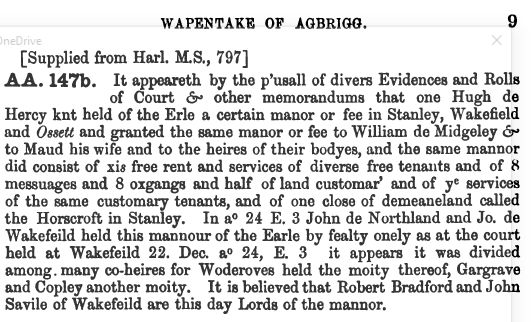
YAJ vol. 8, (1884), p. 9.
 |


|
..Midgley
of Stanley. |
Stanley
[Midgley] Hall, North
of Wakefield, England.
The ownership of Stanley Hall Estate and
Woodhall was as follows11
1. John de Amyas may have held Stanley Hall in 1312. He is mentioned in the Wakefield Court Rolls of the early 1300's and is known to have held Stanley Mill. He may be the same John de Amyas who farmed in Wakefield and ran a dying mill there.18
2. Hercy - Sir Hugh de Hercy of Grove, Notts. was granted the fee or manor of Stanley by Earl John Warenne about the year 1314 and thereafter granted it to his daughter Maud and her spouse, William de Midgley. [The Antiquarian Repository, vol. IV, (1784), p. 125.] This was probably a reward to Hugh from Earl Warenne for having enjoined the earl against the Scots in 1297 and may indicate his presence at the Battle of Stirling Bridge. In the following year Hugh was summoned twice against the Scots, once upon King Edward I's return from Ghent and the other ordering him to muster at York on 24th May of that year, suggesting that he may also have been present at the Battle of Falkirk where the Scots were convincingly defeated.
|
| YAJ vol. 8, (1884), p. 9.
|
3. Midgley
- Stanley Hall, then called Midgley
Hall from the early Middle Ages. This was held by
Sir William de Midgley (son of John de Midgley, of Hathershelf, forester of the
forest of Sowerby) as indicated by this description from 1784:-
'The last John Earl Warren, Lord of the
manor of Wakefield, 7 E. 2. made many grants of manors, wastes, and vaccaries
(Dairies) and let some by copy &c. which the Kings of England afterwards confirmed within this great lordship of Wakefield. And it appears (Says Dodsworth, No. 797. Harl. MS. in
Brit. Mus.) by the perusal of diverse evidences and rolls of court, and other memorandums, That one Sir Hugh de Hercy, Knt. (who bore for his arms, gules on a chief argent a
label of three points azure) held of the Earl Warren a certain manor or fee in Stanley, (by which it seems that there were two manors in that township) Wakefield and
Osset,19 and granted the same manor or fee to William de Midgely and Maud his wife, and to the heirs of their bodies; and the same manor did consist of eleven shillings free rent, and services of diverse free tenants, and of eight messuages, and eight oxgangs of land, and a half, customary, and of the services of the same customary tenants, of our close of demeasne land called the Horsecroft in Stanley.
The said family of Midgley, in process of time gave name to the said manor, and the same is known by the name of the manor of Midgely in the Court Rolls at Wakefield, and the house is called by the name of Midgley, alias
Stanley Hall. In Anno 24.E. 3. John de Northland and John de Wakefield held this manor of the Earl [Warenne] by fealty only, as at the court held at Wakefield, 22 December, Anno 24. E. 3. it appears. It was afterwards divided amongst many coheirs.....'
[The Antiquarian Repository. vol. iv, (1784),
pp. 125-126.]
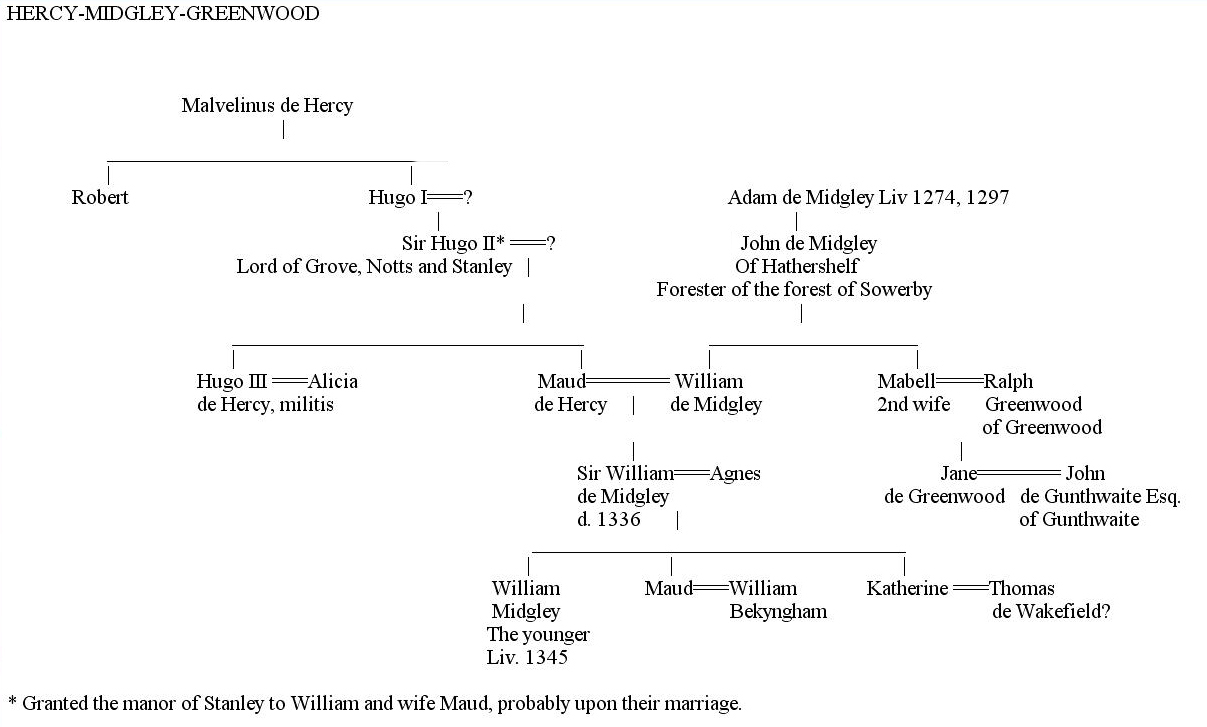
Thus it appears that William gained the manor of Stanley by his marriage to Maud (Matilda) de Hercy.
 |
|
Hercy-Midgley-Greenwood
relationships. PDF
for Midgley-Thornhill-Everingham |
Another record from the Wakefield Court
Rolls provides us Sir William's wife's
name:-
Friday 24th August 1324 - Matilda de Miggeley's servant Richard was sued for seizing cattle. [WCR 1322-1331, p. 43.]
Matilda is also variously rendered as Maud,
Maude, Matild, Mathild &c.
Matilda is also recorded in
the Court Rolls when she has a dispute with
others over the taking of cattle and
horses:-
16th November 1324 - Thomas Filcock (elsewhere Philcock) sued John de St. Swithun for taking 2 horses from 'Colyhall' in the town of Stanley to John Gargrave's house in Wakefield. John de St. Swithun said Thomas took the horses as the bailiff of Matilda de Miggeley, and asked for her assistance in the defence which was granted. Thomas Filcock also sued Richard, servant of Matilda de Miggeley in a similar matter and similar permission was granted.
John de St. Swithun said Thomas' father German Filcock, took 2 of his cows from his croft at Stanley, driving them to his own house in Wakefield. German said the cows were grazing in his enclosure. German agreed to return the cows. [WCR 1322-1331, p. 49.]
Friday, 21st December 1324 - Thomas Philcock sued Richard, servant of Matilda formerly wife of William de Miggelay, for seizing cattle. [WCR 1322-1331, p. 56.]
Court held at Wakefield Friday 24th June 1331:-
Thomas Filcock complained that in August 1325 William de Migeley distrained Thomas' father German in the town of Stanley by a horse worth 7s., said to be for rent then in arrears. German says he delivered the horse. Later Thomas Filcock the son removed the horse. Thomas denied the charge.
[W. C. R., 1322-1331, pp. 188-189.]
Midgley Hall then passed to the Chaloners
of Guisborough. The estate appears to encompass the "Pinder's
Fields" famed in local ballads, where, "all on the Green," Robin
Hood, Little John, and Scarlet, fought the Pinder of
Wakefield. The Stanley estate seems have been granted
by Edward III to William de Miggeley [See William
Midgley, knight].
|
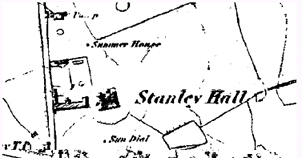
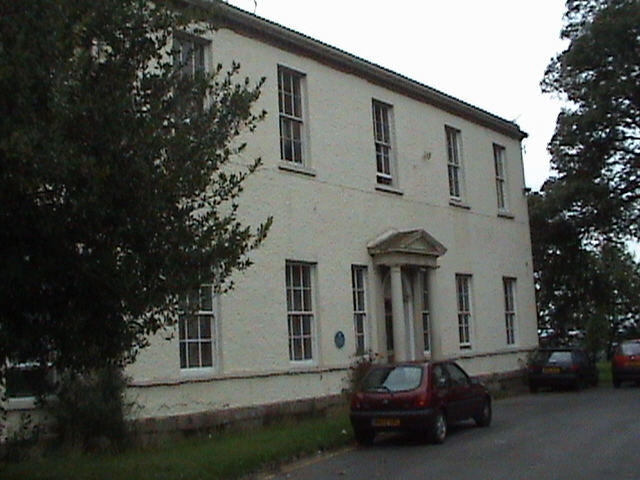
Midgley Hall now Stanley Hall, Stanley |

|
See Stanley Hall 2006
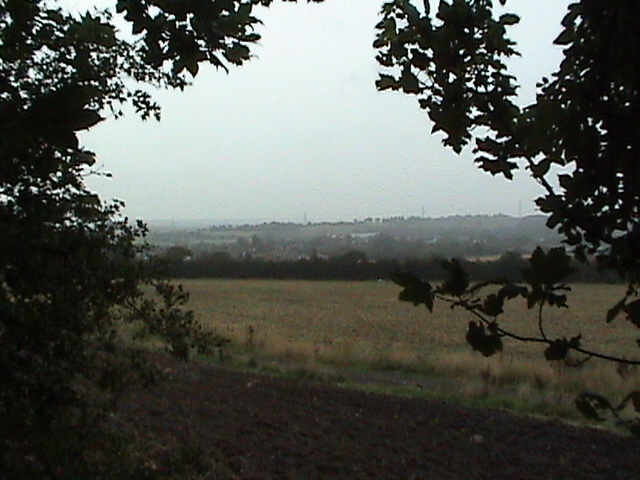
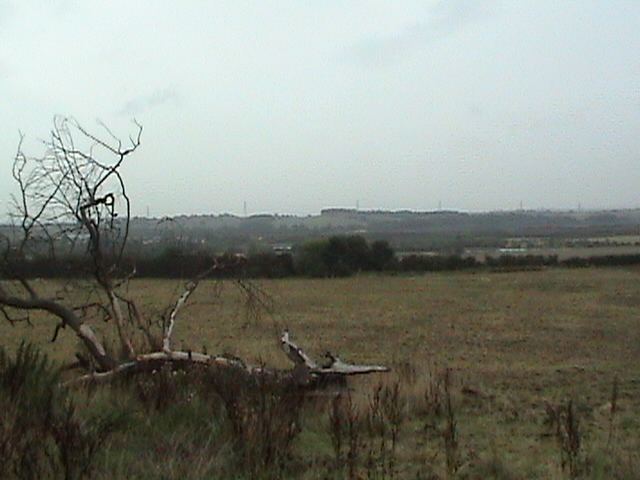
See Fields below Stanley Hall 1 2 2006
The place is still called Pinder's Fields.
These fields marked on the map of Wakefield North for 1890
are on the opposite side of the Wakefield-Stanley road to Stanley
Hall Park7 The nearby Pinder's Fields Hospital lies
on the south side.

|
|
Pinders's Fields in 1854, Newton is to the West, Wakefield to the south and Midgley [Stanley] Hall to the east |

|
|
Pinder's Fields today Source: Getmapping |
The supposed meeting of Robin Hood, Little John and Will Scarlet with the
Pinder of Wakefield occurred here and is celebrated in the post medieval
narrative [Childs ballad 124] The Jolly Pinder of Wakefield. The
first surviving copies of the narrative date from the middle
1600's, but prof. J.C. Holt believes that the main outlines of the
story were well known at least a hundred years earlier. 'A ballett
of Wakefylde and a grene' was recorded as early as 1557-8. The Jolly
Pinder was known to all levels of Elizabethan society. Holt also expresses
the opinion that the historical origins of George-a-Green are even
more mysterious than those of Robin Hood himself. It appears like Maid
Marian the Pinder appeared through the agency of the May Games, perhaps
at Wakefield. During the time that the ballad of Wakefield was recorded,
Queen Elizabeth I's bowbearer, Thomas Pilkington, who died about 1566, resided
at Stanley and Lower Bradley. See below.
In 1202 a John Hood and Ragnild his wife, both appeared as parties
in a land agreement at Stanley Bottom. This land was held a hundred
years later by the Hood family. [Holt 1982.]
Nearby at Newton is recorded in the Wakefield Court Rolls,5
Robert Hood of Newton. Robert is mentioned as being
the son of Adam Hood of Stanley. Adam, first mentioned in 1274*
lived until at least until 131417,p50 Adam was a forester
to the earl de Warrene6. Robert or his son, also named
Robert died in 1341-1342.17,p50
* The earliest surviving W.C.R.
Adam Hood===========?
d>1314
|
Robert I Hood==========?
of Newton
|
d 1341-2
Robert II Hood
Robert Hood is recorded in the W.C.R. as having leased land at Stanley
in 1315. As Holt [1985] states as a second case, "...the Hoods of Wakefield
absorbed the tale of the outlaw into their family traditions or their
neighbours and descendants came to associate the two".
Before 1322 a Robert Hode or Hood lived in a house at Bichill
[Wakefield Marketplace - now the bus station] with his wife
Matilda, but according to Joseph Hunter he lost his house when
he became an outlaw6 [this is unsupported speculation
by Hunter].
What we might ourselves speculate is that this person
became associated with the ballad character in the Geste,
for there was also a Robert Hood of Newton,
a Robert Hode probably of Stanley and another in Sowerby :
| Date of
Wakefield
Court |
Wakefield Court Proceedings 1331-1333 Red text indicates a similarity to the occurence in the Jolly Pinder of Wakefield ballad. |
Reference W.C.R.5 |
| 18th October 1331 |
"Robert Hood of Newton
in a plea of unjustly taking and detaining a horse; to attach Robert
Hood of Newton to answer John Le Couper and to Thomas Chatburn
in pleas of tresspass." |
p 4 |
| 25th October 1331 |
Robert Hood was fined
2 pence for not attending the Wakefield
Tourn. |
p 7 |
| 8 November 1331 |
Robert Hood was fined
2 pence for taking dry wood. |
p 17 |
| 8 November 1331 |
For Stanley:- "Order is given to attach Simon servant of Thomas le Roller to answer Geoffrey de Birkinshaugh and Alice his wife in a plea of tresspass; to distrain John Le Couper and Thomas de Chatburn to answer Robert Hood of Newton in a plea of unjustly taking and detaining a horse; and Robert Hood to answer John Le Couper in a plea of trespass; and to attach Robert Hood to answer Thomas de Chatburn in a plea of trespass." |
p 15 |
| 29th November 1331 |
For Alverthorpe:- "An inquisition
is to come to the next court between John Couper plaintiff and Robert
Hood to determine if the aforesaid Robert
trampled and depastured with cattle John's corn and rye in the field
of Newton or not. |
p 30 |
| 15th December 1331 |
For Alverthorpe:- "Robert Hood of Newton plaintiff and John Couper compromise in a plea of unjust taking and detention of a horse; Robert is amerced 3 pence" |
p 10 |
| 15th December 1331 |
For Alverthorpe:- "John Coupar plaintiff and Robert Hood of Newton compromise by licence of the court and plea of tresspass; Robert is amerced 3 pence." |
p 11 |
| 10th January 1332 |
For Alverthorpe:- "Robert Hood of Newton plaintiff offers himself against Thomas de Shatteburn* in a plea of trespass; because he does not state his case in the words of the court he is to take nothing by his suit and is amerced 3 pence for false claim." * Chatburn above in 1331. |
p 34 |
From here the entries change from 'Robert Hood [of Newton]' to 'Robert Hode' [perhaps of Stanley and Sowerby]. Stanley and Newton were adjacent vills. |
||
| 13th November 1332 |
Wakefield Court for the Graveship
of Stanley "The inquisition between Thomas Hydebier and John Tyting and Robert Hode in a plea as to why they impleaded him in Court Christian respited." |
|
| 4th December 1332 |
Wakefield Court for Sowerby :- |
p 145 |
| 8th January 1333 |
For Stanley:- " An inquisition
finds that Robert Hode (6 pence) and John Tyting (3
pence), executors of the testament of Matilda Tyting,
impleaded Thomas Hydebyer in Court Christian, therefore amerced 9
pence." |
p 149 |
| 4th June 133?3 |
Robert Hode is sued by
William Templer in a plea of tresspass At Stanley:- "He says that Robert's cattle trampled his corn to his damage 40 pence" "Robert says he is not guilty; therefore inquisition |
p 195 |
| Thus it appears that there were
four persons who have a name approximating to Robyn Hode
of the Geste: 1. Joseph Hunter's Robert Hood of Bichill, Wakefield. 2. Robert Hood of Newton. 3. Robert Hode probably of Stanley. 4. Robert Hode probably of Sowerby Is it any wonder that the narrative of A Lytell Geste of Robyn Hode became associated with Wakefield? |
.
A= Site of Midgley Hall, Stanley and surrounding fields
4. In 1346 it is recorded that
the lords of the manor of Stanley were
Robert Bradford and John Saville of
Wakefield but the third resident family at Midgley Hall were
the Chaloners of Guisborough Sir Thomas Chaloner appears
to have made his wealth by establishing the first alum works
in England at Guisborough in 1614. A year later this prompted
an alum works to be built at Whitby.9 Guisborough was
originally lay within North Yorkshire. Guisborough is purported to
be "Gisborne" and is referred to on early maps as Gisburgh. Guisborough is given the name form
of Gisborne in the Bruce account. This name evolved
from forms found in the Domesday Book such as Ghiges-, Gighes-,
Ghigesburgh, -burch, and -borc.
Guisborough is given the name form
of Gisborne in the Bruce account. This name evolved
from forms found in the Domesday Book such as Ghiges-, Gighes-,
Ghigesburgh, -burch, and -borc.
A John Chaloner was also found to be resident at Stanley,
alias Midgley Hall.10 John Chaloner's daughter Catharine/Katherine
was heiress to the Chaloner estates, she married Thomas
Savile of Wakefield, great grandson of Henry Savile and Elizabeth
Thornhill,
thus the property passed into this branch of the Savile family, namely
Thomas' third son, John Saville 'of Stanley
alias Midgeley Hall in Stanley'.
5. Robert Savile de Stanley who had a son Robert in the 1500's In 1574
Edward
Savile [d. 1590], son of John Savile of Stanley and Elizabeth
Cockson of Wakefield and who married Katherine Alvery of Batley,
is found to be resident at Stanley/Midgley Hall.
6. George Savile was granted
Stanley Hall in the1590's, following a legal wrangle, Grace
Hatfeild (sic) another claimant land owner, took up the occupation
of the new hall in the Horsecroft. Sir George Savile of Thornhill
married Lady Ann Wentworth in 1607.
In the next century, Mr.Jarvis Hatfeild [sic] is recorded as having to
pay tax for 10 hearths in 1672. Thomas Savile esq. likewise
was taxed for 15 hearths in Stanley township3. The
Savile's of Thornhill were powerful landed gentry in West Yorkshire.
Sir George Savile sold the estate to :-
 6. Thomas Pilkington
of Snapethorpe - 1603. In 1672 Sir Lyonell (sic) Pilkington of
Stanley Hall was taxed for 14 hearths or chimneys in Stanley township, this would
have represented a large residence or a number of residences on the
estate3.
6. Thomas Pilkington
of Snapethorpe - 1603. In 1672 Sir Lyonell (sic) Pilkington of
Stanley Hall was taxed for 14 hearths or chimneys in Stanley township, this would
have represented a large residence or a number of residences on the
estate3.
See Lady Day Hearth
Tax for Stanley1672.
In 1759 the hall was burnt but restored. The Spencer-Stanhopes
of Cannon Hall, Cawthorne later married into the Pilkingtons.
7. Benjamin Heywood
Esq. purchased the newly built hall in 1802, he is mentioned as the
occupier in18224 Stanley Hall was auctioned in
1853.
8. From 1854 Stanley Hall was the home of William
Shaw [1804-59] who was a highly successful railway contractor during
the 1830's and 40's. He constructed the Macclefield
Canal, the Leeds and Selby Railway and railway tunnels such as those at
Chevet ('Chute'), Woodhead, Morley and Woolley.16
 William
Shaw was the son of William Shaw (1776-1832)
and Elizabeth White and a the nephew of Anne
Midgley (b. 1777, ch. 15 Feb. 1777
Wakefield All Saints.) Anne's father was Robert
Midgley (b. 1730) and her grandfather
was Robert Midgley (b. 1690) See
Felkirk page
William
Shaw was the son of William Shaw (1776-1832)
and Elizabeth White and a the nephew of Anne
Midgley (b. 1777, ch. 15 Feb. 1777
Wakefield All Saints.) Anne's father was Robert
Midgley (b. 1730) and her grandfather
was Robert Midgley (b. 1690) See
Felkirk page
9. Let to tenants - 1862
10. Purchased by West Riding County
Council
11. Used as a nurses hostel for
Pinderfields Hospital nearby.
Other halls in the district were :
*Hatfield Hall
*Woodhall
*Clark[e] Hall
*Methley Hall to the N.E.
HATFIELD HALL
Hatfield Hall lies a little to the north
of Stanley Hall
|
|
In the 1100's there was a William FitzRaven
of Hatfield11 a.k.a William FitzRaven of
Wakefield and Willelm Filius Raven. He was William de Warrene's
steward for the manor of Wakefield. 1148-1159. William was b.
perhaps 1100, his daughter and heiress was Mabel FitzRaven born
~1132. Mabel married Otto de Tilli [Tilly] seneschal to Hamelyn
Plantagenet [half brother to King Henry II] of Conisbrough Castle.
Otto and Mabel's daughter Dionysia e Tilli married Henry de Novo
Mercato son of Adam de Newmarche of Womersley.
CLARK[E] HALL
Adjacent to and a little south of Midgley Hall. This was
the residence of a local archaeologist, H.C. Haldane who had an interest
in the legend of Robyn Hode.

|
| A photograph
of H.C. Haldane holding the purported 'Little John's' bow
outside Cannon Hall , Cawthorne.12 However this looks suspiciously like the one which now hangs in the Cawthorne Museum, not the one hanging below the Cawthorne Hall minstrel gallery in the early 1950's. |
He also wrote 'Clarke Hall, its Builders & Owners'.13
Mr. H.C. Haldane purchased the property, of which he was a tenant,
in 1913 and completely restored the hall. The family recently sold the
hall to WRCC for use as a folk museum.
Mr. Haldane also came into the possession of a sword from
the Battle of Wakefield [1460] which he says was 'dug up a few years
ago during the operation of cutting a main drain near the site of the Battle
of Wakefield'.14 "The sword is of an unusual sort, not
a knightly weapon, but single edged, possibly cut down from a larger blade.
It has a curious guard with an extension of the cross guard protecting
the back of the hand. Whilst this is a late medieval form, some concern
may be felt that this particular type of sword has tended to be dated by
the Wakefield example despite its rather doubtful provenance. The weapon
is now in an anonymous private collection."15
Mr Haldane also excavated the site of St. Swithen's chantry,
which lay a little to the east of Clark and Midgley Hall on
a piece of land called St. Swithen's Close. The chantry was founded
by John 8th* earl of Warrene [d. 1347], Lord of Lewes [Sussex], Conisbrough, Sandal,
and the manor of Wakefield. It was ostensibly built for plague victims,
[from 1349 the
'Great Pestilence' appeared] who could
attend devotionals whilst others could attend their parish churches without
the fear of plague or 'cadaveric particles' being transmitted.
Thus it is ironic that the 8th earl died in 1347, possibly from
an early circulation of the Black Death. * Often referred to erroneously as John 7th
earl.
Recently
researched are the family of the Yorkshire
branch of the Pilkingtons who resided at
both Stanley Hall and Lower Bradley. The
Pilkingtons were in residence at Stanley in
the time of Arthur Pilkington [b. 1482, d
> 29 June 1537] who married Alice Saville,
daughter of Nicholas Saville of New Hall,
Elland. Their eldest grandson, who also
resided at Stanley and Lower Bradley, was
Thomas Pilkington [d~1565] who acted as bow
bearer for Queen Elizabeth I! If so, the bow
that Haldane is holding may be an
Elizabethan example.

Above : 1854 map of the site of St. Swithen's Chantry, well and Close with the location of Stanley [Midgley] Hall and Clark Hall. Right : The site of St. Swithen's and St. Swithen's Close today. |

|
Image at right reproduced and modified from the Ordnance
Survey Get-a-map
service. Image reproduced with kind permission of Ordnance Survey and Ordnance Survey of Northern Ireland. Reproduced
from Ordnance Survey map data by permission of Ordnance Survey, © Crown
copyright.
WOODHALL MANOR
Described as part of the manor of Stanley8.
Later called Hatfeild [sic] Hall, after it passed from the
Saville family and came into the possession of the Hatfeild family
through marriage. The Hatfield family originated in Great Hatfield,
Holderness. The former manor house at
Woodhall now belongs to the Normanton Golf Club.
METHLEY HALL
Held by the Waterton family during the Hundred
Years War when during the reign of Henry V, Robert Waterton
played "host" to Charles of Orleans, a pawn in the wars between
England and France. Robert was a constable of Pontefract Castle
eight miles away. In Methley church there is a chapel housing effigies
of Robert Waterton and his wife. It was Arthur Pilkingtn's son, Robert of
Stanley and Lower [Nether] Bradley [b~1514, d. 1541] who married Rosamund
Waterton of nearby Walton, their eldest son being Thomas, Queen Elizabth I's bow
bearer sometime between 1547, the beginning of the reign and Thomas' death
{~1556].
|
Names appearing in the Wakefield Court
Rolls for Stanley 1330-1331: We can see here how some of the early surnames were evolving William Albray, William Attetounend, Richard de Bateley [son], Robert de Bateley [father], John Bateman, William Benet, William de Birton, John del Bottom, Agnes Bul [wife], Henry Bul, Geoffrey de Dewsbury, Roger Duning, Henry Dyker, William Eliot, William de Erdeslowe, Hugh Forestarius [father], John Forestarius [son], Thomas Gunn, Walter Gunne, Adam le Heuwer, Adam Hoggeley, Thomas Hydebyer, Adamm [sic] Isbell, John Isbel, William Isbel, Richard Kay, Margery del Ker, William de Langefeld, John de Methley, Hugh del Okes, Jacob del Okes [father], William de Okes [son], Henry Poket, John Poket, Elena de Rastrick, John de Ratrick, Richard Ricard, Robert Ricard, Joan de Sandale [wife], William de Sandale, John de Seville, William de Shefeld, John de Sheppedene, Richard Short, Hugh de Stanley, Robert Taylur, Geoffrey Tepel, Eva Tyting, John Tyting/Titing, Matilda Tyting, Simon Tyting, Robert del Spen, William del Spen, Adam de Steinclyf, Gilbert Theker, John Wacknase. |
WRENTHORPE This place was called Potovens until the 1800's, now recognised in the name Potovens Road, a name originating from the fact that there was a strong pottery industry here just outside Wakefield in the mid 1500's and probably earlier. In 1297 the Wakefield Court Rolls mention a "Richard le Potmakere" of Alverthorpe, the hamlet nearby.
* cum refers to the O. E. word for 'next to' in English place names.
Links:
The Pinder of Wakefield
Robert Hood of Newton .
Wild Yorkshire- Stanley Marsh